 Guide On Map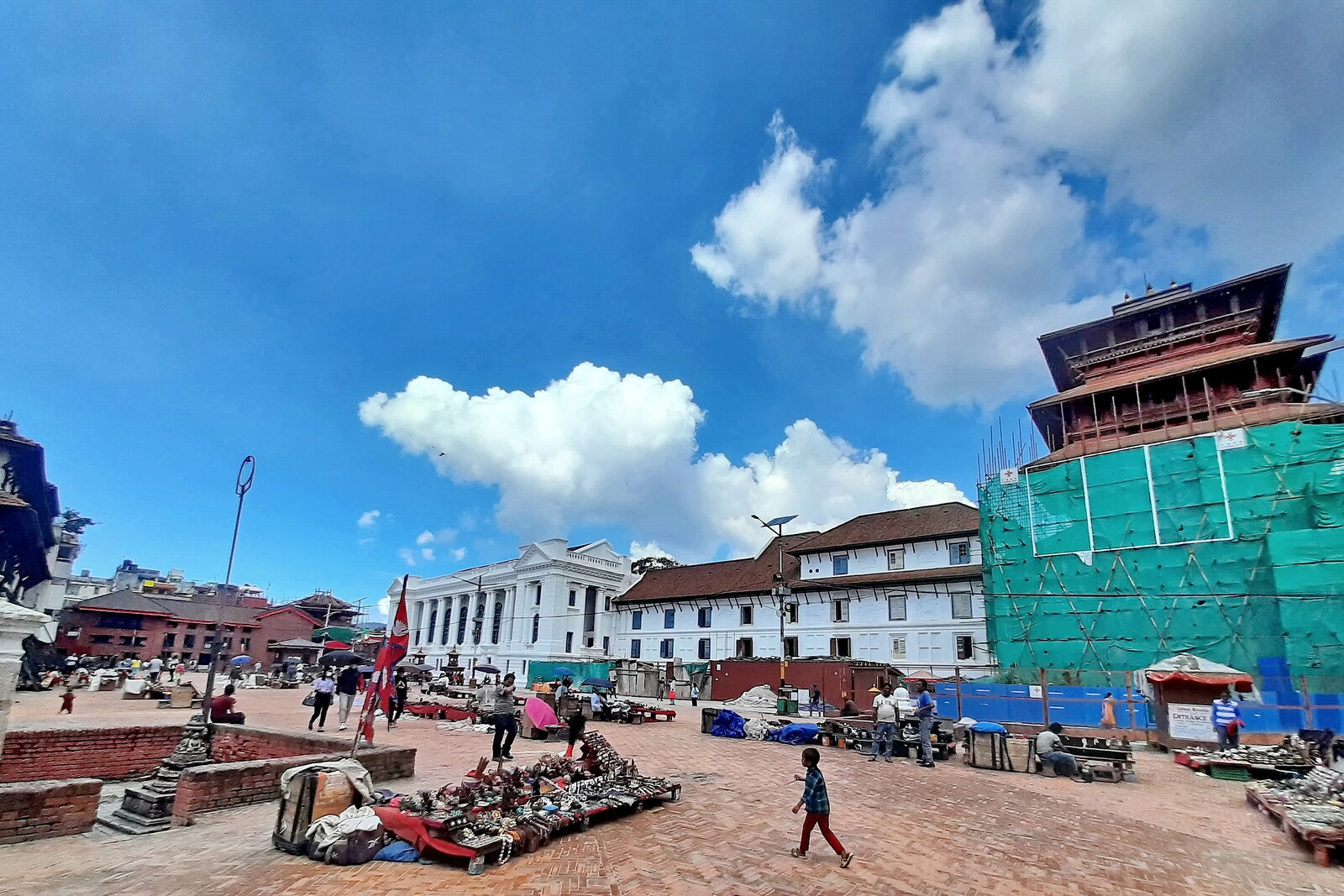
Look around first
What to notice
- Stone figure of Hanuman
- Red cloth and umbrella
- Palace gates
- Nine-story Basantapur Tower
The story of the place
Beyond the palace gates stretches the former royal residence from which a separate city-kingdom was governed. Above the southern part of the complex rises the nine-story Basantapur Tower; it is part of a wing with four towers named after the cities of the valley. Here, in stone, are gathered Kantipur, Kirtipur, Lalitpur, and Bhaktapur—places that once each lived under their own rule.
Beneath red cloth and an umbrella at the palace gates is a stone figure of Hanuman. Its facial features have almost disappeared beneath layers of red paste left by worshippers. Hanuman is a warrior from the Ramayana, a loyal ally of King Rama. The Malla dynasty traced its lineage to Rama and regarded Hanuman as a protector capable of bringing victory in war. In sixteen seventy-two, the king of Kathmandu, Pratap Malla, ordered the figure placed at the main entrance. In Nepali, “dhoka” means “gate.” This figure gave its name to both the entrance and the entire old royal palace behind it.
About a century later, the protector remained at the gates, but the palace's owner fled. Kathmandu, then called Kantipur, was a separate kingdom. Its last king, Jaya Prakash Malla, tried to hold the city against Prithvi Narayan Shah, the ruler of neighboring Gorkha.
Gorkha was a small mountain kingdom west of Kathmandu Valley and received almost no income from trade between India and Tibet. The main roads, markets, and mints were in the hands of the valley's kings. For more than two decades, Prithvi Narayan captured the passes and fortresses around the valley, cutting off the supply of goods and food. Jaya Prakash requested soldiers from the British East India Company, but the detachment sent to him was defeated while still on the way.
On September twenty-fifth, seventeen sixty-eight, the people of Kantipur were celebrating Indra Jatra. In the evening, Gorkha troops entered the city and reached the palace. The guards could not hold the entrance. Jaya Prakash left Hanuman Dhoka Palace, while Prithvi Narayan took his place in the palace courtyard and declared himself king of Kathmandu.
For Jaya Prakash, the flight only postponed the outcome. First he took refuge in Patan, present-day Lalitpur, then in Bhaktapur. When Gorkha troops took that city as well, the former king of Kathmandu took part in the final defense, was wounded by a musket ball, and soon died. Prithvi Narayan subjugated the entire Kathmandu Valley and moved his court here from Gorkha.
In seventeen seventy, he ordered a new wing with four towers added to the conquered palace, representing Kantipur, Kirtipur, Lalitpur, and Bhaktapur. The tallest was the nine-story Kantipur tower, Basantapur. Prithvi Narayan did not return to Gorkha: his residence rose above the same courtyards from which Jaya Prakash had fled two years earlier. The red Hanuman remained at the former gates, and Basantapur of the new king appeared above the southern part of the palace.
Useful on site
Open square in a heritage area; ticket checks may be possible at the entrances.
Checked: date not specified. Check the official source before visiting.Viewing from the square is enough for the story; check access to the interior rooms separately.