 Guide On Map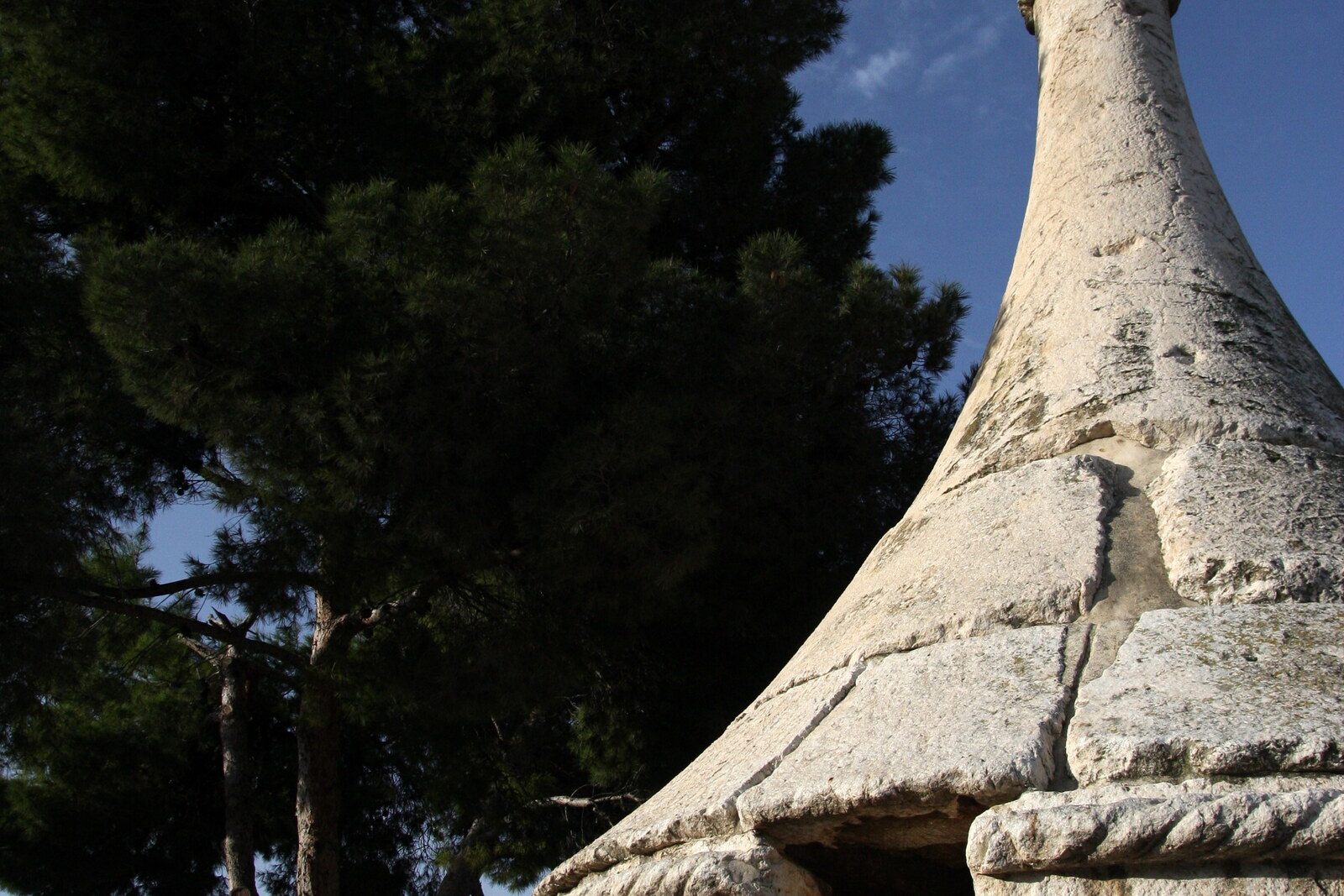
Look around first
What to notice
- Absalom's Pillar
- Ionic half-columns
- Doric frieze
- Pockmarks on the upper part of the monument
The story of the place
The Kidron Valley served as the ancient city's cemetery: beyond Jerusalem's walls, family tombs were cut into the soft limestone of the eastern slope. Above one of them rises a stone monument from the first century CE, commissioned by someone among the wealthy townspeople. Stonemasons separated a large block from the hillside, carved a burial chamber inside it, covered the façade with Ionic half-columns and a Doric frieze, and assembled the upper part from separate stones beneath a rounded roof with a point. An inscription with the names of several generations of a priestly family survives in the neighboring tomb, whereas the name of this structure's owner has disappeared.
In the sixteenth century, Jerusalem fathers brought disobedient children here. Pilgrims threw stones at the tall monument and cursed Absalom, while children were told what disobedience to one's father leads to. Jews, Christians, and Muslims all took part in this ritual: all three traditions revered King David, so his rebellious son suited a shared lesson.
Absalom was David's son, who rose in rebellion against him. In the biblical account, while still alive, he set up a pillar for himself in the King's Valley because he believed there was no one to preserve his name. It was a memorial marker, not a burial place. When the Kidron Valley came to be identified with the King's Valley, the monument here was given Absalom's name. In Hebrew, it is called Yad Avshalom—“Absalom's monument.”
Absalom himself had nothing to do with this structure. Archaeologists date it to the first century CE, almost a thousand years after David's time. An unknown patron from the Jerusalem aristocracy instructed stonemasons to separate a huge block from the hillside, carve a burial chamber into it, and decorate the outer walls with Ionic half-columns and a Doric frieze. The upper part was assembled from stones and finished with a rounded roof with a high point. This blend of a local funerary form with Greek and Roman details revealed the structure's true age. Its owner's name disappeared.
Absalom's name, by contrast, determined the stone's fate. Pilgrims threw stones here for centuries; travel accounts mention the custom as early as the fifteenth century. The mound had to be cleared every year, but it grew again. In photographs from the late nineteenth century, the layer of stones and earth rose to nearly seven meters in places. The upper walls, where the stones struck, became covered with pockmarks. The lower part, buried beneath the mound, was inadvertently protected by the stones from new blows. Even today, this damage makes it possible to distinguish the exposed upper section from the smoother base. A study of the monument reconstructed the history of these traces from old images and the condition of the surface.
In nineteen twenty-four, the archaeologist and Hebraist Nahum Slouschz undertook to free the monument. He worked on behalf of the young Israel Exploration Society, which had neither a state budget nor a wealthy church patron: the participants themselves raised money and recruited people. In surviving film footage, Slouschz stands in a suit on the stone base while workers carry away the accumulated soil. They uncovered the lower part of the pillar and the entrance to the multi-chambered family tomb behind it, then put up an iron fence and allowed visitors in. This was one of the local society's first excavations, carried out by Jewish archaeologists. The society's archive calls Slouschz's work more a clearing: there was nothing of Absalom to find beneath the mound.
Such funerary complexes appeared here because of the layout of ancient Jerusalem. The dead were buried beyond the city walls, and the soft limestone of the eastern slope made it possible to cut out family chambers. Wealthy townspeople erected tall stone markers above them, visible from the opposite side of the valley. At the neighboring Tomb of Benei Hezir, an ancient inscription survives with the names of several generations of a priestly family. There the owners named themselves; at Absalom's Pillar, a later name obscured the anonymous patron.
The medieval mound at the base is gone. What remains are the pockmarks above, smooth stone below, and the name of a man who was not buried here. According to the biblical account, Absalom set up his own pillar so that he would not be forgotten; in the Kidron Valley, his name endured on someone else's monument.
Useful on site
Open for exterior viewing; best visited during daylight
Checked: June 28, 2026. Check the official source before visiting.The approaches may be uneven and dusty, so watch your step and do not climb on the monuments. Details of the upper sections are easier to examine from a short distance.