 Guide On Map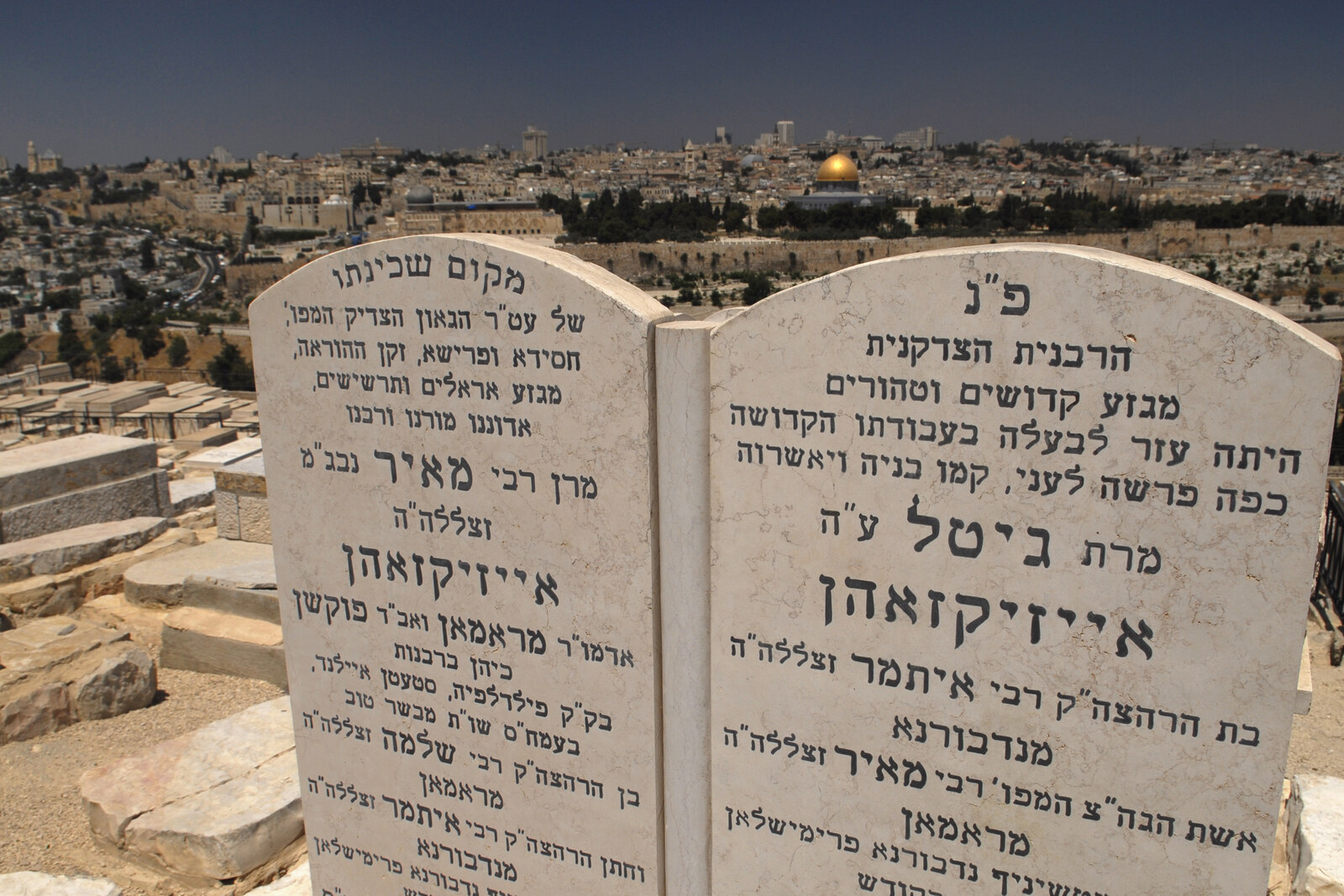
Look around first
What to notice
- Stone rows of headstones
- The headstones of Meir Feinstein and Moshe Barazani
- The graves of Aliza and Menachem Begin
The story of the place
The stone headstones lie across the slope in dense bands: sections of several cemeteries meet here, each with its own burial society. Beneath the later graves, archaeologists uncovered caves used for burials in the first century; later, burials were also made in the open air. Plots on this side of the Mount of Olives were bought for their position opposite the Temple Mount, across the Kidron Valley. In Jewish tradition, the resurrection of the dead will begin on the Mount of Olives, and proximity to the Temple gave hope of being among those resurrected before others.
In the spring of nineteen forty-seven, a British military convoy brought here the bodies of nineteen-year-old Meir Feinstein, an Irgun fighter, and twenty-year-old Moshe Barazani, a Lehi fighter. The armored vehicles remained at the foot of the slope. The parents, Feinstein's brother, his fiancée, and the people carrying the bodies climbed the rocky path to the prepared grave. No one else was allowed to attend the funeral.
Irgun and Lehi were armed Jewish underground organizations seeking an end to British rule in Palestine. Feinstein took part in sabotage at Jerusalem Railway Station. During the retreat, he was seriously wounded, captured, and lost an arm. Barazani, who had left school as a teenager to help support his family, was detained with a grenade before an attempt on the life of a British military commander. Both were sentenced to hanging.
Their families urged them to ask for a pardon. They refused and decided to die on the scaffold together with their executioners. Two grenades were secretly passed into the prison; one proved defective. Then Rabbi Yaakov Goldman, summoned to support the condemned men before their execution, said that he would go up onto the scaffold with them. Feinstein and Barazani did not want to kill him. A few hours before the hanging, they placed the one working grenade between them and detonated it in their cell.
Because of the manner of their deaths, the question of burial in consecrated ground had to be decided separately. Chief Rabbi Yitzhak Herzog permitted both men to be buried here, in a section for those killed during earlier disturbances. Thus, two people whom British judges intended to lead to the gallows ended up on the Mount of Olives after a brief service guarded by the same British garrison.
The stone rows on the slope belong to several neighboring cemeteries, administered by different burial societies. Archaeologists found first-century burial caves here, and burials on the surface continued later. The site was chosen for its position opposite the Temple Mount, across the Kidron Valley. According to Jewish religious tradition, the resurrection of the dead will begin on the Mount of Olives. For this reason, plots here were bought for their proximity to the Jerusalem Temple and in the hope of being among the first to be resurrected.
Several decades later, Menachem Begin, who had commanded Irgun during the underground years and later became prime minister, ordered that his own burial be linked to the graves of Feinstein and Barazani. The note he left contained one request: to bury him beside them. He declined state honors. In nineteen ninety-two, Begin was buried after a simple ceremony without graveside speeches, beside his wife Aliza and a few steps from the two underground fighters.
Their headstones stand here in one close group: Meir Feinstein, Moshe Barazani, Aliza Begin, and Menachem Begin. The former prime minister's final request was carried out literally: his grave lies beside the two stones for which he declined another burial place.
Useful on site
Active cemetery; access to individual sections depends on passageways, funerals, and security
Checked: June 28, 2026. Check the official source before visiting.Walk only along the paths, speak quietly, and give way to funeral processions. Do not step on the slabs or photograph people without their consent.