 Guide On Map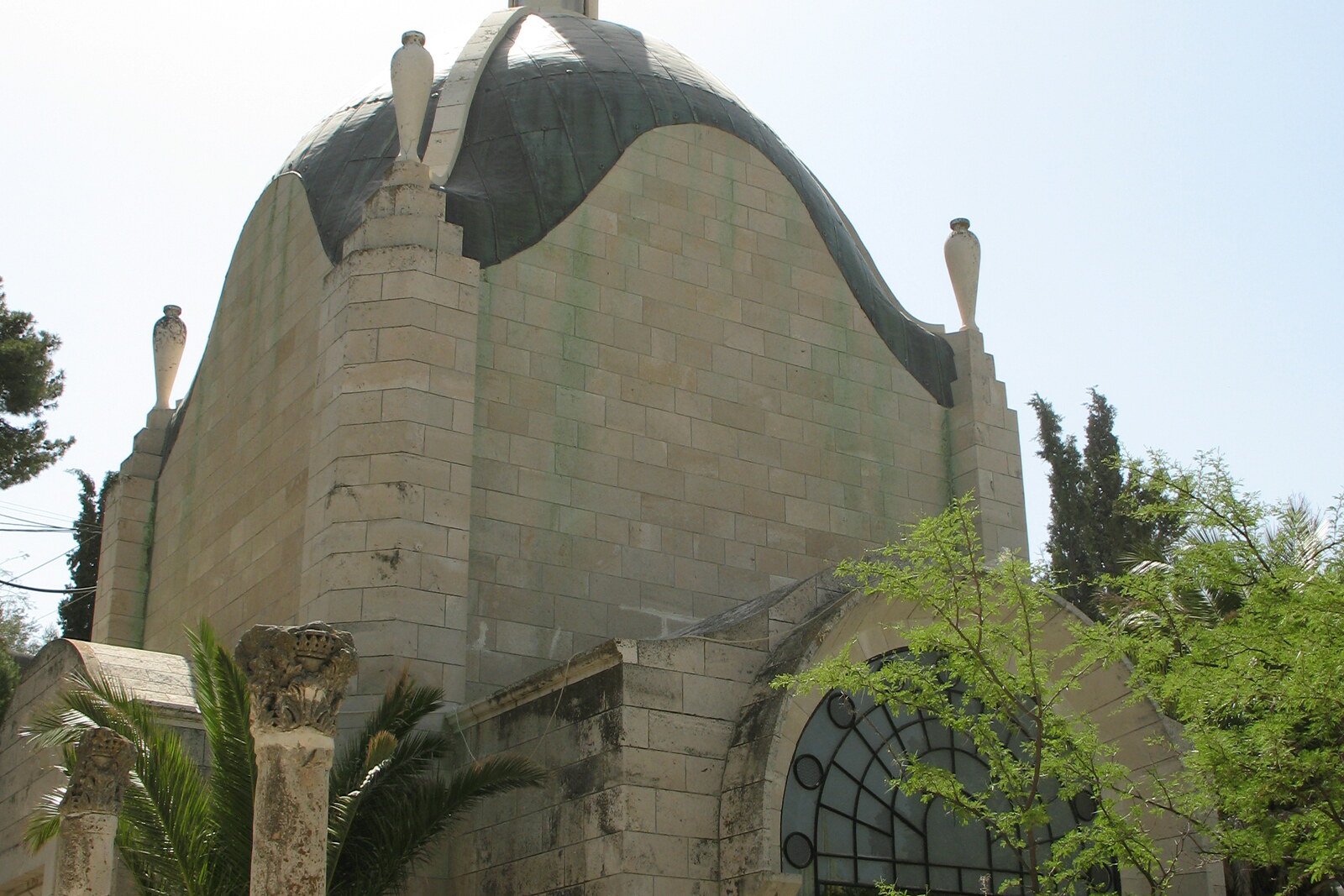
Look around first
What to notice
- A tear-shaped roof
- A wide window behind the altar
- Jerusalem framed by the window
The story of the place
Dominus Flevit stands on the slope of the Mount of Olives: the small church was built in nineteen fifty-five to a design by the architect Antonio Barluzzi. Earlier, there was a Franciscan chapel nearby, built in the late nineteenth century. The roof was given the outline of a tear, and the altar was turned toward Jerusalem. A wide window was left in the wall behind it, and the city can be seen through the church.
According to the Gospel of Luke, Jesus was descending the Mount of Olives toward Jerusalem as an itinerant teacher, surrounded by disciples. When the city came into view, the disciples began to praise him as king and spread garments before him. In Judea, ruled by Rome, such a proclamation could have ended in a charge of rebellion. Several Pharisees, religious teachers, demanded that Jesus make the disciples be silent. He refused: if they fall silent, the stones will cry out.
Then Jesus saw Jerusalem and wept. He himself named the reason: the city had not recognized what could have led it to peace. This is followed in Luke by a description of a future siege: enemies will surround Jerusalem with embankments, hem it in on every side, and destroy it together with its children. The name “Dominus Flevit” is translated from Latin as “The Lord Wept.” The Lord here is Jesus, and his tears are directed toward the city before him.
He nevertheless entered Jerusalem. In the Temple, he drove out the merchants, after which the chief priests and scribes began seeking a way to destroy him. A few days later, Jesus was arrested and crucified by Roman sentence. Nearly forty years later, in the year seventy, Roman legions did indeed besiege Jerusalem and destroy the Second Temple.
Most scholars date the Gospel of Luke to the eighties or nineties of the first century, when the destruction of the city had already taken place. Therefore, the account that has reached us is a religious interpretation of a catastrophe that had been endured, not a record of words made here on that same day. Luke alone among the evangelists places Jesus’ weeping over Jerusalem on this descent.
The evangelist names no exact stone or bend in the road. Christian pilgrims connected the present site with the weeping only in the late thirteenth or early fourteenth century; at that time, they were shown a stone in the middle of a field. The Franciscans built the first small chapel nearby in the late nineteenth century.
The present church was built in nineteen fifty-five by the architect Antonio Barluzzi. He gave the roof the outline of a tear and turned the altar toward Jerusalem. History has not preserved the exact place of the weeping. Behind the altar, Barluzzi placed a wide window: in it stands the city over which, according to the Gospel of Luke, Jesus wept on this descent.
Useful on site
Monday—Thursday and Saturday 8:00—17:00; Friday and Sunday 8:30—11:50 and 14:00—17:00
Checked: June 28, 2026. Check the official source before visiting.Keep quiet inside, and do not block the window for those who are praying. If the entrance is closed, the architectural idea can still be clearly read from the exterior form and the building’s orientation toward the city.