 Guide On Map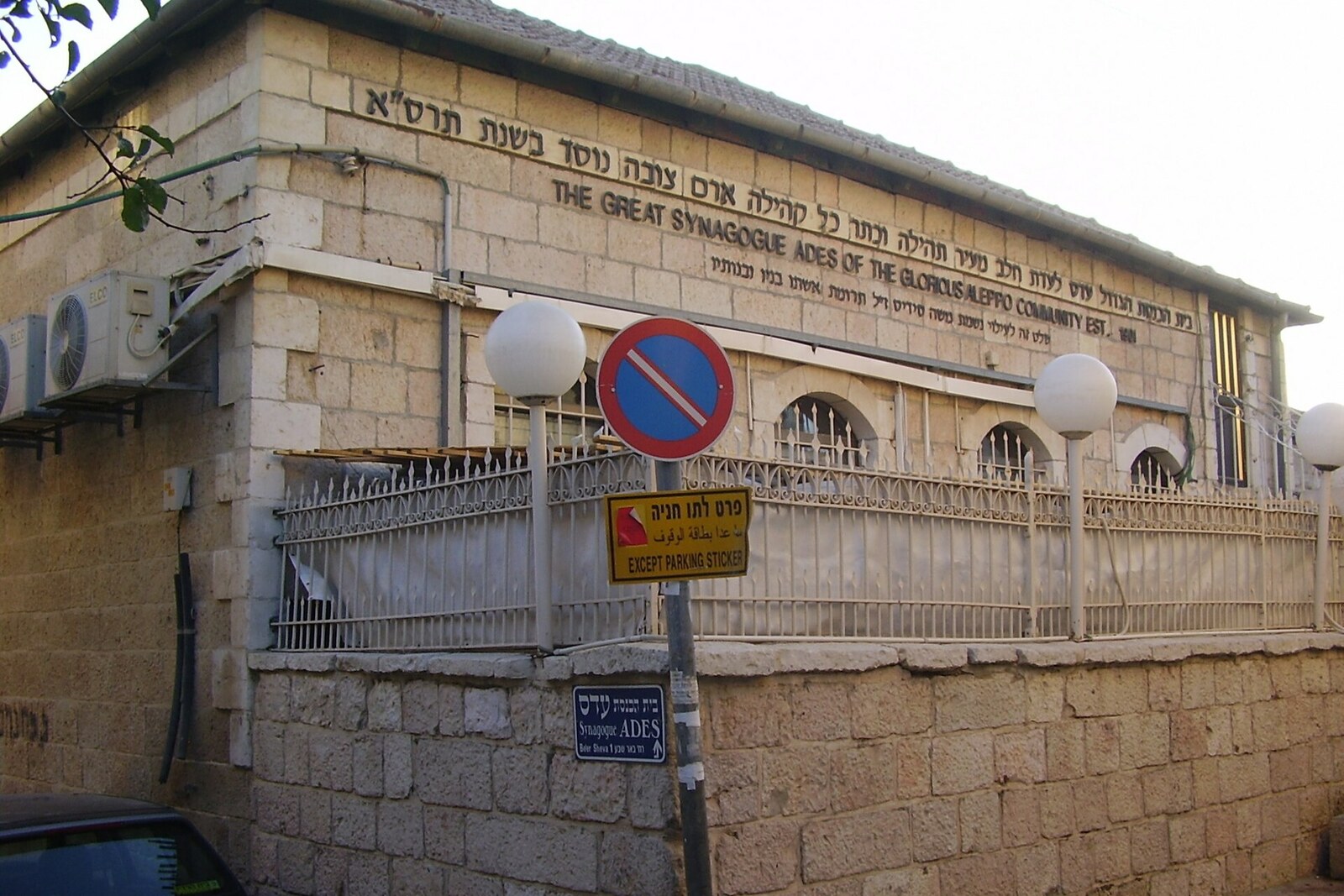
Look around first
What to notice
- The sign from 1883, photographs from the “Picture in Stone” project, the mother-of-pearl ark, and paintings with signs of the zodiac, menorahs, and the Twelve Tribes.
The story of the place
Mazkeret Moshe had a neighbor—the Sephardi quarter of Ohel Moshe, “Moshe’s tent.” The name promises a tent, but everything here is arranged more like a large family home: living rooms surround courtyards, wells stand in the courtyards, and other people’s lives are always just one window away.
One of the courtyards is called the Mulberry Garden. Once, mulberry branches met above it, giving shade and perhaps making the cramped conditions a little easier. It is hard to go unnoticed in a courtyard like this. You can hear whose child has woken up, who is arguing, who is singing, who is calling people to the table. Several generations live side by side, and every family conversation inevitably becomes a little bit of a neighborhood one.
Yitzhak Navon, the future fifth president of Israel, was born at number eleven Gilboa Street. Later, he brought the quarter of his childhood back to the stage in the play “The Sephardi Orchard.” It is set here in the 1930s. The title sounds almost idyllic, but Navon’s orchard is not a quiet green backdrop. It speaks Ladino, interrupts itself with neighbors’ voices, laughs, sings, and quarrels. There are too many people in it and too little space, but no story is left without witnesses.
At Ohel Moshe’s centennial, Navon recalled that families lived in poverty and cramped conditions, often with six or seven children. But he was not speaking of poverty as a useful trial. For someone who grew up in one of these courtyards, something else mattered more: cultured, educated people with good manners and common sense came out of the cramped apartments. Square footage said nothing about their dignity. Perhaps that is why, in his play, the quarter does not ask for pity. It speaks confidently, sometimes noisily, like a person who does not need to prove the right to its own memory.
That memory also has its old address—Ohel Moshe Synagogue. Its sign from eighteen eighty-three has survived. The building immediately reveals how the community was organized: people prayed upstairs, while downstairs there were classrooms, a communal oven, and a mikveh. The sacred and the everyday did not go off to different ends of the city. Only one staircase stood between a lesson, bread baking, and prayer.
The synagogue keeps a Torah scroll from eighteen forty-one. According to tradition, Moshe Montefiore gave it as a gift. For a quarter that bears his name, it is an almost ideal relic: not a ceremonial object seen from afar, but a scroll meant to be read aloud. Here, memory again exists only when a human voice returns to it.
In two thousand four, the voices of longtime residents appeared directly on house walls. The family photographs and stories of the “Picture in Stone” project were not taken away to a separate museum. They were mounted where the people shown in the photographs had once lived. Something remarkable emerged: a house remains a house and at the same time becomes its own archive. Here is a family portrait, and beside it that very window; here is a story of childhood, and all around it is the courtyard that was its stage. Stone does not depict the past—it continues to live beside it.
But the strongest voice of this neighborhood is heard in Ades Synagogue. It was founded in nineteen oh one by immigrants from Aleppo—a Syrian city they called Haleb. Two cousins, Yosef Yitzhak Ades and Ovadia Yoshiyahu Ades, created a center for their community here. They brought to Jerusalem not a copy of the city they had left, but a familiar way of being together: praying, learning melodies, distinguishing modes, passing on to children a sound in which home is recognized before it can be described.
Even the interior of Ades resembles a meeting of several roads. The ark was made by craftspeople from Damascus, from wood with delicate mother-of-pearl inlay. Light never lies still on the mother-of-pearl: the pattern emerges, then disappears, as if the surface keeps its own breath. And in nineteen twelve, Yaakov Shtark, an artist of the Jerusalem Bezalel School, painted the walls and ceiling.
The paintings bring together the Twelve Tribes of Israel, signs of the zodiac, flowers, menorahs, and Stars of David. Early Zionist symbols also appear beside them—signs not of a lost city, but of a new Jerusalem modernity. That is why it is difficult to call Ades simply a “Syrian synagogue.” Here, Aleppo’s religious tradition met the craftsmanship of Damascus and the art of new Jerusalem. In one room, people, ornaments, and hopes came together that had previously belonged to different geographic points.
And yet Ades’s main work cannot be seen on a wall. It begins in winter, on the night leading into the Sabbath, at around three in the morning. People gather in the synagogue to sing bakashot—Kabbalistic poems of petition. The time itself seems chosen as if this music needed to find a gap between yesterday and tomorrow: Friday evening is already far away, dawn has not yet come, and the city is almost silent.
The singing follows a strict order. The cantors follow the system of Aleppo maqams—musical modes. Each maqam has its own character, its own inner movement. The Friday evening service sounds in the Nawa maqam; for other prayers, the mode is linked to the weekly Torah portion and an established cycle. A beautiful voice is not enough here. You need to know which melodic path suits these particular words and this particular Sabbath.
So music becomes not an ornament of the service, but a way of reading time. The week changes, and the mode changes. The Torah portion returns, and with it a familiar sound returns. One singer begins a line, the others take it up, and the ancient system is held not in an archive of musical notation, but in the memory of people who rose in the middle of the night and came to sing together.
By day, Ades can be remembered for its mother-of-pearl, flowers, and painted ceiling. But the synagogue’s real life begins when almost nothing can be seen. At three in the morning on a winter night, old Aleppo sounds in Jerusalem—not as an echo of a vanished world, but as a living petition still answered by dozens of voices.
Useful on site
The lanes are always open; Ades Synagogue is open during prayer times and tours
Checked: June 22, 2026. Check the official source before visiting.The photographs on the facades can be viewed without entering the houses. See the interior of Ades only if the synagogue is open to visitors; bakashot are a separate religious tradition, not a guaranteed performance for tourists.