 Guide On Map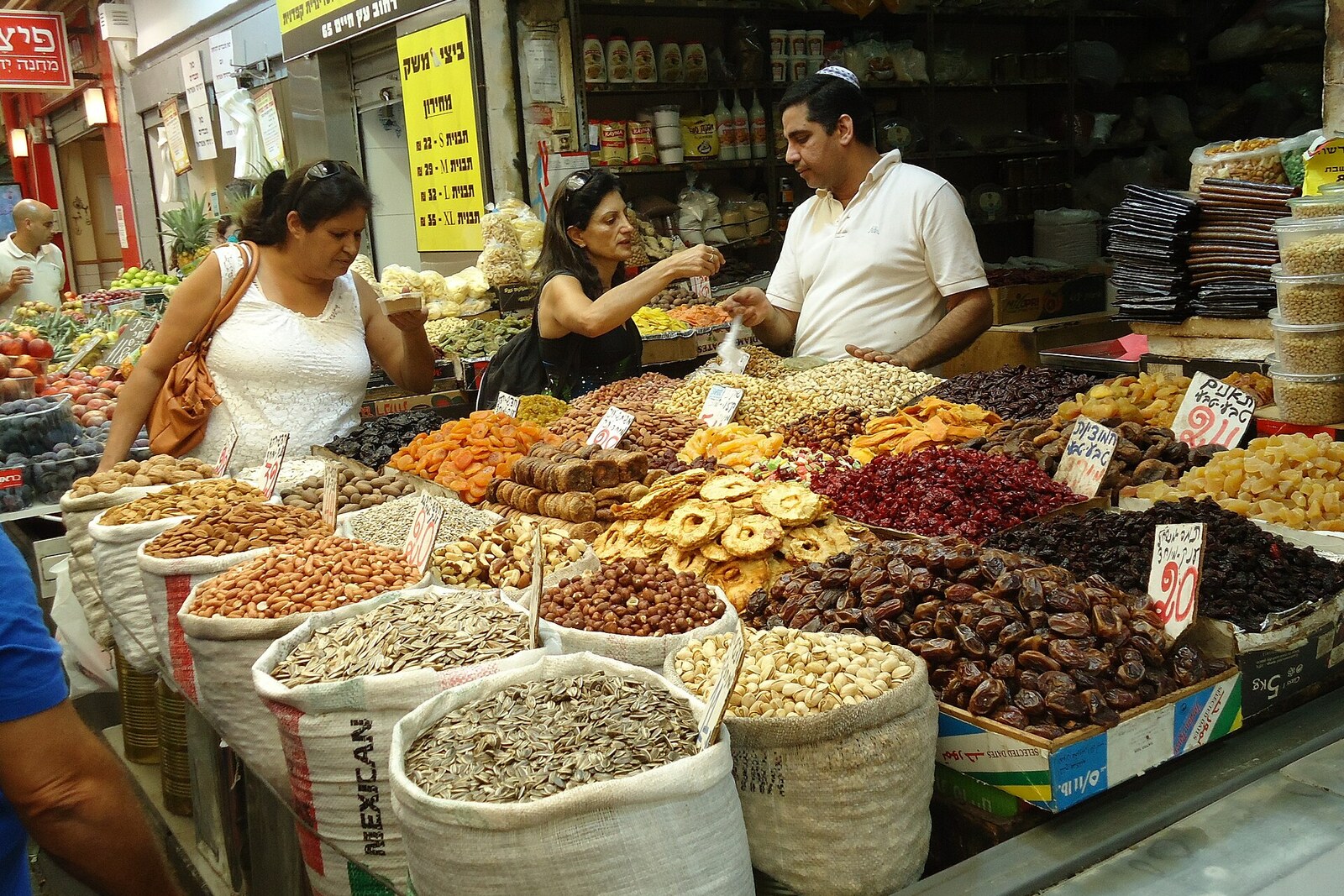
Look around first
What to notice
- Display windows with coffee and spices, slabs of halva, and the old Saloniki Dairy poster.
The story of the place
Etz Chaim Street is formed by a covered shopping arcade among display windows with coffee and spices, pale slabs of halva, and dairy shops. Once, permanent shops and a roof brought together trade that had previously stood on a vacant lot; later, a few meters of counter became a family business for generations. Behind today's glass, the old market can still be glimpsed: coffee blends, spices, dairy products, and a poster promising home delivery. Some owners stick to familiar goods, while others add products for new cuisines, and the street changes through smells faster than through facades.
The market has its own accounting of miracles. A customer hands over a coin for bread or meat, a merchant pays rent, and somewhere beyond the wall a student bends over an ancient text with that money. This is exactly how Etz Chaim Street was arranged.
Its name translates as “Tree of Life.” It did not come from a pretty sign or from a later attempt to give the market a sense of dignity. The renowned Jerusalem Etz Chaim Yeshiva operated nearby. It was founded as early as eighteen forty-one by Shmuel Salant, the chief Ashkenazi rabbi of Jerusalem. At that time, Mahane Yehuda Market did not yet exist in its familiar form, and this part of the city itself was only preparing to become a bustling commercial machine.
When the spontaneous market began to acquire permanent shops, the yeshiva acted very practically: it opened a shopping arcade here and began leasing out premises. The rental money went toward supporting the school and its students. It created a simple and very Jerusalem-like system: a butcher chops meat, a grocer weighs grains, a customer carries a basket home, and together they pay for religious education. Torah and trade did not argue with each other—they shared one roof and one cash register.
This connection can still be felt in the very fabric of the street. Behind a modern display window there may be premises that were originally not merely commercial real estate, but part of the yeshiva's larger operation. The street seems to remember that every purchase has a continuation invisible to the person who pays.
But “Tree of Life” suits this place for another reason as well: the family businesses here really do resemble a tree. The roots remain in place, while the branches reach toward wherever new flavors appear.
The Danon family has sold coffee here since nineteen forty. Once, the foundation of its trade was coffee blends, spices, and baking ingredients. It all makes sense: the smell of roasted beans, bags of spices, home cooking, a recipe passed on together with a tin box. Now Indian pastes, tandoori, tea, and sushi products have appeared beside the familiar goods. An old merchant would probably not have recognized the entire assortment at once, but would have understood the principle perfectly well. Here, a profession is not locked in the past like an exhibit. It is stretched, adapted, and made to accommodate new cuisines.
The street tells its story not through dates, but through smells. Coffee lingers in the air a little longer than it needs to, mixing with spices, baked goods, and cheese. A few steps later, one era already smells of another.
This market way of dealing with time is especially clear at Halva Kingdom. The roots of the family shop lie in the Old City, and the family itself has been in the business since the nineteen forties. Here they offer more than a hundred kinds of halva and say that Ethiopian sesame is one important part of the family secret.
Halva itself looks as though it has absolutely no need to change. Heavy pale slabs, a calm, dense surface—a sweet with the appearance of ancient stone. But once you get to the names, the stone turns into a laboratory: coffee, fruit, nuts, dozens of combinations that would once have seemed almost daring. Tradition survives here not because it is guarded against every new flavor. On the contrary, it is constantly testing it with its teeth.
The whole market works the same way. Family memory does not lie under glass. It goes to work in the morning, pays bills, argues about the price of sesame, and decides what else can be added to halva without ceasing to be itself.
At one of the old dairy shops, a historic Saloniki Dairy poster has survived. Its advertisement sounds almost like the voice of a merchant shouting over the neighbors. The dairy owner, Yitzhak Benvenisti, probably came from the Jewish community of Greek Thessaloniki. He promised fresh cheese and leben every day, hot, thick sahlab, and a rice-milk dessert. A customer was entitled to compensation for a fake—five Israeli liras. Home delivery took five to six hours.
Today, such advertising seems touching and combative at the same time. The merchant does not merely praise the product—he solemnly vouches for its authenticity. Five liras become almost a knight's glove thrown down before cheap imports: try to prove that our product is not genuine. And the promise to bring dairy products within a few hours recalls that delivery existed long before apps, couriers with electronic maps, and flashing notifications. Only then, the route was kept in one's head, the address was written by hand, and the freshness of the goods was a matter of personal reputation.
But behind the word “Saloniki Dairy” lies a story far heavier than an advertising dispute. The enormous Jewish community of this Greek city was almost completely destroyed by the Nazis in nineteen forty-three. Families, streets, familiar ways of life, and the voices of merchants disappeared. And yet part of that world continued to live in Jerusalem—not as a monument in a square, but as a taste. In a glass of leben, a cup of sahlab, and a rice-milk dessert prepared as it was remembered at home.
For the market, this is perhaps the most natural form of memory. Here, the past rarely makes long speeches. It offers you cheese to taste, cuts a piece of halva, pours coffee, leaves an old advertisement on the wall. And a person may not even know that, together with a sweet or a spice, they are receiving a tiny part of someone else's family geography.
Closer to Agrippas Street, the smells change especially quickly: a butcher shop, spices, coffee, baked goods, cheese. The variety seems accidental only until it becomes clear that every smell preserves someone's small piece of the past. In the nineteenth century, permanent shops and a roof turned a commercial vacant lot into a real market. Then families made it their own—not all of it, but a few meters of counter at a time.
That is why Etz Chaim Street remains a “Tree of Life” today without any strained metaphor. Its roots are the yeshiva, old communities, and family trades. Its trunk is the row of shops that once supported the school. And its branches smell of coffee, Ethiopian sesame, Indian spices, and fresh milk. Here even memory is compelled to trade—and that is precisely why it remains alive.
Useful on site
The same as the market's; bars and restaurants operate until late at night
Checked: June 22, 2026. Check the official source before visiting.The passage remains busy and narrow: do not block display windows or customers' access. Old details may be inside operating shops—look at them only where visitors are invited.