 Guide On Map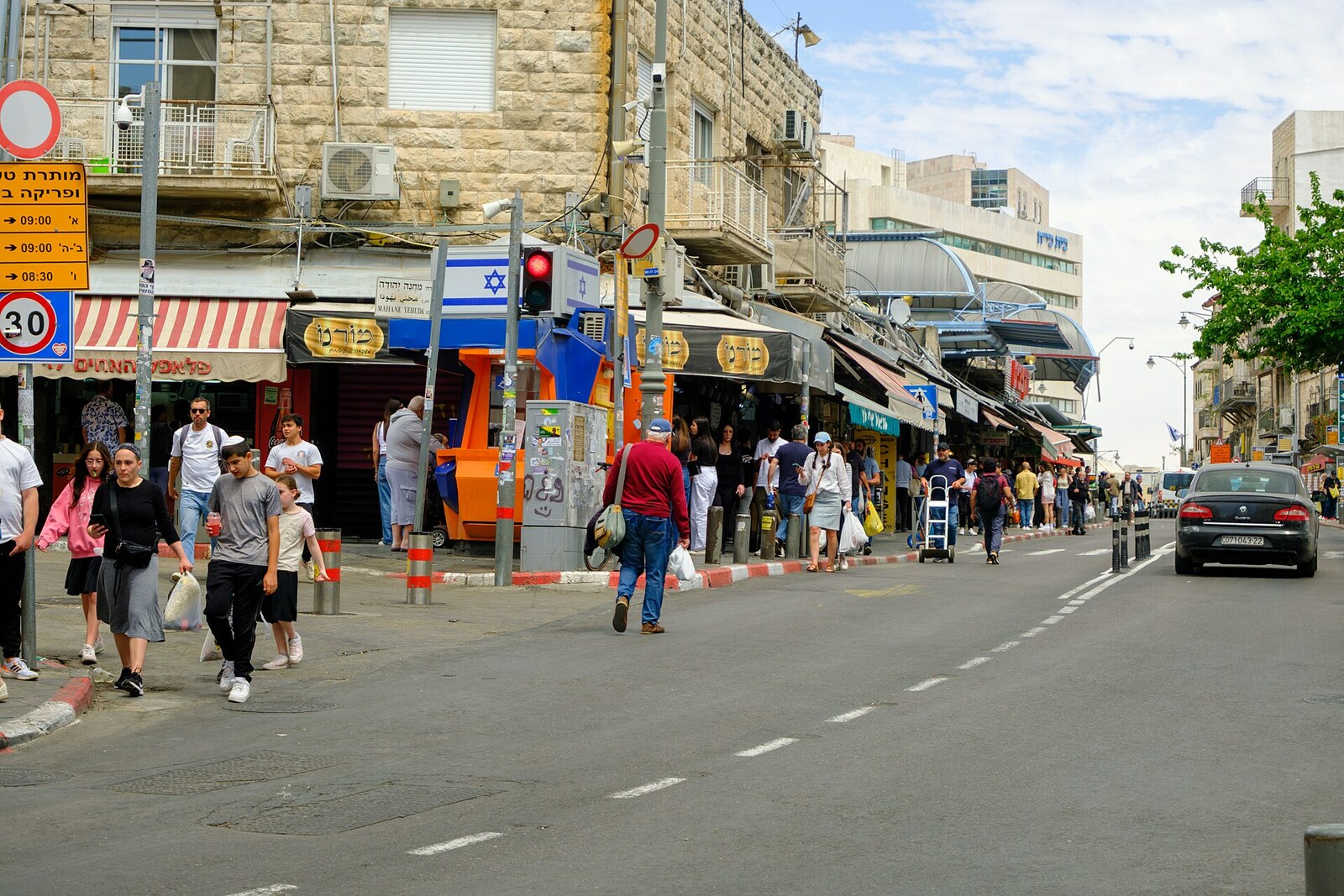
Look around first
What to notice
- The flow of buses, carts loaded with goods, and stone arches opening into residential neighborhoods.
The story of the place
Agrippas Street does not know how to speak softly. Buses press up against the curb, vendors call to one another across the stream of people, carts laden with goods rattle over stone, and the smells of the market change every few steps. It seems like a road that has always existed—so naturally does the city flow here from every direction. But legend says that Agrippas did not begin as a street at all. And not quite legally, either.
In eighteen seventy-five, a narrow path ran here along land owned by an Arab landowner. According to a local story, the owner did not want Jewish residents of the new neighborhoods crossing his plot and drove them away. There was almost no other convenient route between the Old City and the homes beyond the walls. Then, one night, the neighbors gathered and set to work. By dawn, they had widened the path and turned it into a road—not a private passage, but an established public fact.
It acquired the nickname BILA—an abbreviation of the phrase “in one night.” The story sounds too neat not to suspect an urban legend. But Jerusalem loves stories in which the right to a place arises not from a document with a seal, but from an act. In the evening, there is still someone else's plot and a prohibition; in the morning, there is a road already used by the whole neighborhood. Try turning it back into a path after that.
That night’s work explains Agrippas Street’s character well. The street was born not for a grand facade and not at the whim of an urban planner. It was needed by people who had already left the Old City, settled beyond the walls, and suddenly discovered that a new home did not yet mean a new urban life. Roads, shops, schools, workshops, and synagogues were needed. People needed some way to get to work and return with their purchases. The city beyond the walls had not merely to be built—it had to be connected with the rest of Jerusalem every day.
Later, the street was named after King Agrippa II. Here again, a story begins at the boundary between history and legend. They say that Agrippa paved Jerusalem’s streets with marble, and that is why one of them was named in his honor. Historians debate how accurate this explanation is. Yet the image is almost comic: noisy, narrow, endlessly busy Agrippas bears the name of a ruler credited with a marble city. And the street’s own birth is associated with neighbors who worked at night, surely without marble, ceremony, or royal permission.
Agrippas has an unusual relationship with its royal name in general. There is none of the ceremonial distance one normally expects from a street named after a monarch. The king’s name appears on signs, addresses, and bus routes, while ordinary life continues below: someone is wheeling boxes, someone is opening a workshop, someone is arguing over a price. Agrippa II, if the legend is to be believed, gave the street a marble past. Jerusalem gave it a present made of asphalt, stone, trade, and human voices.
Agrippas is often seen as the edge of Mahane Yehuda Market: the rows of stalls end here, and Nachlaot begins. But it would be more accurate to call it not a border, but a seam. It did not divide the market from the residential neighborhoods; it stitched them together. On one side were concentrated goods, craft, movement, and livelihoods. On the other, entrances opened into Even Yisrael, Mishkenot Yisrael, Mazkeret Moshe, and Ohel Moshe—neighborhoods arranged around inner courtyards.
They were built for people for whom the Old City was becoming too crowded and too expensive. Moving beyond the walls promised air and a home of one’s own, but for a long time it still seemed dangerous. That is why the new neighborhoods resembled small fortified worlds. The houses formed an enclosed courtyard, the entrances could be closed, and inside was everything essential. The city outside remained unpredictable, but beyond the arch began a space of familiar faces, shared concerns, and mutual help.
By the beginning of the twentieth century, the area around Agrippas was no longer an outskirt where people came only to sleep. Nearby were schools and orphanages, synagogues, shops, and workshops. A small area contained an almost self-sufficient town: people studied, prayed, earned a living, bargained, repaired things, raised children, and discussed their neighbors here.
But even in such a town in miniature, they tried to draw a line between noise and home. In Even Yisrael, for example, there was a separate courtyard for shops and workshops. Trade was not banished—the neighborhood could not have survived without it—but it was given its own place. Family life began a little farther in, beyond a passage: there were a well, a communal oven, children’s voices, and neighbors’ doors whose occupants knew too much about one another.
That is why the arches here are not merely beautiful entrances of old Jerusalem. Each of them worked like a switch. Outside, a person was a vendor, an apprentice, a buyer, a student, or a passerby. Inside, that person became a courtyard resident, a participant in shared life, someone who the next day would have to share water, fire, news, and responsibility for gates closed at night.
Agrippas Street has preserved this division while constantly disrupting it. The market spills onto the road, kitchen smells drift into the courtyards, residents pass through the noise of trade on their way home, and old residential arches become part of the city’s flow. That nighttime path long ago became an arterial road, but its original meaning has not disappeared. It is still a passage that people needed and a space that they made shared before it had time to become official.
Beyond the arch, the noise of Agrippas can still be heard, but differently now—as an outer layer of the city. A few meters separate the royal name, buses, and trade from a world where life once gathered around a well and a communal oven. In Jerusalem, one such threshold is sometimes enough for a street to end and a whole neighborhood to begin.
Useful on site
Open around the clock; traffic is heaviest during working hours
Checked: June 22, 2026. Check the official source before visiting.Listen to the story on the sidewalk, away from the edge of the road. Cross the street only at a designated crossing, and do not linger in the roadway to photograph an arch.