 Guide On Map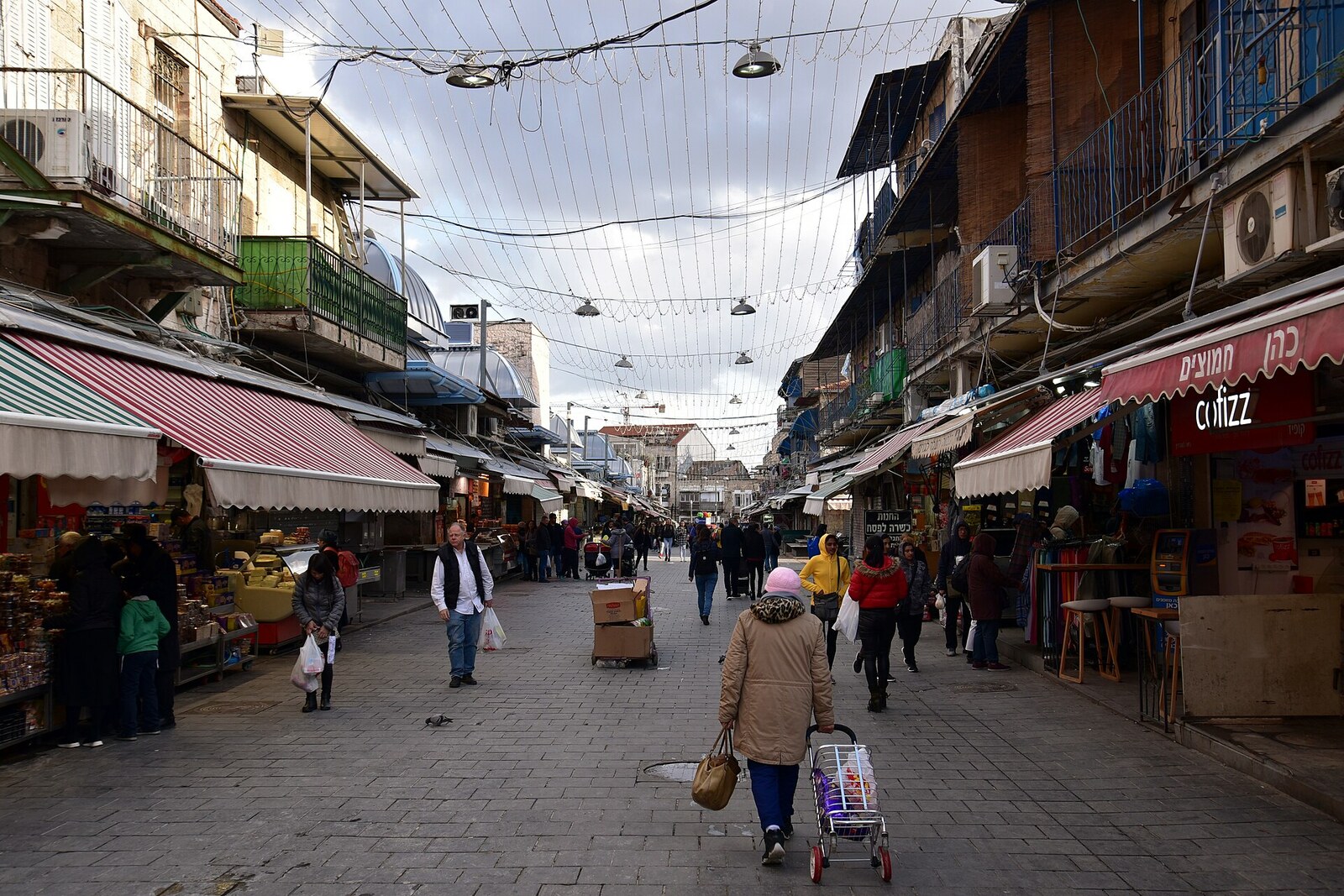
Look around first
What to notice
- Covered passageways, cramped permanent shops, and painted metal shutters.
The story of the place
Mahane Yehuda Market has no grand entrance and no single beautiful birth date. The market appeared because people found it inconvenient to go to the Old City for groceries. Farmers from nearby Arab villages brought vegetables to a vacant lot between the new Jerusalem neighborhoods, laid out their goods under makeshift awnings, and gradually made a home for themselves on an unremarkable patch of land. Shoppers got used to coming here—and the habit proved stronger than any city plan.
The vacant lot belonged to the influential Sephardi Valero family, so at first the market was called Valero, and also Beit Yaakov, after the neighboring neighborhood. In Ottoman times, there were no neat rows, no drainage, and no proper storage rooms here. The merchants built everything themselves: in one place they stretched fabric to block the sun, in another they knocked together a wooden booth, elsewhere they hid sacks and baskets in a hastily built shed. Dust mingled with the smell of vegetables, mud appeared after rain, and sellers shouted over one another. What emerged was not an architectural ensemble but an urban organism—noisy, awkward, and absolutely necessary.
In the late 1920s, this organism nearly died from its own disorder. The British authorities effectively closed the market because of unsanitary conditions. Jerusalem Governor Ronald Storrs found himself in an ambivalent position: he understood that trade gave people a livelihood and was necessary for the city, but he no longer wanted to put up with the sight of the market. The task of bringing order was assigned to planner Charles Robert Ashbee.
And here Mahane Yehuda's history took a funny turn. What now seems like an old Eastern market was, in many ways, born of a British desire to defeat dirt. Permanent shops, roofs, and more orderly passageways appeared. In nineteen thirty-one, the market officially received the name Mahane Yehuda Market. Its picturesque crampedness is not an untouched fragment of antiquity, but chaos that was once made to wash up, comb its hair, and register.
Trade here supported more than just the sellers' families. Etz Chaim Yeshiva opened some of the shops, and the rent went toward education. It made for a very Jerusalem system: downstairs, people weighed vegetables, counted coins, and argued over prices, while the money earned from this supported the study of the Talmud. Everyday trade and religious learning did not exist in separate worlds: one literally paid for the other.
The market can compress a great deal of history into the size of a single stall. The father of a merchant named Uri ran a butcher shop here. Uri took over the family business at sixteen, but during a period of shortages, meat disappeared from the display case. To avoid closing, the shop had to be turned into a household-goods store. Instead of food, shelves held things needed for everyday life. When food became more plentiful, Uri returned to selling food in nineteen seventy-five. Now his sons sell cheeses, olives, pickles, and salads.
One small shop managed to live through several lives alongside the country: first meat, then the forced sale of household goods, then a return to food and the transformation of an ordinary market into a place people also visit for pleasure. Here, a family business is passed down not as an unchanging tradition, but as the ability to change in time and still remain itself.
Perhaps no one embodied this talent better than Uzili Hazay—the famous the Etrog Man. His small stall stood near Agrippas Street. The etrog, a large, bumpy citron, is usually associated with Sukkot. For many people, it matters for a few days each year and then becomes almost unnecessary. Hazay built an entire universe around it: he sold juices, creams, soap, sprays, and even etrog beer.
He was born into a Yemeni family that came to Israel around nineteen fifty. The family settled in the moshav of Eshtaol, grew vegetables, and kept goats and cows. Hazay's mother planted an etrog grove, and the fruit became for him at once a family memory, a religious symbol, and a profession. He linked his recipes to Yemeni folk medicine and to advice on the benefits of etrog that is attributed to Maimonides.
But perhaps Hazay himself was the main product. He knew how to turn buying juice into a small performance. One drink bore the provocative name “Viagra from nature,” and the seller, with a completely serious expression, explained that the mixture gave a person vigor. It was less a promise of miraculous healing than classic market magic: an unusual fruit, a family recipe, a vivid name, and an owner whose story you wanted to hear through to the end. Uzili Hazay died in 2022 at the age of eighty, and his son Or continued the business. At Mahane Yehuda Market, even stage charm can be inherited along with a stall.
The market also has a memory that does not turn into an entertaining story. Terrorist attacks took place here in nineteen ninety-seven and two thousand two; visitors and merchants were killed. After them, there were noticeably fewer shoppers. For a place that lives on the flow of people, empty passageways were almost like a heart stopping.
That is why infrastructure renewal in the two thousands meant more than improvement. The market was bringing people back to itself. Restaurants and bars appeared alongside vegetables, spices, cheeses, and pickles; Mahane Yehuda Market learned to live after the daytime stalls closed. At night, metal shutters turn into walls with paintings, music and conversation replace sellers' calls, and the smells of cooking linger in the passageways until late.
The night market did not grow in place of the old one, nor did it abolish it. It appeared thanks to the same ability that once saved Uri's butcher shop and turned a holiday citron into beer, soap, and a family craft. Mahane Yehuda Market changes all the time because that is precisely how it preserves itself. Once, there was a vacant lot here where farmers found it convenient to bring vegetables. From that simple convenience grew a place Jerusalem could no longer do without.
Useful on site
Sun–Thu 8:00–19:00; Fri 8:00–15:00; closed Saturday, while cafés open late in the evening
Checked: June 22, 2026. Check the official source before visiting.Stand at the edge of the passageway before starting the narration. Purchases and tastings are optional, and it is best to photograph sellers and goods only after receiving permission.