 Guide On Map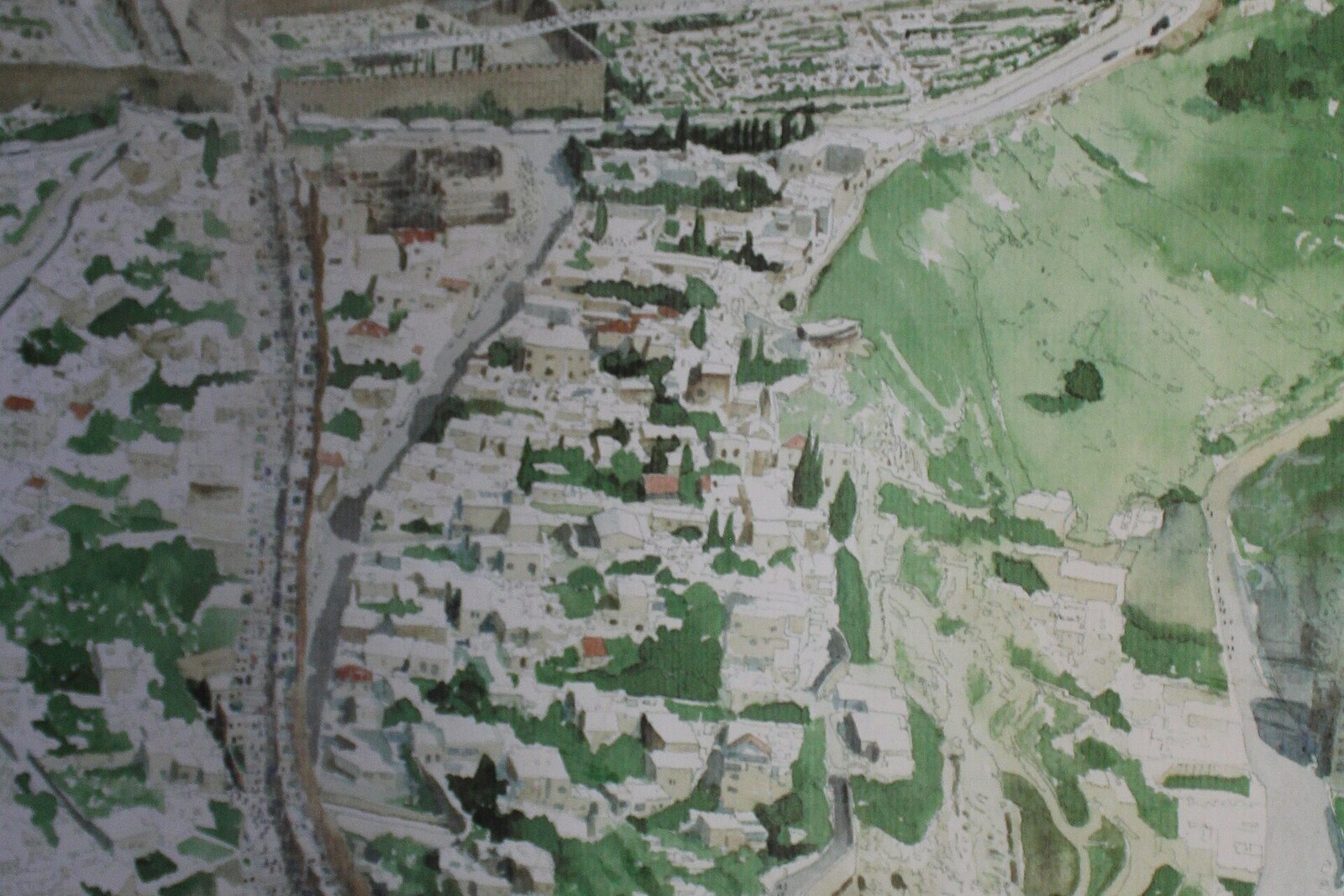
Look around first
What to notice
- Massive paving slabs, broad steps, the stone edges of the street, and the narrow drainage channel beneath it.
The story of the place
A broad street once ran here, linking the lower city with the Temple area. Large slabs, wide steps, and stone edges were designed for a dense flow of people, not for a narrow passage between houses. A narrow drainage channel was laid beneath the pavement: it carried away winter water so that it would not wash away the road.
The first thing that returns here from the past is not prayer, but noise. The stone beneath your feet hums with countless footsteps. Someone is bargaining, someone is leading an animal, someone is counting small change. A seller names a price; a buyer demands that the weight be checked. Food smells drift from the shops; nearby there is the scent of dust and livestock. This may have been how this street sounded two thousand years ago—not a silent route for pious individuals, but one of Jerusalem’s major urban arteries.
Archaeologists found coins and stone weights here, as well as a special table on which goods were weighed. Animals for sacrifice were sold on the road. Everything was arranged quite practically: a person arriving from far away did not have to lead a sacrificial animal across half the country. It could be bought in the city itself. But first, one had to make sure that the price was fair, the weight was correct, the coin was accepted, and the animal was suitable for the ritual.
After washing in the Pool of Siloam, the pilgrim emerged cleansed and ready to ascend to the Temple, and immediately entered the dense life of the city. Here, the sacred did not begin beyond a door where trade, money, and the smell of fried food disappeared. They accompanied the way to the sanctuary. Prayer stood alongside calculation, ritual alongside purchase, and hope for an encounter with God alongside anxiety over whether one had been cheated at the scales.
This is probably what a real city of pilgrimage looks like. People are heading toward one goal, but each brings their own road with them. Someone saw the walls of Jerusalem for the first time that morning. Someone had been traveling for many days, saving money, watching the children, and fearing they would be late for the festival. Someone knew every shop here and already understood in advance which merchant to buy from. The crowd moved upward, toward the Temple Mount, and the street became part of the ritual—not because it was quiet and solemn, but because thousands of human concerns passed along it.
This pavement also has an almost theatrical historical irony. Coins found beneath its slabs help date its construction to the time of the Roman prefect Pontius Pilate—around the thirties of the first century. A coin beneath a stone is like a signature from an era left there by chance: the street could not have been paved before it.
That does not mean Pilate personally chose the stone slabs or ordered where to place the weighing table. Archaeology speaks more cautiously: the road appeared under his administration. But the coincidence still sounds powerful. In Christian memory, Pontius Pilate is the judge before whom Jesus’ earthly fate is decided. But for the inhabitants of Roman Judea, he was also an official connected with taxes, order, expenditures, and urban construction. The man who remained through the centuries as a participant in the Gospel drama also belonged to the ordinary bureaucratic machinery of the empire. And that machinery probably gave Jerusalem the broad road along which pilgrims ascended to the Temple.
The upper side of the street was festive and crowded. It also had another side—an invisible one. A large drainage channel ran beneath the pavement. In winter, water could pour down on the city in torrents, and without drainage it would have washed away the road. While coins rang above and processions passed, dirty water flowed below. Ordinary urban engineering: something a passerby does not think about while it works.
But in Jerusalem’s history, even a drain once ceased to be simply a drain.
In the year seventy, during the Romans’ destruction of the city, the space beneath the street became a shelter. People hid under the stone slabs. They went down there no longer for repairs or to clear the channel. Above, where sacrificial animals had once been bought and prices discussed, devastation was underway. A street created for the movement of a huge crowd became a dangerous open strip, and its dark underside became a last hope.
Archaeologists found cooking pots, oil lamps, and hundreds of bronze coins from the time of the Great Revolt in the channel. There is no heroic pose in these objects. A pot is needed for eating. A lamp is needed to make out faces in underground darkness. A person takes money along while they still believe it will have a tomorrow. Nearby, archaeologists also found a Roman sword in a leather scabbard—an object from an entirely different world, a world of pursuit and violence.
Josephus wrote that the Romans found people hiding in underground passages and killed them. Archaeological finds do not name names or reconstruct each person’s fate. It is unknown who owned a particular lamp, who held these coins, who brought the dishes down below. But together they make the ancient account almost unbearably confined. Where a human body can fit, people sit in the darkness, hear footsteps overhead, and try to understand whether they are drawing nearer or moving away. The oil in the lamp grows scarcer. The city, still full of festive voices only recently, is collapsing directly above them.
That is why today’s underground route is made up of different spaces. In some places it is the line of the ancient street; in others, its drainage channel, the technical underside of the ceremonial ascent. What has not survived before the modern visitor is an intact avenue, frozen as the pilgrim saw it. What remains is the city’s layout: a stone road above, water beneath it, the Temple ahead.
And there are two utterly different movements through the same place. First, people ascended here openly, together, amid trade and the clinking of coins. A few decades later, other people went beneath the same slabs, pressing lamps, dishes, and money to themselves. In a single historical moment, the ceremonial route to the sanctuary became a road of flight. And the pavement remained between them—a stone boundary between celebration above and fear below.
Useful on site
The official Pilgrimage Road page, checked 2026-06-30, states a route of about two hours, an ascent of roughly 600 meters, full illumination, and a recommendation to book in advance. The section is not accessible to wheelchairs or walkers.
Checked: June 30, 2026. Check the official source before visiting.Allow for a long underground ascent without a convenient way to exit quickly midway through. Do not touch the masonry or excavated elements, even if they are close to the passage.