 Guide On Map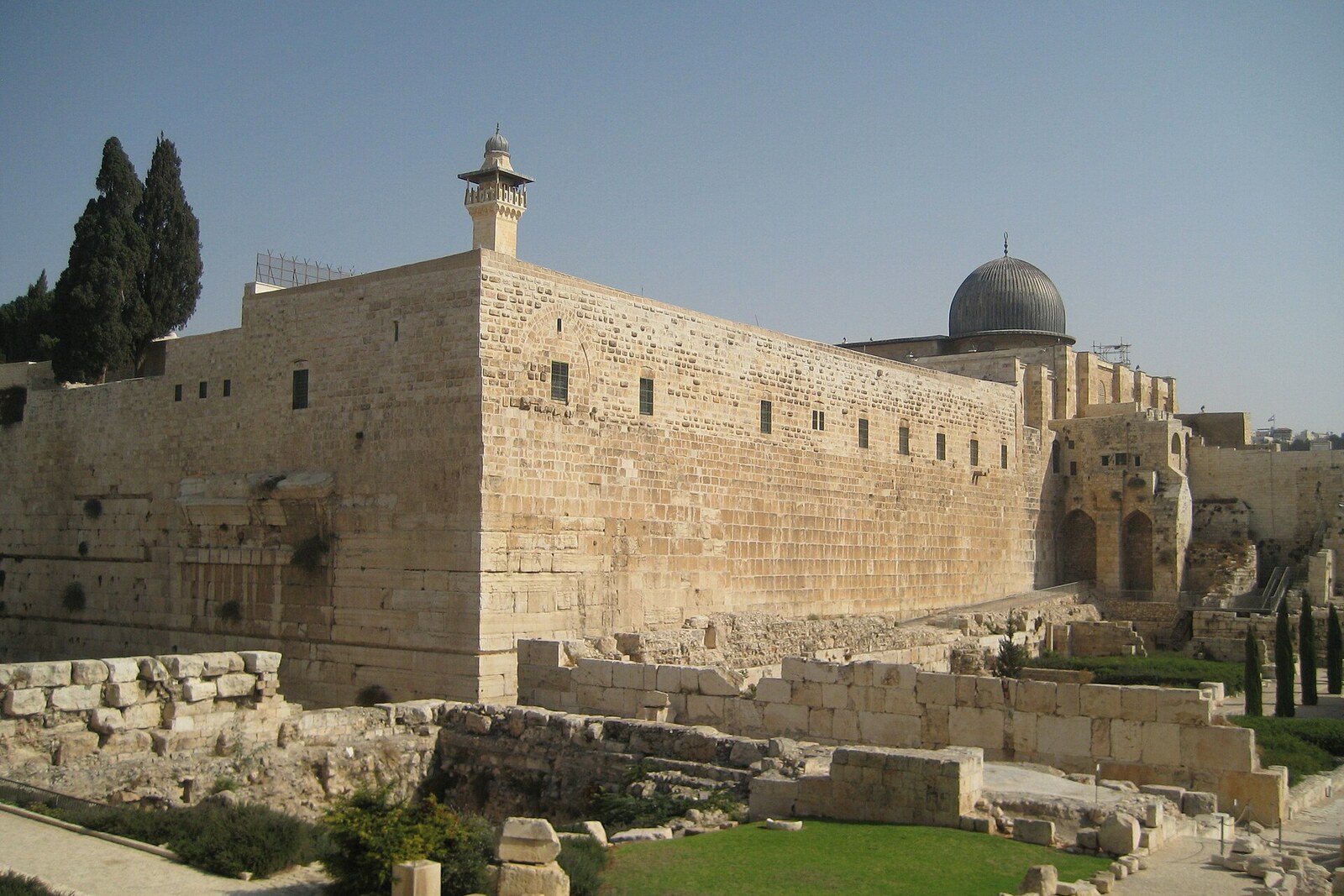
Look around first
What to notice
- The uneven southern steps, the sealed openings of the Huldah Gates, the projecting stones of Robinson's Arch, the fallen blocks, and the stone with the inscription about trumpeting.
The story of the place
Davidson Archaeological Park lies by the southern and western walls of the Temple Mount, where the approaches to the ancient temple complex have been preserved. From the south, pilgrims climbed a broad staircase to the Huldah Gates, as rabbinic tradition calls them; their sealed openings now stand beside a sequence of narrow treads and broad landings. This pattern of steps breaks an even stride before the entrance. On the western side, stones of an ancient support project from the masonry, from which an enormous arch once carried people over the street to the Temple Mount.
At Jerusalem's southern wall, the city reads not as a collection of ancient stones but as a city in motion. Everything here leads somewhere: stairs rise, gates draw people inside, an arch carries a route over the street. Even the debris at the wall looks as though the fall had ended only moments ago.
The broad steps before the southern gates once received streams of pilgrims. People approached the Temple Mount through double and triple passageways, known in rabbinic tradition as the Huldah Gates. The crowd here was part of the pilgrimage itself: families, merchants, residents of distant cities, people with sacrificial animals and road dust on their clothes. After the narrow tunnels of ancient Jerusalem, the space finally opens up. What had previously felt like a personal journey through darkness and water becomes the shared ascent of an entire people.
This staircase has a strange rhythm. The steps are uneven: a short step is followed by a broad landing, then the movement changes again. Perhaps this was intentional. Archaeologists are not certain, and calling the staircase a special device for meditation would be too beautiful. But the stone really does direct the body. It is hard to pick up speed here, and impossible to keep one's usual pace for long. The ascent itself breaks up each step, as though the city had already taken away a person's ability to burst into the sacred space at a run.
The name of the gates adds another voice to this ascent. Huldah was a prophetess whom people consulted in the time of Josiah, king of Judea. A Book of the Law had then been found in the Temple, and it was necessary to understand whether the people truly had a sacred text before them. The king's messengers came to Huldah. She confirmed the significance of the discovery and predicted disaster for Judea, but said that Josiah himself would not see it in his lifetime.
A direct connection between the prophetess and these particular gates remains a tradition. Perhaps her name appeared here much later, and ancient pilgrims called the passageways something else. But the tradition has a remarkable precision of image. A person ascends to the Temple, and the entrance preserves the memory of a woman whose voice once confirmed the authenticity of a word found in the Temple. The stone staircase leads upward, a text returns from oblivion, prophecy warns of catastrophe. And catastrophe does indeed come, though in an entirely different era.
In the western part of the park, movement changes direction. There, stone no longer lifts people up: it itself flies down. The enormous blocks at the base of the wall were thrown down during the Romans' destruction of Jerusalem in the year seventy. Josephus described the capture of the city as a disaster of almost unimaginable scale. Here, imagination is not especially necessary. The stones lie where they fell from above, and their weight turns a historical date into a physical event.
A colossal arch once crossed above this street. Today it is known as Robinson's Arch, although Robinson neither built it nor saw it intact. The American biblical scholar Edward Robinson came to Jerusalem in eighteen thirty-eight and noticed several projecting stones in the masonry of the Western Wall. They looked almost accidental, like an irregularity left by ancient builders. Robinson understood that before him was not a mistake in the masonry but the beginning of a vanished arch.
The insight was astonishing: from several stones on a wall, to reconstruct an entire urban structure; from a fragment, the direction of movement of thousands of people. Later, during Benjamin Mazar's excavations, it became clear how correctly Robinson had read these projections. They really were the remains of the support of a single enormous arch, spanning the street and connecting the city with the Temple Mount.
This is how archaeology sometimes restores not an individual building but a gesture of the city. Several “extra” stones turn out to be the beginning of a road in the air. The street below, the arch above it, the stairs and gates farther on: the whole space fills with people again, though the people themselves have long been gone.
Among the debris, they also found a stone with an inscription usually read as “to the place of trumpeting.” It probably marked a spot above from which a priest blew the shofar, announcing the beginning of the Sabbath and its end. For the ancient city, this sound was not a decoration of ceremony but a common signal. It passed over the rooftops, entered courtyards, and told thousands of people that time had changed.
Now the stone lies below. The inscription has preserved a direction to a place that no longer exists, and the fallen block has preserved the memory of a sound that is no longer heard. Something almost impossible results: the voice of the horn has been caught inside the stone.
This is what all of ancient Jerusalem is made of: water, footsteps, and sounds. At the Gihon Spring, water determined the city's daily life. People drew it, carried it uphill, hid it in tunnels, directed it through cut channels. Here, by the wall, the scale is different: enormous staircases, gates, a bridge over the street, the shared rhythm of pilgrimage, and the signal of the shofar, heard far around.
At the beginning of the route, the city spoke in water beneath the ground. At the end, in human breath above the wall. Between them, all of Jerusalem grew: from a jug at the spring to a horn announcing time to the whole city. Water continues to flow, the sound vanished long ago, and the stones have preserved both.
Useful on site
According to Davidson's ticket page, checked 2026-06-30: in winter Sunday–Thursday 9:00–17:00, Friday 9:00–14:00; in summer Sunday–Thursday 9:00–19:00, Friday 9:00–15:00. Hours may change on holidays, during services, and for security reasons.
Checked: June 30, 2026. Check the official source before visiting.The park may have separate access hours from the City of David complex, so check them in advance. Observe barriers on the steps and among the large blocks, and watch out for uneven stone.