 Guide On Map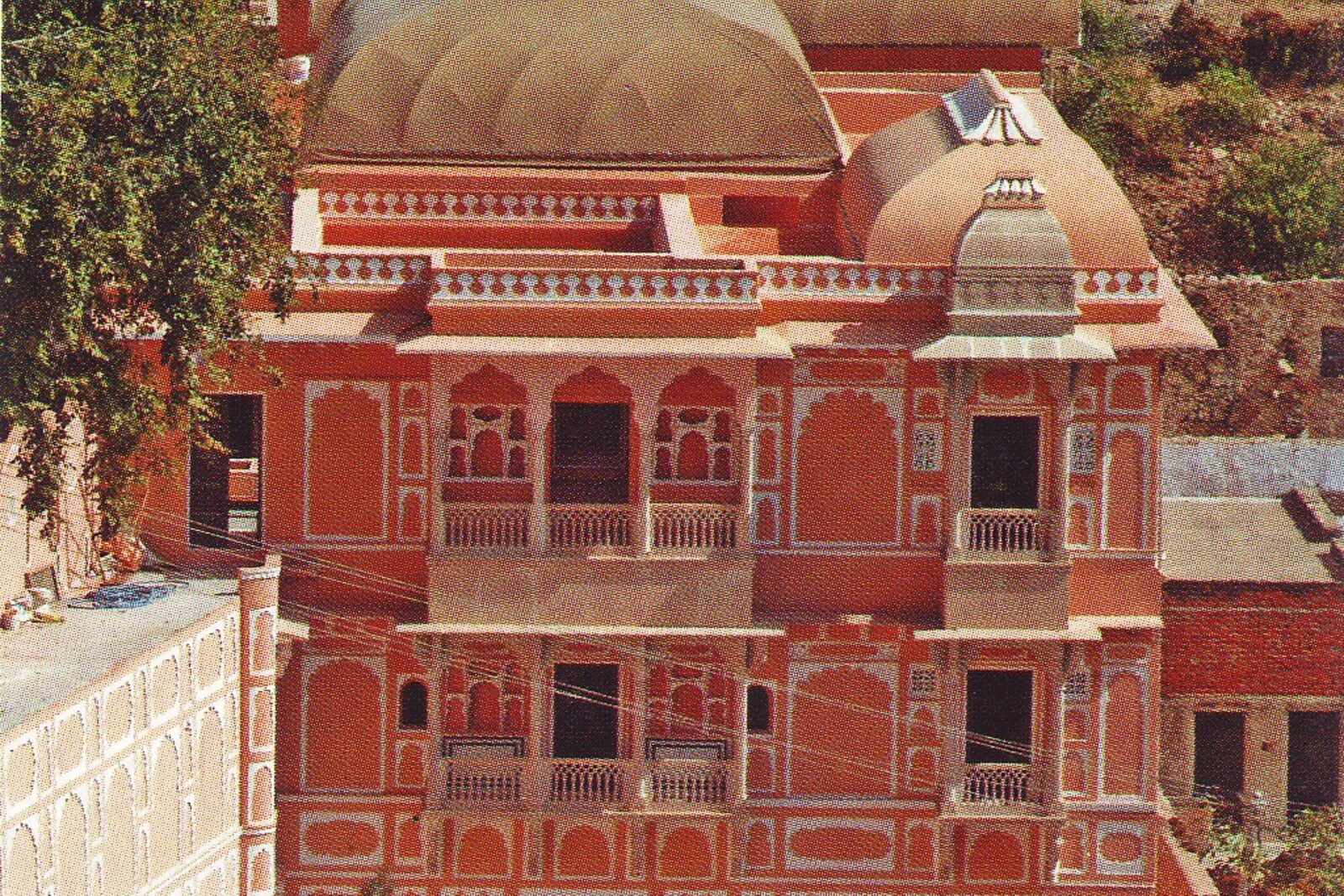
Look around first
What to notice
- Inner courtyard
- Carved wooden blocks
- Forged chisels
- Hand-printed textiles
The story of the place
Beyond Kheri Gate, a sixteenth-century urban haveli has survived. Small rooms stand around a courtyard, and above them is another floor where people still work with wood and textiles today. The house's former name is associated with a family of court palanquin bearers, although documents do not name its first owner. Hand-printed textiles, clothing, and the tools of a craft that requires precision of hand are now gathered here.
John Singh spent three months looking for a master mason. In nineteen eighty-nine, he undertook the restoration of a collapsed house by Kheri Gate. John was a co-founder of the textile company Anokhi and headed Jaipur's branch of a heritage-preservation organization. With this restoration, he wanted to test his own claim: Amer's old houses could still be repaired with local materials and by methods mastered by local artisans.
The house was built in the sixteenth century. Its former name, Chanwar Palkiwalon ki Haveli, was associated with a family of palanquin bearers at the court of Amer; the name of the first owner has not been reliably established. After the court moved to Jaipur, many residents left the old capital, and over time the haveli became a ruin.
The master John finally found was Premchand Saini. He knew how to work with lime and restore old masonry, but clients increasingly chose quick modern construction methods. Premchand complained that his people were rarely given the chance to apply what they had spent years learning. He came to the haveli with five artisans.
They were not given a finished set of construction drawings. Decisions were made together with the restorers as the work proceeded, by examining the surviving parts of the house. Cement was replaced with lime compatible with the old masonry. For decorative plaster, the lime mixture was left to mature for up to one year; the terracotta color of the walls was produced with a mixture of limestone and red clay. For three years, Premchand and his people restored the courtyard, rooms, and exterior finish using traditional tools.
By nineteen ninety-two, the haveli was complete. In two thousand, the project received a UNESCO award for cultural heritage preservation. The consequence for the builders themselves was even more direct: the five artisans who had come with Premchand later became independent contractors and assembled their own crews. The work for which clients supposedly no longer found time began bringing them commissions again.
For several years after the restoration, the house had no defined purpose. It was turned into a museum by Rachel Bracken-Singh, the designer of the family textile company, and her husband Pritam Singh, John's son. They needed premises for an archive of hand printing, and the old haveli had to be further adapted to store textiles away from bright light and sharp changes in temperature.
The museum's name comes from the company Anokhi—in Hindi, the word means “unusual” or “one of a kind.” John and his wife Faith Singh founded the company in nineteen seventy, when Jaipur's woodblock carvers, dyers, and printers were losing customers: the former court patronage had disappeared, and the market was shifting to machine-made textiles and synthetic dyes. The couple began ordering contemporary dresses and household items from artisans, sold their first collections through English shops, and provided craftspeople with work throughout the year. Along with the products, they preserved wooden blocks, textile samples, paper patterns, and information about the dyes used.
Rachel and Pritam studied this archive and opened the museum here in two thousand five. In the small rooms around the courtyard are textiles, clothing, carved blocks, and tiny forged chisels used to remove the wood between the lines of a future pattern. Designers of new collections also use the archive: old samples continue to take part in production.
On the third floor, a carver makes wooden blocks, while printers transfer patterns onto fabric by hand. Visitors are given the chance to make their own print. The fabric the artisans work with during a demonstration is then sent to tailors—it is paid work of the same kind for which John and Faith Singh once founded Anokhi.
Useful on site
Officially closed for the summer and expected to open July 15, 2026. Usual hours: Tuesday–Saturday 10:30–17:00, Sunday 11:00–16:30, closed Monday; demonstrations pause for lunch breaks. Before visiting, the museum asks you to confirm that it is open.
Checked: June 29, 2026. Check the official source before visiting.Check museum access and the demonstration schedule in advance; the chance to see an artisan at work should not be considered guaranteed.