 Guide On Map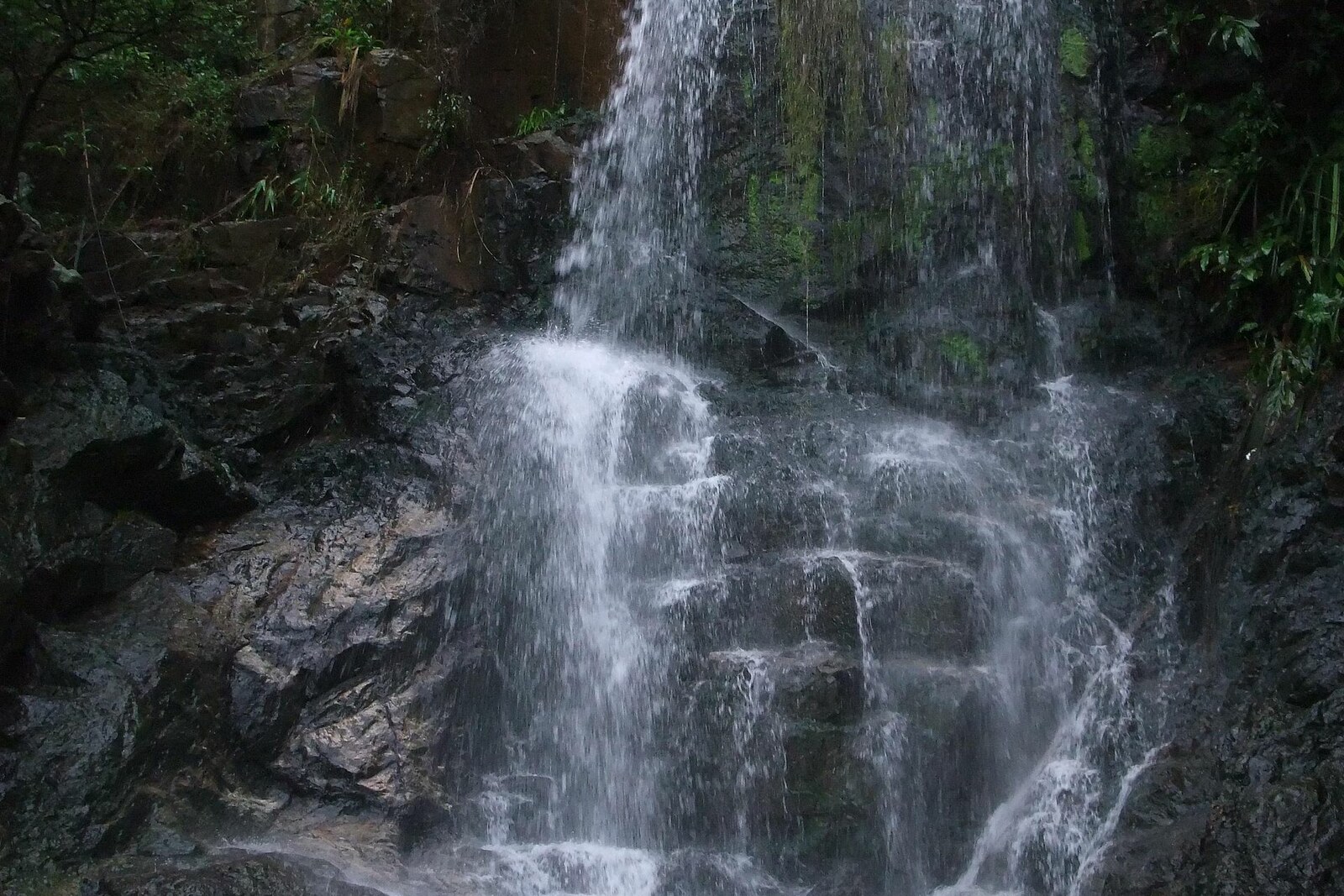
Look around first
What to notice
- Stone arch
- Stream
- Cascade on the rock
- Harlech Road surface
The story of the place
A stone arch beneath Harlech Road carries a stream through the road. The water gathers higher up, on the slope of what is now The Peak Garden, falls down the rock, and flows downhill toward the tributaries of Pok Fu Lam Reservoir. After rain, the cascade grows larger; in dry weather, only a narrow trickle may remain. Its flow depends on rainfall because this is the headwater of a catchment system, not an enclosed decorative pond.
In the middle of the nineteenth century, there was still no road across the stream. Victoria was growing rapidly on the island's northwestern shore—that was the name then given to the built-up area around what is now Central and the neighboring districts. Over twenty years, the population grew from about seven thousand to one hundred twenty thousand people. Water came from wells and mountain streams; residents of nearby villages diverted it to homes and fields through bamboo channels.
In eighteen fifty-nine, Governor Hercules Robinson, who needed to establish a reliable supply for the city, offered a reward of one thousand dollars for a feasible project. The winner was C. B. Rawling, a civil works overseer with the Royal Engineers. He was paid to inspect and supervise construction sites; the competition gave him a separate prize and a major contract of his own.
Rawling chose Pok Fu Lam Valley because of what can be seen at this very waterfall. Steep slopes collected rainwater from several streams at once, there was enough elevation for gravity-fed delivery, and a pipe could be laid to the densely populated shore. In his design, the reservoir held thirty million gallons. From it, a cast-iron main, thirty street standpipes, and one hundred twenty-five fire hydrants were to run to the city.
The entrepreneurs invited to invest in the system refused: construction was expensive, and future income remained uncertain. The administration then introduced an annual water rate of two percent of a property's value. Savings still had to be made. Instead of the thirty million gallons Rawling had planned, the first reservoir held only two million. Rawling himself was given the job of supervising construction, and at the end of eighteen sixty-three water began flowing to the city. But by then the city was using half a million gallons a day. The entire reserve lasted four days.
Just three years later, officials began an expansion, and in eighteen seventy-seven they brought a new reservoir, higher than the old one, into service. Its successor is the one still operating in the valley today. The first small dam was later dismantled. Its upper tributary has survived: the builders of Harlech Road carried the road over a stone arch, and the stream continues to descend beneath the roadbed to where Rawling's project directed it.
Useful on site
Harlech Road is always accessible; the fitness trail and waterfall are free to visit.
Checked: June 17, 2026. Check the official source before visiting.The stones and the edge of the streambed may be slippery even after the rain has ended. Do not enter the stream or stand across the fitness trail: people regularly walk and run here.