 Guide On Map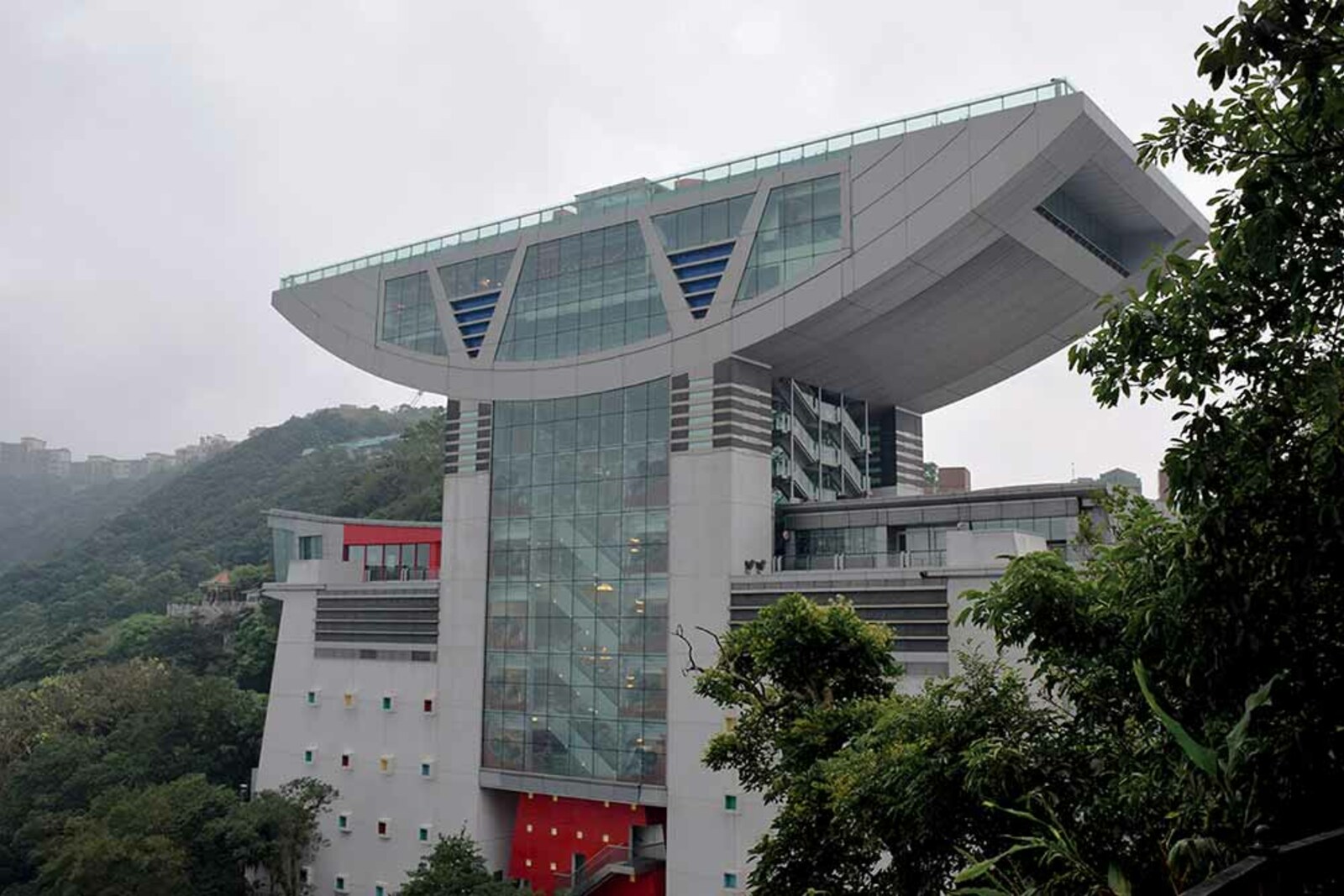
Look around first
What to notice
- Bowl atop Peak Tower
- Glass-enclosed supports
- Crisscrossing escalators
- Peak Tram tracks
The story of the place
A wide bowl on tall supports hangs over the mountain plaza, and its low middle leaves an opening between two slopes. The lower floors are given over to retail, while the upper section spreads out to the sides, so the silhouette can be made out even from the harbour. The current tower replaced the former one, and its image appeared on a twenty-dollar Hong Kong banknote.
Peak Tower stands about one hundred fifty meters below the summit of Victoria Peak. This is Victoria Gap, a saddle where Peak Tram has run since eighteen eighty-eight. Its upper station was built into the tower; Peak Galleria stands opposite. Viewing platforms, restaurants, and shops appeared specifically around the passenger flow.
In the early nineteen nineties, that flow became the subject of competition. The Kadoorie family hotel company owned Peak Tram and the former Peak Tower. By then, it had sold the site across the plaza to another developer, Henderson Land. Peak Galleria, a large shopping center intended to intercept visitors arriving on the mountain, was already being prepared there.
Michael Kadoorie, representing the family company, needed a building that would keep people from leaving straight across the plaza. In nineteen ninety-one, he held an architectural competition and required entrants to create Hong Kong's own Eiffel Tower: a silhouette recognizable from below, from the harbour.
For the British architect Terry Farrell, the competition was a chance to establish his firm in Asia. Eleven years earlier, he had already come to Hong Kong for a major commission and lost. This time, Farrell took a large photograph of the mountain ridge, painted over the old tower on it with correction fluid, and began trying out different outlines. An egg, a square, and a rectangle did not work. He chose a wide bowl: it could be recognized from afar, while the building's low middle fit into the dip between the slopes.
The project drew sharp criticism, but Kadoorie did not cancel it. The old tower was demolished, five hundred million Hong Kong dollars were spent on rebuilding, and the new Peak Tower opened in May nineteen ninety-seven. Its image later appeared on twenty-dollar banknotes, and the victory enabled Farrell to secure commissions for the British Consulate and the Kowloon Station complex, as well as to open a Hong Kong office.
However, the striking silhouette did a poor job of directing people inside. The bowl stood on tall supports, separate from the lower retail floors, and Peak Tram passengers could bypass a substantial part of the shops. In two thousand five, the owners enclosed the space between the supports in glass, cut a central passage, and installed crisscrossing escalators. The retail area grew by about one fifth, and the route from the station was taken through the building. Farrell later said outright that the original concept had been heavily reworked.
Today, the bowl at the top is the easiest part of Farrell's design to recognize. Beneath it are the glass-enclosed supports and escalators added to direct shoppers. Peak Galleria stands across the plaza; it had opened four years earlier. At the lower level of Peak Tower, the tracks of Peak Tram end, and the exit from the platform still leads into the shopping center.
Useful on site
Peak Tower is open 10:00–23:00 (weekdays) and 08:00–23:00 (weekends); Sky Terrace 428 is open 10:00–23:00 (weekdays) and 08:00–23:00 (weekends); Peak Galleria is open daily 10:00–22:00.
Checked: June 17, 2026. Check the official source before visiting.First get your bearings between the two complexes and look at them from outside: it is easy to lose track of the exit direction inside. Do not linger in the flow of passengers by the station.