 Guide On Map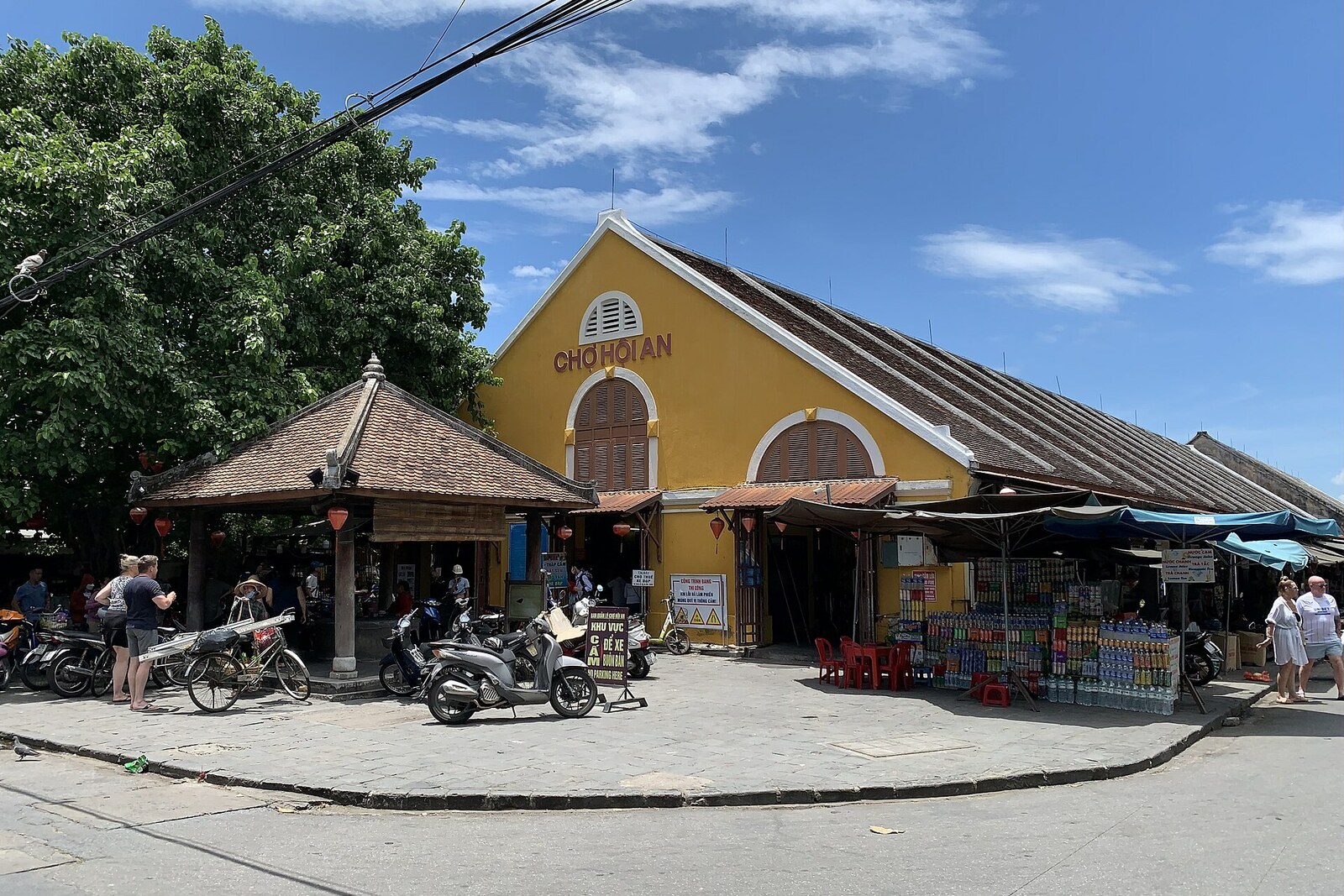
Look around first
What to notice
- The market's brick building
- The covered well
- Brick pillars
- The hand-operated windlass
The story of the place
In port-town Hoi An, major merchants traded from shop-houses and kept goods in warehouses. Other sellers came to the market: residents of surrounding villages, often with little capital, bringing fish, rice, vegetables, and handicrafts by river and overland routes. That is why the disappearance of seagoing junks did not destroy trade here. Today the market still serves Hoi An itself and neighboring districts: food stalls, prepared food, fabrics, and household goods occupy several buildings and the space around them.
A market appeared on this site only in the mid-nineteenth century. Before that, it assembled by Ong Voi Communal House and stretched along what is now Le Loi Street toward the river. Nguyen Thai Hoc Street did not yet exist. After it was laid out, a new intersection by the shore, opposite Quan Cong Temple, was chosen for trade. But the site was not vacant.
Beside a covered well stood the grave of Luong Hue Hong. He was a monk from China's Anhui Province, the fourth abbot of Quang An Pagoda and a benefactor of the Minh Huong community. He worked to help the settlers' community take root in Hoi An and gave the community a large tract of land. After Quang An Pagoda was destroyed, his memorial tablet was moved to Minh Huong Buddhist Temple behind Quan Cong Temple, while the abbot himself was buried nearby, by the well. At Minh Huong Ancestral Hall, he was honored among the people who helped found and establish the community.
In eighteen forty-eight, the site was set aside for a new market. The Minh Huong community had to clear the land while preserving the burial of the man to whom they owed that land. The grave was moved to Chuc Thanh Pagoda, and a tomb tower was built there. Its inscription recorded that the entire Minh Huong community had jointly erected the monument. After the relocation, the market opened here, while the monk's burial remained at Chuc Thanh Pagoda.
The present brick building is newer: it was erected in the early twentieth century and then expanded repeatedly. The grave by the market is gone. But the well has survived; according to local tradition, it existed even before the market stalls. When the market was laid out, a four-sided tiled roof on brick pillars and a hand-operated windlass were installed above it; sellers and residents of neighboring streets used the water. By the entrance remains the well beside which once lay the man whose grave the community moved for the sake of this market.
Useful on site
A working market with no separate tourist entrance; the route does not depend on ticket hours.
Checked: date not specified. Check the official source before visiting.Do not stand in passageways or unloading areas, and watch out for baskets and carts. Photograph people with their consent; buying food remains an optional part of the stop.