 Guide On Map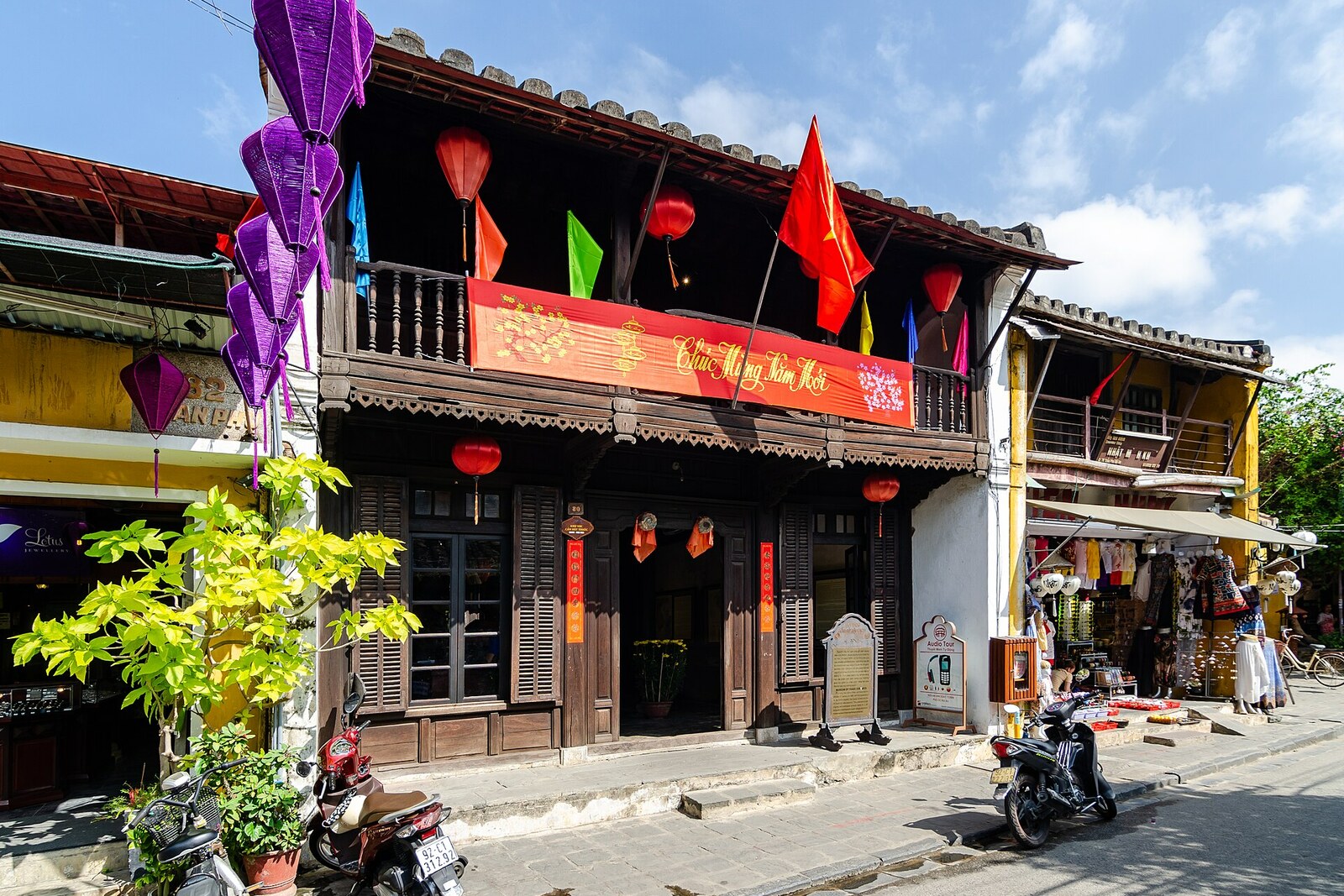
Look around first
What to notice
- Wooden framework of the house
- Courtyard
- Display cases with ceramics
- Hizen pieces
The story of the place
The museum's name is tied to the journey of its objects: ships carried them by sea in commercial consignments. The exhibition brings together ceramics from Vietnam, China, Thailand, and the Japanese region of Hizen, while the wooden framework of the old house survives above the display cases. This house once combined commercial and domestic spaces; its courtyard links the street-facing rooms to the rear part of the building.
In the early nineteen nineties, house number eighty on Tran Phu Street was barely fit for a museum. Damp and termites had damaged the wooden posts, and the joints between the beams had become loose. Trade and domestic life had once taken place here: the front rooms faced the street, with a courtyard and the rear part of the house stretching behind them. From nineteen fifteen to nineteen ninety-two, the building belonged to the family of Thai Thuan Thang.
Professor Hiromichi Tomoda, head of a program at Showa University, arrived with Japanese specialists to teach local craftspeople how to preserve Hoi An's wooden houses. Funding had to be gathered piece by piece: first from private companies, then from charitable foundations; later, the Japan International Cooperation Agency joined in. House number eighty was chosen as the first pilot project.
Hoi An's mayor, who sought to transfer the new method to local builders, banned all other restoration work for two years, except for the work of this team. The architects dismantled the structure together with Hoi An carpenters and tried to leave old wood in place wherever it could still bear a load. If termites had hollowed out the core of a beam, the damaged section was removed and new timber inserted, while the carved outer sides were preserved. Along with the house, they restored the skill of working with such buildings: after the foreigners left, the craftspeople were to continue the work themselves.
At the same time, Japanese and Vietnamese archaeologists excavated courtyards and sites in the old town. In nineteen ninety-three, they opened twelve exploratory trenches. They brought up bowls, plates, and sherds from Vietnam, China, Thailand, and the Japanese region of Hizen. These were remnants of goods used as payment, ordered for local homes, and transferred onto ships. The finds made it possible to reconstruct trade routes even where neither merchants' ledgers nor warehouses remained.
The restored house was adapted for these finds. On October second, nineteen ninety-five, the Museum of Trading Ceramics opened here; Japanese researchers also took part in arranging the first exhibition. The word “trading” in its name refers to the former history of these objects: they were carried by sea as cargo. The display brought together ceramics from urban excavations and vessels raised from a sunken ship near the Cu Lao Cham Islands.
Today, Hizen pieces found in Hoi An itself remain among the exhibits. Above them stands the wooden framework of the first house, on which Japanese architects and local carpenters worked out a method for preserving old beams: archaeologists brought traces of trade out of the ground, and the craftspeople prepared a former merchant house for them.
Useful on site
Museums are included in the 120 000 dong ticket; check the actual hours at the ticket office.
Checked: date not specified. Check the official source before visiting.Read the labels beside the objects: their origin and date matter more than their outward condition. Move carefully through the old house, and do not place belongings on the display cases.