 Guide On Map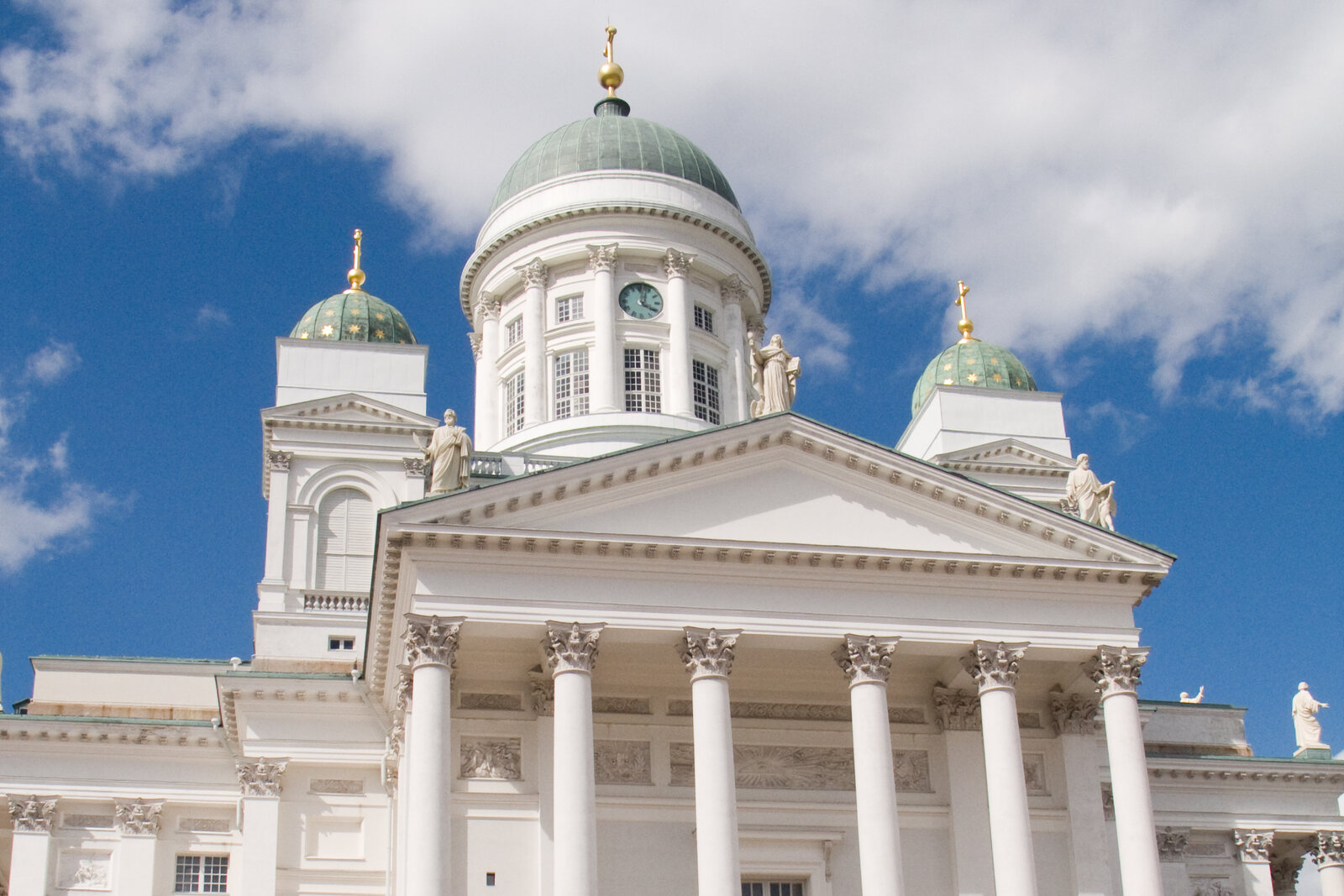
Look around first
What to notice
- The broad staircase
- The main façade
- Neff's altarpiece
The story of the place
The church received its current status with the establishment of the Diocese of Helsinki: it is now a cathedral, the church of its bishop. It was built for the Swedish-Finnish Lutheran community at a time when Finland was part of the Russian Empire. The main façade faces Senate Square, and inside, The Entombment of Christ, sent from St Petersburg as an imperial gift, remains above the altar.
Where the broad staircase descends to Senate Square, the city guardhouse stood until the eighteen forties. Nicholas I, Emperor of Russia and at the same time Grand Duke of Finland, ordered it removed. In place of the guard building, a staircase about sixty meters wide appeared. The church gained an open route to the square—the very one used by university processions, state funerals, and participants in ceremonial services.
Construction began under Nicholas in eighteen thirty. Finland was part of the Russian Empire, but the church was intended for Helsinki's Lutheran Swedish-Finnish community. At its consecration, it was named St Nicholas' Church, now Helsinki Cathedral, in honor of two Nicholases at once. The first was the emperor himself, who had begun the construction. The second was his heavenly patron, Saint Nicholas, Bishop of Myra in Asia Minor, whom Christians venerate, among other things, as a protector of seafarers. The connection between the name and a port city was fitting here, but the saint was chosen above all as the monarch's namesake patron.
Nicholas left his decision inside the church as well. The Finnish artist Robert Wilhelm Ekman was commissioned to paint Jesus Blessing the Children for the new altar. Ekman worked on it from eighteen forty-six to eighteen forty-eight, expecting to see it in the capital's main church. But the emperor's representative ordered the canvas given to another church. It ended up in Helsinki's Old Church, where it remains today.
For the vacant place, Nicholas I sent his own gift—The Entombment of Christ, painted by Timofey Neff, a court artist from St Petersburg. Ekman received the altar of the temporary wooden church, while Neff received the main altar of Helsinki Cathedral, formerly St Nicholas' Church. If the church is open, it is still the emperor's gift that hangs above the altar: people bow for communion before a painting chosen for them not by Helsinki's parish.
After Finland gained independence, Nicholas's name ceased to be used, and the church came to be called the Great Church. In nineteen fifty-nine, the Diocese of Helsinki was established; the church became the church of its bishop and received its present name—Helsinki Cathedral, formerly St Nicholas' Church. Saint Nicholas is no longer in the official name. What remains of the former dedication is the sixty-meter staircase and Neff's painting above the altar.
Useful on site
For viewing the roof, it is more convenient to stay below; move carefully on the steps. The interior can be added only if entry is available; without it, the story is not lost.