 Guide On Map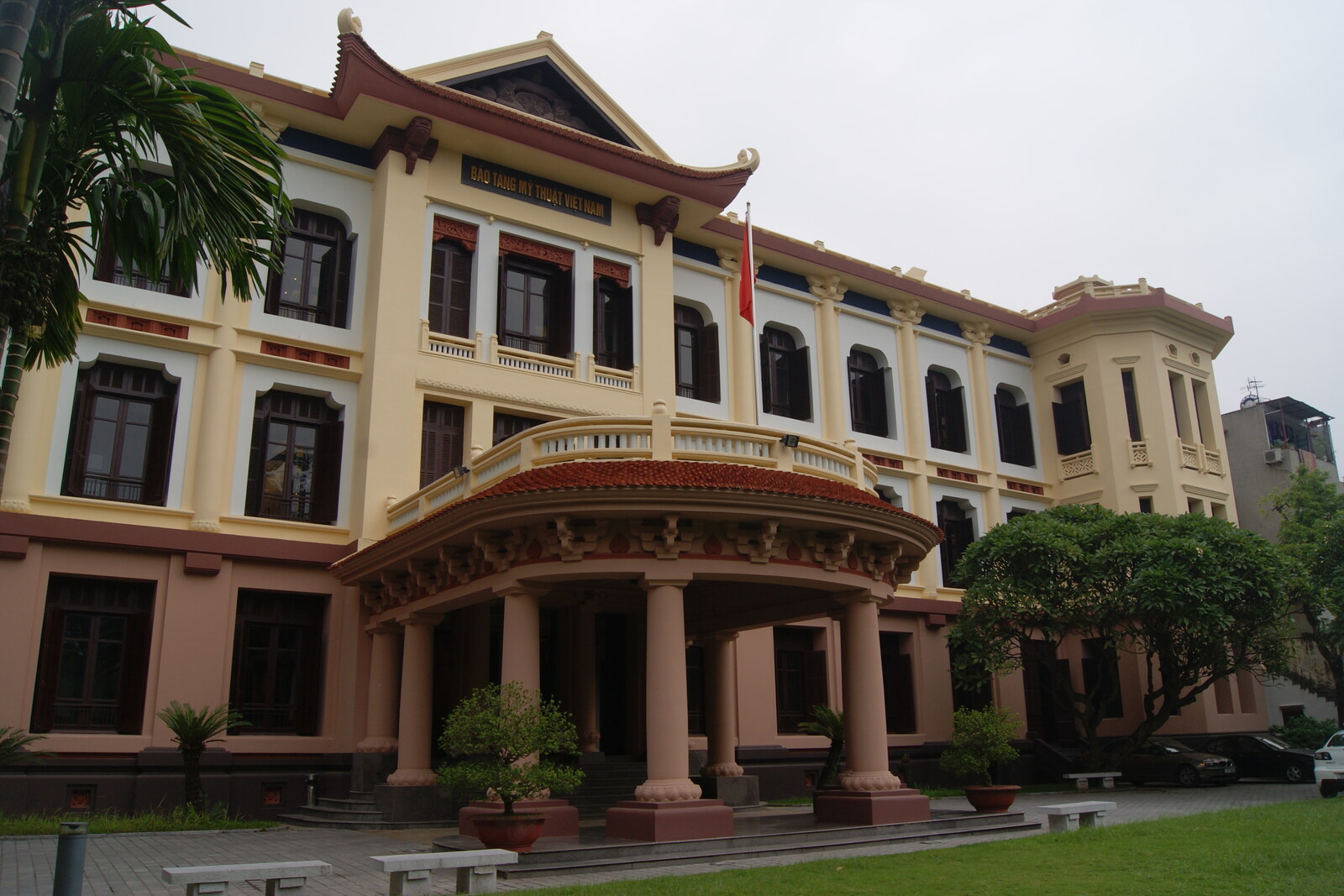
Look around first
What to notice
- Wooden figure of Guanyin
- Forty-two hands
- Lotus throne
- Polygonal base
The story of the place
The present museum occupies a building that once served as a dormitory for the daughters of French officials. It was adapted as a repository for Vietnamese art, and the collection was expanded through trips to villages where old statues still remained in temples and pagodas. Among the halls stands a wooden Guanyin covered in red lacquer and gilding, dating from the turn of the sixteenth and seventeenth centuries: the figure is raised on a lotus throne and a polygonal base.
The main staircase is only one meter twenty centimeters wide. In nineteen sixty-five, this staircase posed an unusual problem for the architect: how could a wooden statue more than three meters tall be brought upstairs if its separate parts weighed almost a ton each, while the floor of the hall still had to support the assembled figure?
The museum was only being established then. A former colonial dormitory for the daughters of French officials was being converted into a repository for Vietnamese art. The artist and researcher Nguyen Do Cung was responsible for the future collection. He recruited young historians and sent them to look for old sculpture in villages: two weeks on the road, two weeks writing reports, then back on the road.
One of them was twenty-five-year-old Nguyen Do Bao. In the summer of nineteen sixty-five, he was cycling through Vinh Phuc Province and stopped to ask for water near an agricultural cooperative. Beside it stood the abandoned Hoi Ha Pagoda. Its roof had been leaking for a long time, there was no monk, and the peasants were planning to dismantle the building and enlarge the rice-threshing area.
When one of the peasants learned what the visitor was doing, he offered to let him take a large statue from the pagoda. The people did not dare burn it, but they could find no other use for it. Inside, Bao saw Guanyin covered in red lacquer and gilding—a Buddhist intercessor depicted in Vietnam as a woman. Some of the hands had fallen off; they, together with a small figure of an attendant, had been placed around the lotus throne. Bao took several photographs on black-and-white film and carried them to Hanoi.
Specialists determined that sculptors had created the statue at the turn of the sixteenth and seventeenth centuries. It has forty-two hands: two are folded at the chest, two rest on the knees, and the others spread out from the shoulders. Nguyen Do Cung came himself to negotiate with the residents and local leaders. They agreed to give the sacred object to the museum if it could truly be saved.
The task of dismantling the figure was entrusted to the woodworker Cai Tuong. He divided it into three heavy parts: the body with the hands, the lotus throne, and the polygonal base. In Hanoi, restorers put the fallen-off parts back in place, and the architect calculated the load on the floors and the route up the narrow staircase.
On June twenty-fourth, nineteen sixty-six, the museum opened, and the Guanyin from Hoi Ha became one of its main exhibits. Soon the staff began evacuating the collection from Hanoi because of the bombings. The statue was successively hidden in a communal house in Phuc Yen, transported to Son Tay, and in nineteen seventy-nine sent farther still—to Da Lat. After its last return, it was never taken away again.
The old pagoda from which Nguyen Do Bao carried out the photographic film no longer exists. Later, museum staff gave money for a new building and commissioned a copy of Guanyin for the residents. In Hoi Ha, they now worship the copy. The original stands here, on a floor that had to be calculated especially for it.
Useful on site
Officially: Tue-Sun 08:30-17:00, Monday closed; adult ticket 40 000 dong.
Opening hours by day
Plan your museum visit separately from Van Mieu. If you do not go inside, from outside you can read only the history of the building, not the story of the collection.