 Guide On Map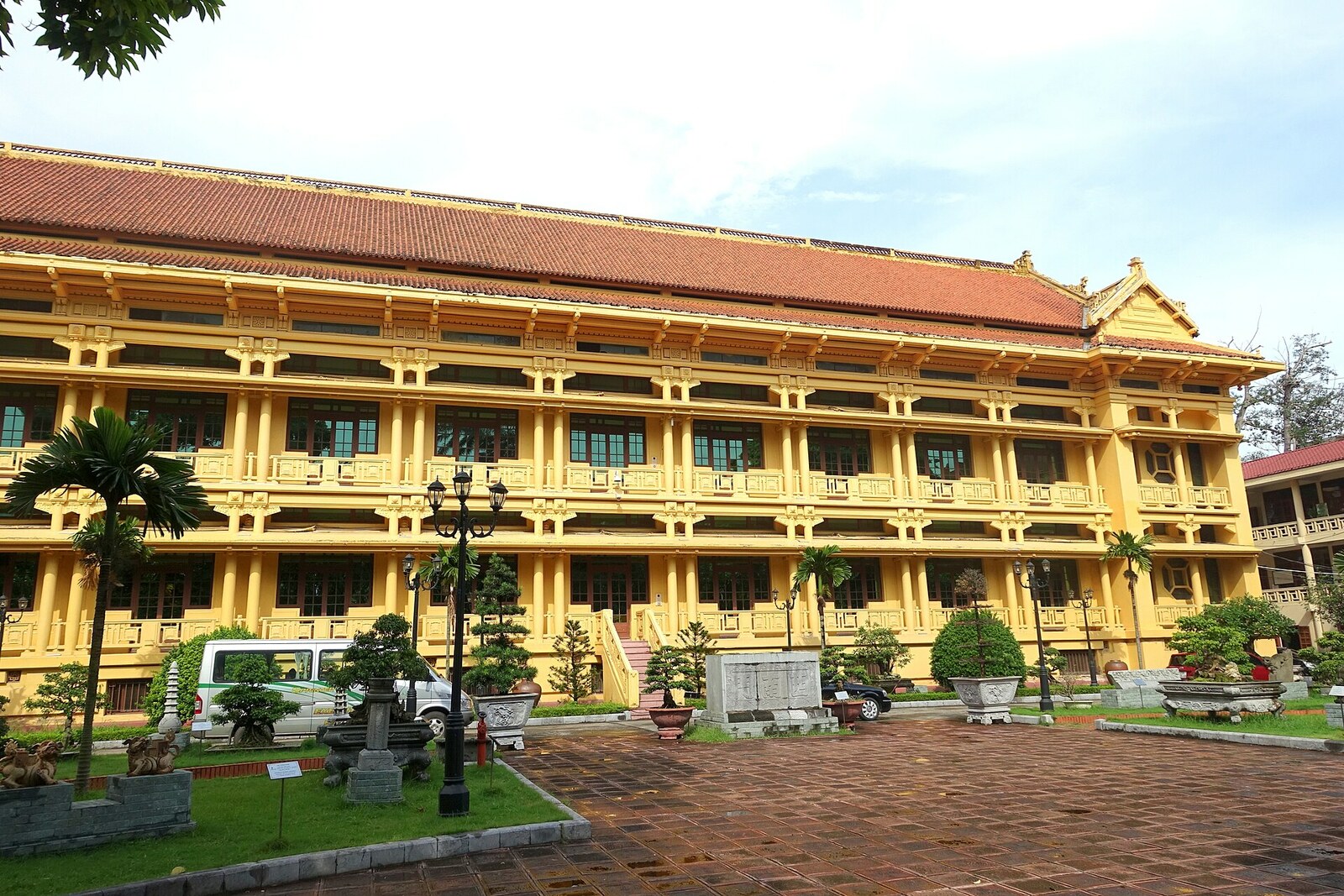
Look around first
What to notice
- High three-tiered roof
- Archaeological display cases
- Ngoc Lu Drum
The story of the place
The museum received its current name after its merger with the Revolution Museum. In the building on Trang Tien Street, beneath the high three-tiered roof, the exhibition leads from prehistoric finds to the fall of the Nguyen dynasty. When the building was transferred to Vietnamese specialists, they received about ninety thousand objects, including items from other Asian countries and finds whose provenance had been lost.
Under the high three-tiered roof, the arts of countries from India to Japan were initially housed. The building was called the Louis Finot Museum, after the first director of the French School of the Far East. Finot studied ancient inscriptions and advocated for separate premises for the collections that the school’s researchers brought to Hanoi. After typhoons, some items had to be packed away in crates, while the most valuable, including the Ngoc Lu Drum, were temporarily moved to the library. The new museum opened in nineteen thirty-two. Storage rooms and restoration workshops were set up beneath the galleries, while display cases upstairs held Vietnamese, Khmer, Lao, Chinese, and Japanese antiquities.
Nguyen Van Huyen, an ethnographer and historian of culture, worked among the school’s staff. He studied in France, becoming the first Vietnamese person to defend a doctoral dissertation there in the humanities, and after returning earned his living through teaching and research. Colonial service could have offered him a civil-service career, but he chose the university classroom and the archive. In nineteen thirty-nine, Huyen became the school’s first Vietnamese research fellow, where senior positions had previously been held by French people.
After the August Revolution, Huyen headed the Directorate of Universities and the French School of the Far East itself. He inherited a museum created by European Orientalists and arranged as a collection of Asian arts. The task now was to assemble from the same holdings an account of Vietnam’s past for a Vietnamese public.
On February ninth, nineteen forty-six, Huyen and the institute’s staff opened here an exhibition of documents and objects on the history of Vietnamese culture. Many visitors saw for the first time objects they had previously known only from stories and books. Ho Chi Minh attended the opening. At the same time, the museum was given the Vietnamese name “National Museum Institute.”
Huyen did not have time to continue what he had begun. In November, he was appointed minister of education, and war began in December. His family had left Hanoi in advance; the scholar himself left the city together with government institutions and spent the following years organizing schools and universities in evacuation. The museum’s property was sealed. The full transfer of the building and collections to Vietnamese specialists took place only in nineteen fifty-eight.
They received about ninety thousand objects. A significant part belonged to other Asian countries, some items had become mixed together, and information about their provenance had been lost. In just under five months, museum staff, scholars, and volunteer helpers assembled a new exhibition. Display cases that had previously placed the arts of different countries side by side were devoted to the archaeology of Vietnam and the history of its dynasties. On September third, the museum reopened its doors as the Museum of Vietnamese History.
In two thousand eleven, it was merged with the Revolution Museum and given its current name—the Vietnam National Museum of History. In this building on Trang Tien Street, the exhibition still begins with prehistoric finds and ends with the fall of the Nguyen dynasty in nineteen forty-five. Its first version was assembled here by Nguyen Van Huyen back when the Louis Finot Museum had received its Vietnamese name for only a few months.
Useful on site
Open urban space; choose a viewing point that does not obstruct pedestrian flow.
Checked: date not specified. Check the official source before visiting.Do not touch the offerings at the altar. A separate visit to the exhibition is required to see the Ngoc Lu Drum and the gold seal.