 Guide On Map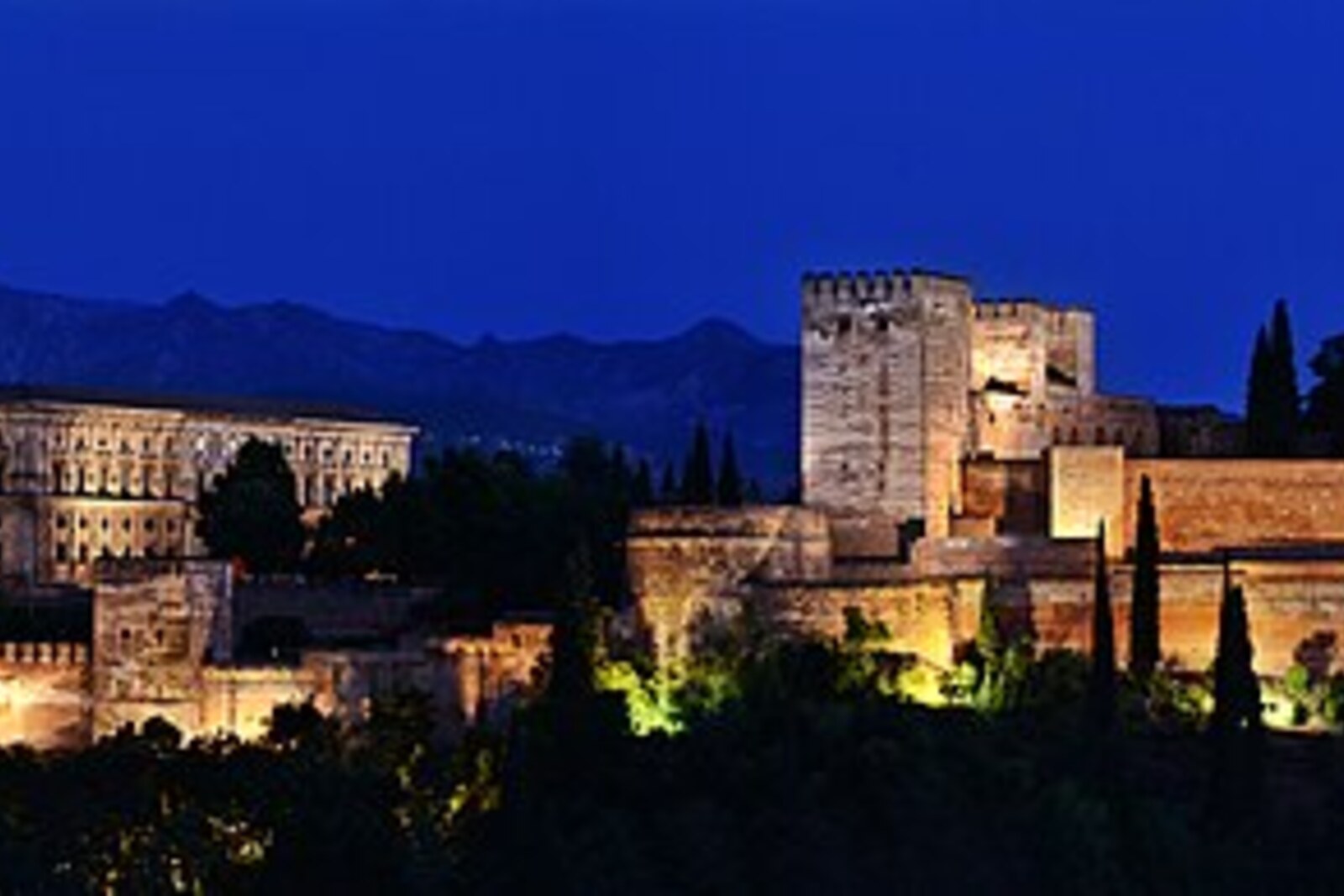
Look around first
What to notice
- Stone parapet
- Gray-stone benches
- Whitewashed church
- Restored cross
The story of the place
The stone parapet with benches curves around the church square of San Nicolás; the church's walls gleam white beside it, and its tower is visible above the Albaicín. The parish was dedicated to Saint Nicholas of Myra, whose relics were moved to Bari in the eleventh century, and it was established only after the forced conversion of Granada's Muslims to Christianity. The church was completed in the early sixteenth century; archaeologists found no mosque on its site, but they did find fragments of Muslim gravestones in its masonry.
People gather at the stone parapet for the Alhambra, yet the viewing point itself was created for that purpose only relatively recently. Until the nineteen forties, this was a church square with an open view. Its conversion into an urban viewing point was ordered by the mayor and professor of art history Antonio Gallego Burín. During his tenure, the paving was relaid, benches of gray Sierra Elvira stone were installed, the old cistern and retaining walls were repaired, and the cross was restored. The whitewashed church became part of the prepared panorama: from here people looked at the Alhambra, and from the Alhambra at its tower above the Albaicín.
The church gave the viewing point its name. San Nicolás is Saint Nicholas of Myra, bishop of Myra; he is called Nicholas of Bari because his relics were moved to the Italian city of Bari in the eleventh century. Documents do not explain why Cardinal Pedro González de Mendoza chose this particular saint for the parish here. The cardinal established the parish itself in fifteen oh one, after the forced conversion of Granada's Muslims to Christianity, and the master Rodrigo Hernández completed the building in fifteen twenty-five. It is often repeated that it took the place of a mosque, but excavations have not confirmed this. Archaeologists found something else: parts of Muslim gravestones are incorporated into the church's masonry.
On August tenth, nineteen thirty-two, participants in disturbances set fire to the church and smashed the cross in the square. The wooden roof, altars, and church images were destroyed. Architect Francisco Prieto-Moreno proposed restoration almost immediately, raised money together with composer Manuel de Falla, and Manuel Medina, a representative of the construction workers, offered one day of free labor on their behalf. The funds were still insufficient. The main nave was roofed only in nineteen forty-seven, and the other parts another decade later. The church remained closed for a long time, but the city council already had its completed viewing point.
Its present fame began with the request of another mayor. Gabriel Díaz Berbel wanted to draw foreign visitors to the poor province. As he later recounted, Hillary Clinton's mother spent a week in Granada and thanked him for the opportunity to see the city without publicity. In return, the mayor asked her to persuade her son-in-law, United States President Bill Clinton, to stop here after the NATO meeting in Madrid.
Clinton did not need separate publicity. As a student, he had already been to Granada and remembered the evening view of the Alhambra; now he wanted to show it to his wife and daughter. On July ninth, nineteen ninety-seven, the Clinton family went up to San Nicolás. The president said that the light and colors remained as he remembered them, and only he himself had changed—he had grown older.
The memory was then turned into a phrase about “the most beautiful sunset in the world.” The exact wording remains disputed. There is a more substantial confusion as well: municipal historians link Clinton's student memory to the neighboring Mirador de San Cristóbal. From here, from San Nicolás, the sun does not set behind the Alhambra at all: the parapet faces south, and west is to the right.
Díaz Berbel chose the more recognizable San Nicolás. He obtained Clinton's consent to use the praise and made it the centerpiece of a tourist campaign aimed at one hundred fifty cities around the world. A commemorative plaque was installed at the viewing point, claiming that the president had said the famous words precisely here. Neighborhood associations damaged it again and again until the plaque was removed. It is no longer on the parapet; what remains are the crowds who come to recreate the sunset attributed to Clinton.
Useful on site
Open public viewing point; the church opens according to the parish schedule. The square is heavily crowded at sunset.
Checked: June 29, 2026. Check the official source before visiting.The viewing point can be crowded by evening, so it is better to come earlier for an unhurried visit. Do not block the view for long, and do not assume that the church's open entrance is guaranteed.