 Guide On Map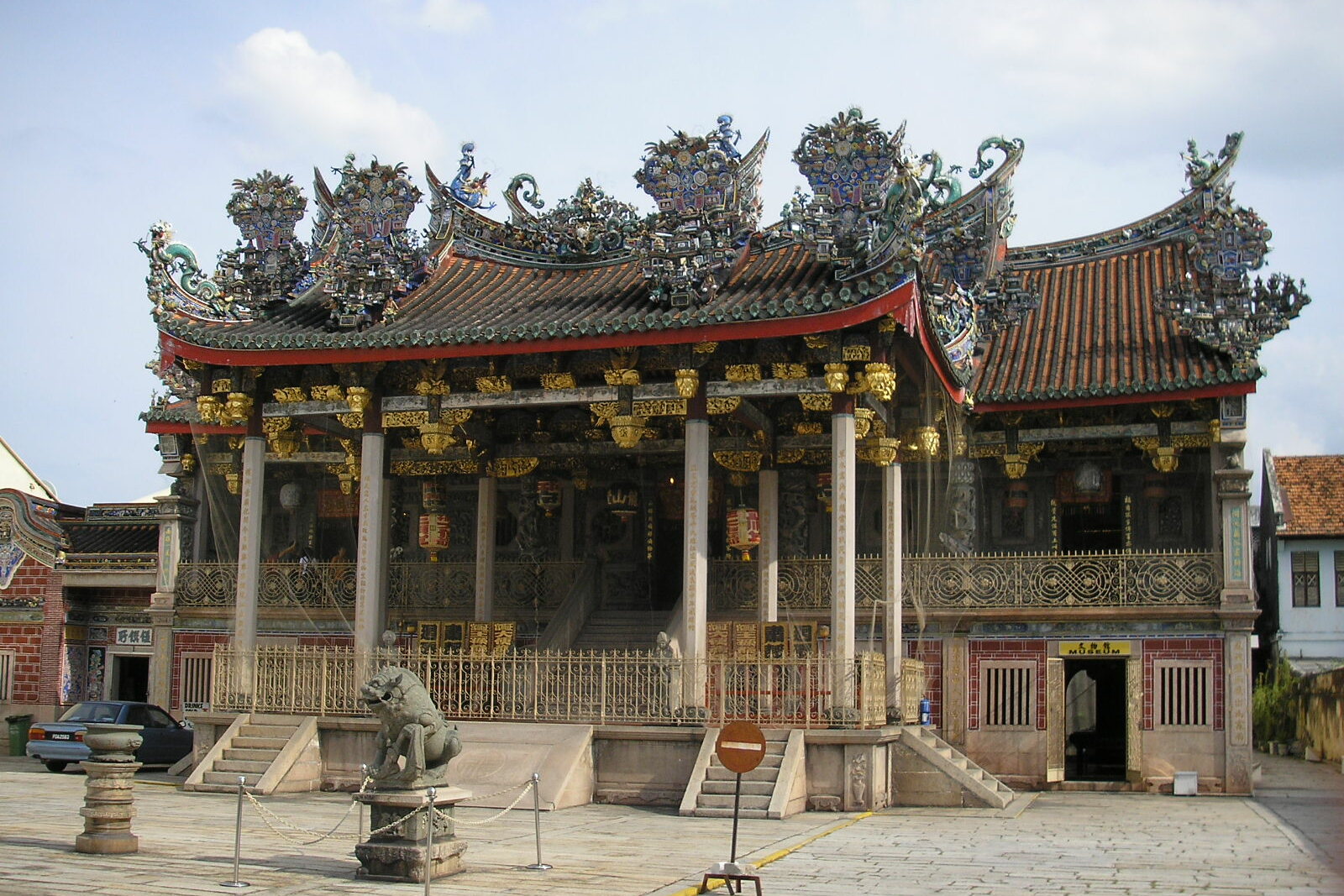
Look around first
What to notice
- The granite courtyard of Cannon Square
- The facade of Leong San Tong Khoo Kongsi
- The theater stage opposite the temple
- Two bamboo plaques in the shrine
The story of the place
The granite courtyard between the ancestral temple and the theater stage is called Cannon Square—the square of the cannon. There is no cannon here, and old accounts disagree even over who owned it. Yet the name of one participant has survived on the facade facing the square.
Khoo Thean Teik was one of the first directors of Leong San Tong Khoo Kongsi. He managed clan affairs, made money recruiting arriving workers, and took part in opium revenue farms—paid rights to income from the opium trade. At the same time, he headed Kian Teik Tong, a secret society that brought together mainly Hokkien merchants and the people dependent on them. His position and income rested on the same network of acquaintances, debts, and mutual obligations that the society could turn into an armed detachment.
In August eighteen sixty-seven, Kian Teik Tong and its allies fought for ten days in George Town against a hostile alliance. These were the clashes that the council of the Goddess of Mercy Temple could not handle. This was the boundary of the territory of Khoo Thean Teik's people: a narrow alley between shophouses and clan houses could easily be blocked off.
According to one local version, colonial forces fired a cannon here and blasted such a hole in the street that residents called the place the Big Cannon Hole. When the hole was filled in, the Cannon name remained. According to another version, the people of Kian Teik Tong themselves placed the gun in the alley. An investigation contemporary with the events confirms that the society had firearms and artillery, but does not establish whose shot exactly gave the square its name. Cannon Square was already listed under that name in documents from the same year, eighteen sixty-seven.
For Khoo Thean Teik, the story ended in prison. The following year, he was arrested as one of the organizers of the clashes and sentenced to death. The sentence was commuted to life imprisonment; seven years later, he was released. Neither the cannon nor the hole it blasted remains here. Nor was the present carved temple here then: on its site stood a remodeled British bungalow that served as the first Khoo clan house.
Khoo, in the name, means people of a single line of descent. The kongsi did not admit every bearer of that surname, but only descendants of settlers from the village of Sin Kang in Fujian. In eighteen thirty-five, one hundred two such settlers decided to create an association to help relatives and honor ancestors. They raised five hundred twenty-eight dollars and put the money into circulation for more than ten years. What they accumulated was enough to buy a plot with a bungalow and, in eighteen fifty-one, establish here a hall for meetings, weddings, and clan rites. Later, an office, the homes and shops of clan members, and, opposite, a performance stage appeared nearby. This explains the courtyard's layout: a temple with ancestral tablets, a room for deciding common affairs, housing, and a theater gathered within one enclosure.
By the end of the century, the old bungalow had fallen into disrepair, while the clan had grown wealthy. In eighteen ninety-four, the trustees demolished it and invited craftsmen from southern Fujian to build a large ancestral temple. The work took eight years and cost more than one hundred thousand dollars. On the eve of Chinese New Year in nineteen oh one, a fire destroyed the nearly completed building. The cause remained unknown. Later, a legend arose that lightning struck the temple because the gods had punished the Khoo for the resemblance of their building to the imperial palace.
The trustees began again from scratch. Another four years of work and another more than one hundred thousand dollars went into the temple completed in nineteen oh six. This is today's Leong San Tong Khoo Kongsi—the “Dragon Mountain Hall,” named for the land from which the clan traced its ancestors. Bamboo paired inscriptions from eighteen fifty-one survived from the first building; they are now kept in the Hok Thye Sue shrine within the complex. The cannon and old bungalow have long been gone, and the burned clan property is represented here by these two bamboo plaques.
Useful on site
Officially, the clan house and museum are open daily from 9:00 to 17:00, including Sundays and public holidays; closures for Chinese New Year and clan events should be checked separately.
Checked: July 1, 2026. Check the official source before visiting.The carving details are best viewed without rushing; access to the temple rooms depends on the complex's hours and community events.