 Guide On Map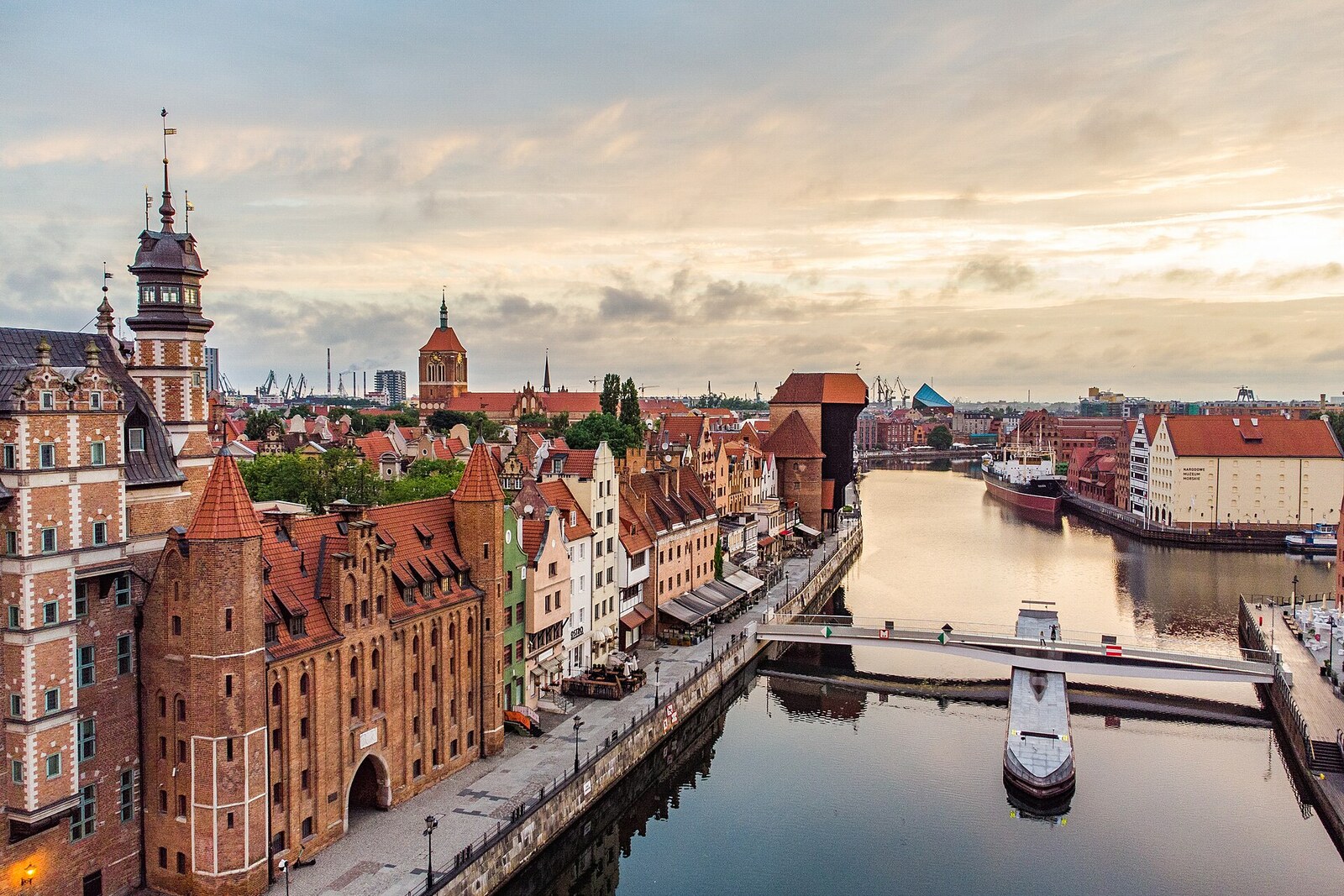
Look around first
What to notice
- Two brick towers
- Wooden hoist
- Loopholes
The story of the place
The name “Crane” is the English rendering of the Polish word for a lifting crane. Two brick towers with loopholes grip a wooden center over the Motława; inside stand enormous wheels in which workers walked, turning an axle with a cable. This was how heavy cargo was lifted from ships’ holds, while the upper mechanism set ships’ masts. From the quay, goods went directly into the merchant streets, and at night the gates blocked the passage from the waterfront.
On March first, fourteen forty-two, Heinrich Vorrath, Gdańsk’s new first burgomaster, received money from the city treasury with a precise purpose: to build a crane at the water gate. The first burgomaster was the title for the head of the city council for the current year. Vorrath sought to replace the old wooden hoist with a stone structure containing protected machinery.
The harbor concerned him personally. Vorrath earned his living through maritime trade; his name survives on a list of merchants who lost goods in attacks on Hanseatic ships. Here, where Broad Street reaches the Motława, cargo went directly from the ship into the merchant city. The crane lifted barrels and bales, while the gates closed off the street at night.
In July, the old hoist burned down together with neighboring houses. The council decided to build faster, but Vorrath’s plan sparked a dispute with the Teutonic Order. At the time, Gdańsk was part of the Order’s state, and the castle of its garrison stood several hundred meters from here. Grand Master Konrad von Erlichshausen wanted the Order to retain oversight of the city’s fortifications. To him, two massive towers near the castle looked like part of the defenses, although a harbor machine was to be installed between them.
In November, representatives of Gdańsk and the Order met in Malbork. Both sides accused each other of taking up arms. Gdańsk’s councilors maintained that they were restoring the burned crane and the waterfront. The Order demanded that the work be limited to a harbor device, without a new fortification.
The dispute did not end there. On April third, fourteen forty-three, Vorrath died without seeing the structure. His successors imposed a special levy on the townspeople twice and continued the work. Only in June, fourteen forty-four, did the grand master agree to gates with a crane. The Order’s specialists set the construction conditions and prohibited any further thickening of the walls. By the end of the year, workers had completed two brick towers, with cannon positions below and loopholes for hand weapons above. They placed a wooden hoist between them.
The Polish word for “Crane” means both a bird crane and a lifting crane. Here, the name refers primarily to the machine. Inside the wooden center stood enormous wheels, around six meters in diameter. Workers walked along their inner rims, turning a common axle, and the cable wound around the shaft. Four men could lift loads weighing up to two tons. The lower mechanism retrieved goods from ships’ holds, while the upper one raised ships’ masts.
A crane master supervised the work. Through a narrow vertical slit between the towers, the crane master could see the people in the wheels, give them orders, collect payment from ships, and pay the workers their wages. Later, city regulations reserved the quay in front of the Crane specifically for wine. The captain first told officials which varieties he had brought, presented a receipt showing payment of the levy, and only then did the crane master permit unloading. Wine clerks recorded who received each consignment and to which cellar it was taken.
The wooden section and the mechanism burned down completely in nineteen forty-five; most of the brick walls were damaged as well. What now stands between the towers was reconstructed for the National Maritime Museum in Gdańsk. The reconstructors preserved the arrangement that emerged from the agreement of fourteen forty-four: a wooden hoist projects over the water, and the gate towers still grip it from both sides—the towers because of which the Teutonic Order delayed construction for almost two years.
Useful on site
Until September 6, 2026: Monday–Tuesday 10:00–18:00, Wednesday 13:00–18:00, Thursday–Sunday 10:00–18:00.
Checked: date not specified. Check the official source before visiting.The entire exterior structure is visible from the waterfront. The treadwheels are inside and can be accessed only as part of a separate museum visit.