 Guide On Map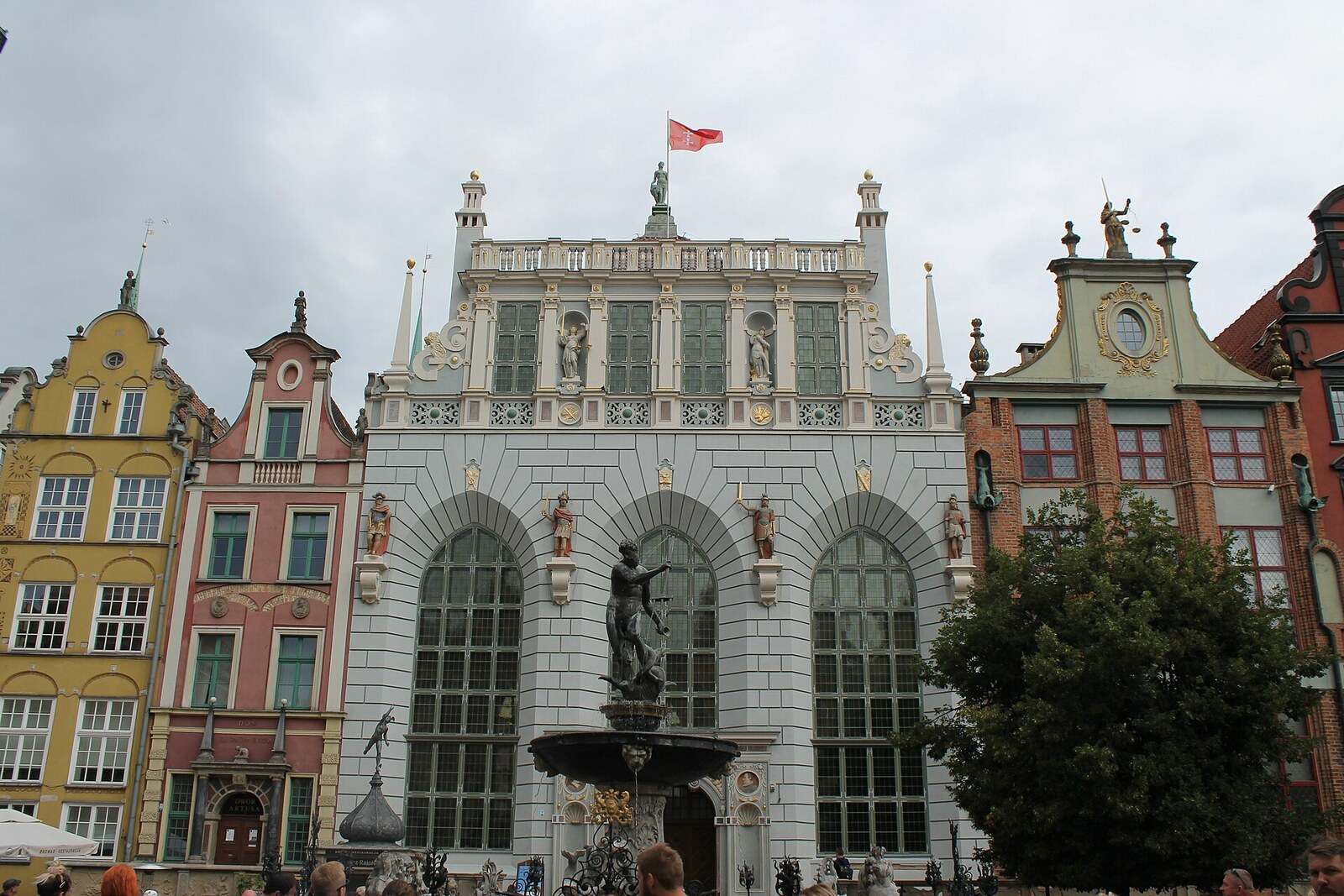
Look around first
What to notice
- The metal figure of Neptune
- The façade of Artus Court
- The houses opposite Artus Court
The story of the place
On December second, fourteen eighty-one, the first beer was served in the newly rebuilt Artus Court. After several years of fire, deaths, and construction, the townspeople regained their hall, but its former owners returned to it as guests.
The first court was built by the Brotherhood of St. George, an association of knights from wealthy families. They required noble birth from both their members and their guests. Here, Artus meant the legendary King Arthur: his Knights of the Round Table served as a model for similar brotherhoods in Baltic cities.
In fourteen seventy-seven, the building burned down. The city council decided to rebuild it at the city's expense and at the same time changed the circle of owners. The Brotherhood of St. George lost its ownership rights, retaining only the honorary first place at celebrations. Merchants and shipowners, organized into so-called benches—literally according to the places they occupied in the hall—took seats beside them.
These associations show what their members lived on. The Lübeck Bench brought together Gdańsk residents who traded with Lübeck; the Dutch Bench, merchants whose deals linked the city with the Netherlands. Here they exchanged information on which contracts and cargoes depended, announced city council decisions, and held feasts. Later, open court hearings were held in the hall, and then a grain exchange moved in. The knights' club became a merchants' house as a result of the decision of those who paid for its reconstruction.
The fountain in front of the façade emerged from the same milieu. At the beginning of the seventeenth century, Burgomaster Bartholomäus Schachmann, a member of a city patrician family, sought a fountain for the Main Market modeled on antique examples he had seen in Italy. Neptune, the Roman god of the sea, was chosen for Gdańsk: the trade connections of the people who gathered at Artus Court passed through seaports. The sculptor and architect Abraham van den Blocke created the design, and masters from the city foundry cast the figure.
The location was calculated precisely. From the market side, Neptune stood in the middle of the façade of Artus Court, and his face was turned toward the houses where Polish kings stayed. But the completed statue did not yet mean that the fountain was working. There was not enough water intended to be supplied through underground pipes: the pressure proved too weak.
The engineer Adam Wybe, invited to make the system work, proposed raising the reservoirs to the attic of Artus Court. They were filled in advance, so the water was turned on only at set hours several times a week. Thus the merchants' hall also became the upper part of the city's waterworks.
Schachmann died in sixteen fourteen. The fountain could be ceremonially put into operation only in March sixteen thirty-four—almost twenty years after his death. Today Artus Court is occupied by a museum and city receptions, the attic reservoirs are no longer needed for the fountain, and in front of the façade stands that same metal figure of Neptune, whose operation Schachmann did not live to see.
Useful on site
The fountain is visible around the clock. Artus Court is closed June 23–26, 2026; regular hours: Monday 12:00–18:00, Tuesday–Sunday 10:00–18:00.
Checked: date not specified. Check the official source before visiting.The square can be crowded: move to the edge so that you can see the figure and the façade at the same time. The famous stove is inside the court.