 Guide On Map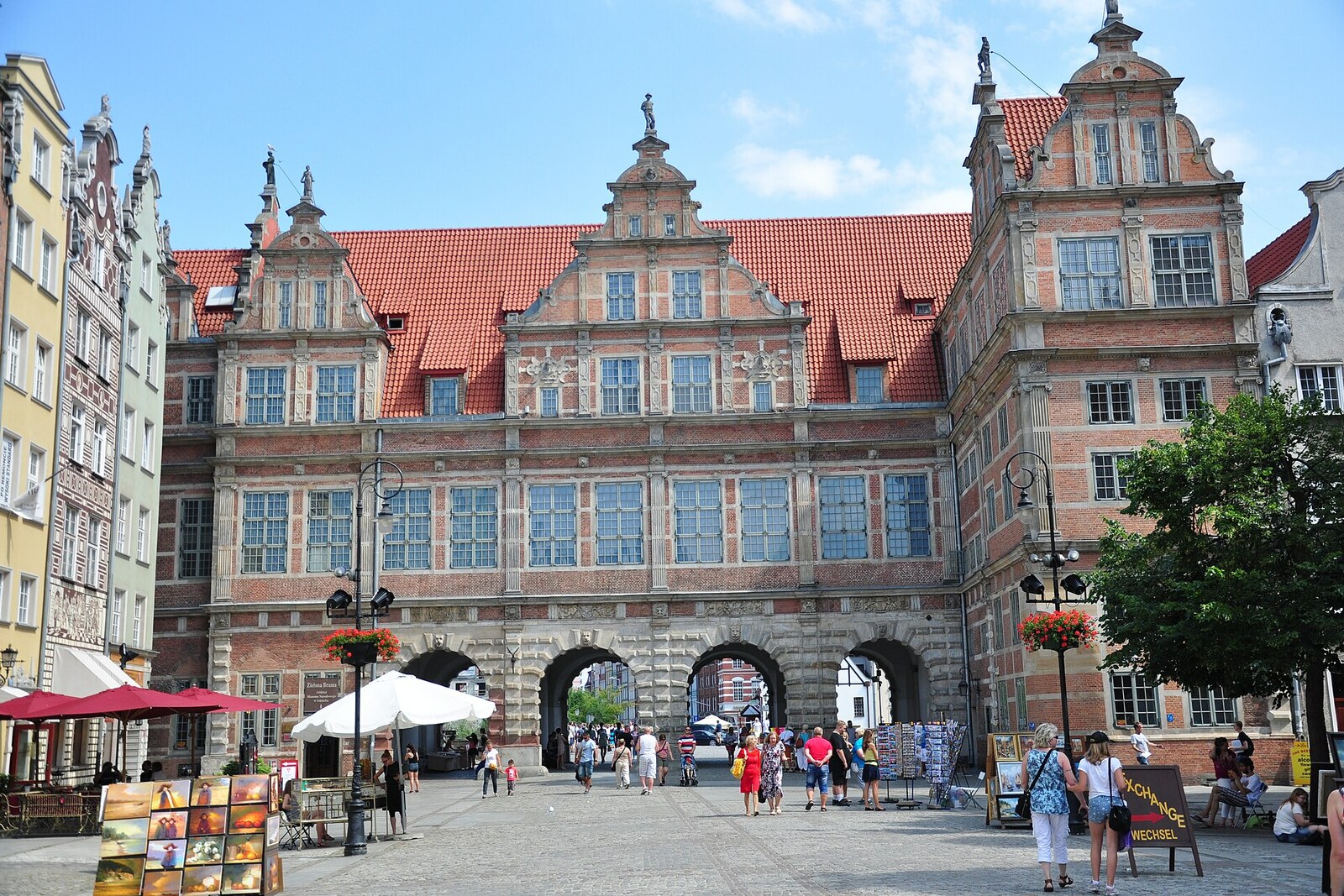
Look around first
What to notice
- The gate's passageways
- Renaissance gables
- The upper floor above the passageways
The story of the place
Where Long Market reaches the Motława, there stands a gate with two passageways and tall Renaissance gables. The city's scales once stood on the lower level: goods arriving by water were brought here. A large hall for ceremonies was arranged above. The current gate was erected by the city council in place of a medieval passageway that bore the name of a merchant ship.
On February eleventh, sixteen forty-six, the French princess Ludwika Maria Gonzaga entered Gdańsk. She was traveling to the Polish king Władysław IV, her husband, whom she had never seen even once. On November fifth, sixteen forty-five, they had been married by proxy in Paris: the absent groom was replaced at the altar by his representative. France's First Minister, Cardinal Mazarin, sought through this marriage an alliance against the Habsburgs. Ludwika Maria's own position depended on the meeting: the agreement had already made her the king's wife, but her coronation and life at the new court still lay ahead.
Gdańsk's city council had to receive her with honors while also fearing her large armed retinue. An early nineteenth-century historian wrote that the city councilors suspected the wedding procession might be a pretext for occupying the city and abolishing its privileges. Senators sent by the king had to persuade them that there would be no attack.
After that, the councilors arranged a reception such as Gdańsk had never seen. They built two temporary triumphal arches on Długa Street and Long Market. The public entry lasted eight hours. At the end of the route, the princess was lodged here, in Green Gate, from February eleventh through February twentieth.
The building was designed for such a guest. In the sixteenth century, the councilors dismantled the medieval Koga Gate that had stood here, named after a type of merchant ship, and built a large hall above its passageways. They installed the city's scales below for goods arriving from the Motława, while the upper floor was intended for ceremonies. Twice, the council negotiated transferring the premises to Polish monarchs for the duration of their visits. Thus, the river gate at the end of Long Market acquired another function: receiving the royal court after its procession through the city.
Yet the kings preferred the connected merchants' houses opposite Artus Court. Not a single Polish king ever took up residence in Green Gate. The only member of the royal family who actually lived here was Ludwika Maria—a woman who stopped in Gdańsk on her way to an unfamiliar husband. They met in Warsaw on March tenth. Two years later Władysław died, and in sixteen forty-nine Ludwika Maria married his brother and successor, Jan Kazimierz, and remained queen.
The origin of the gate's name has not been established with certainty. It is linked to the green coloring of the stone decorations, wooden shutters, or original windows; researchers have been unable to reconstruct the old color scheme.
The rooms prepared for Ludwika Maria have not survived in their entirety either: in nineteen forty-five, the building burned out, its upper sections collapsed, and in the early fifties restorers gave it back its roof and Renaissance gables. Today the National Museum in Gdańsk holds temporary exhibitions upstairs—in the very same spaces where Gdańsk's councilors once housed the only royal guest of their palace.
Useful on site
The arcades and exterior can be viewed around the clock; the interior is not part of the required route.
Checked: date not specified. Check the official source before visiting.View the coats of arms from a safe spot outside the flow of pedestrians. The exhibition rooms inside operate as a separate museum venue.