 Guide On Map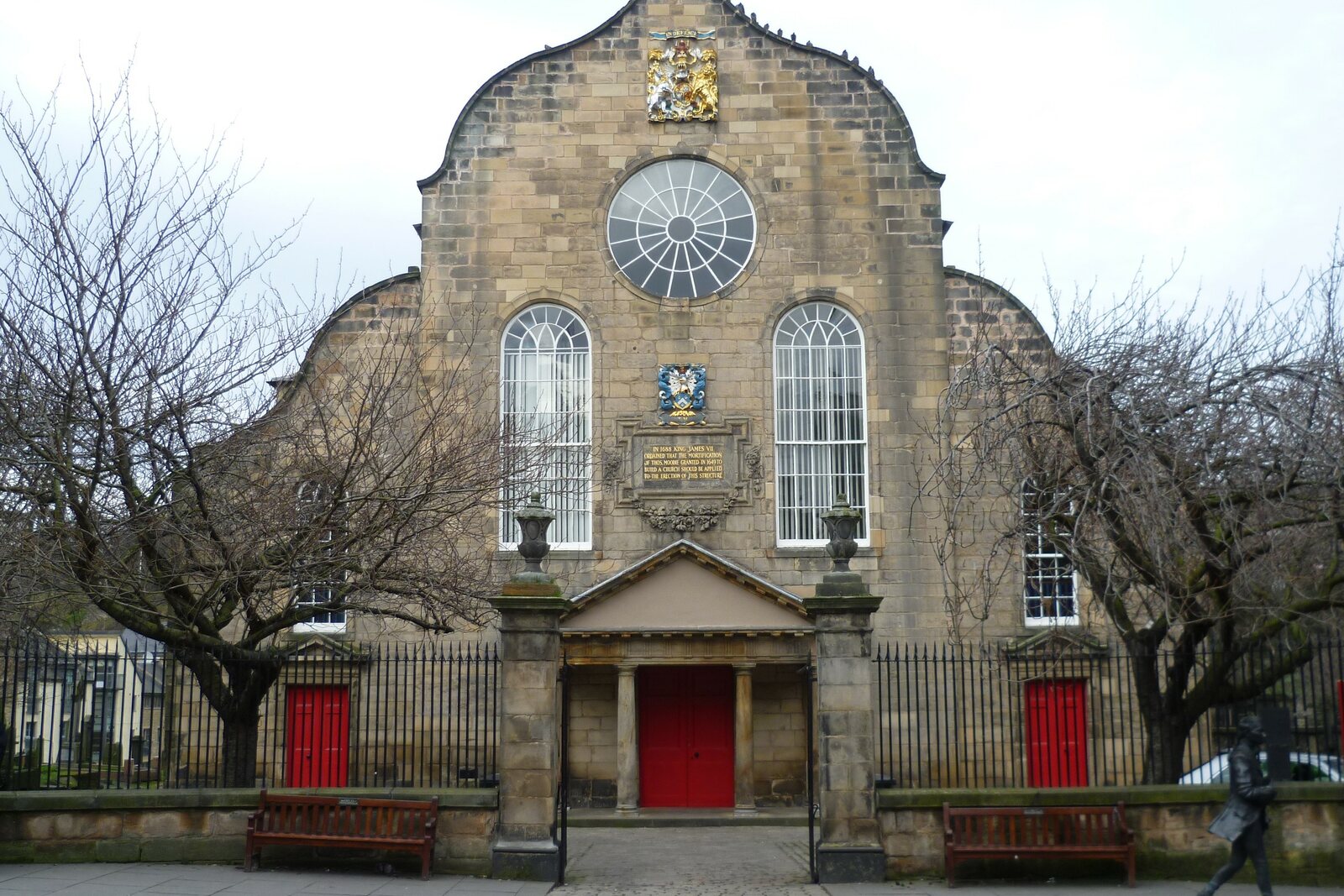
Look around first
What to notice
- Red doors
- Coat of arms with a central escutcheon
- Plaque bearing Thomas Moodie's name
- Robert Fergusson's gravestone
The story of the place
Canongate's name recalls the road that ran from the city gates to the lands of the Augustinians of Holyrood Abbey. Here, red doors lead into a Church of Scotland church, surrounded by an old parish graveyard. In Scotland, a kirk is a church, and a kirkyard is its graveyard. On the stone façade remain a coat of arms with a small escutcheon at its center and a plaque bearing the name of the man whose money went toward the construction.
In the summer of sixteen eighty-seven, King James VII demanded that the people of Canongate vacate their parish church. The congregation did not then have a building of its own: after the Scottish Reformation, parishioners of the Church of Scotland worshipped in the nave of medieval Holyrood Abbey, at the bottom of the street. James, a Catholic king, revived the Order of the Thistle, Scotland's royal order of chivalry, and set aside that same nave for its chapel. The parishioners were temporarily moved to another church, Lady Yester's Kirk.
Canongate was then a separate small town at the gates of Edinburgh. Its name means “the road of the canons”: it linked the city gates with the lands of the Augustinians of Holyrood Abbey. That is why the displaced congregation needed a new church on this very street.
The parishioners found the money in a will that the town had left unfulfilled for almost forty years. Thomas Moodie, who had grown wealthy through trade and served as the town treasurer, had left a large sum in sixteen forty-nine for building a church in Edinburgh. The people of Canongate secured James's direction that this fund be used to replace the building taken from them. A plot was bought on the north side of the street, and construction of the present church began in sixteen eighty-eight.
James did not see it open. He was deposed in the same year, and William of Orange received the crown. The builders were preparing James's coat of arms for the façade, but after the change of king they inserted the escutcheon of the House of Nassau at its center, turning it into William's coat of arms. Below, they left Moodie's coat of arms and a plaque bearing his name. One façade still preserves the figures in the whole story: the king who evicted the parish, his successor, and the merchant whose long-ago will paid for the new building. A Church of Scotland congregation still gathers behind the red doors; in Scots, “kirk” means church.
The plot around the building was bought together with the land for the church. Parishioners were buried here from the late sixteen eighties onward, and so the kirkyard, the church graveyard, came into being.
In seventeen seventy-four, Robert Fergusson was buried here, a young poet who wrote about Edinburgh in Scots. After his father's death, he left university and earned a living copying legal documents. Illness deprived him of that work; after a severe breakdown and a fall, he was committed against his will to the city's institution for poor people with mental illness. Fergusson died there at twenty-four, and his family buried him in Canongate Kirkyard without a gravestone.
Thirteen years later, Robert Burns, a poet who regarded Fergusson as his predecessor, found the grave. Seeing bare earth, Burns wrote to the administrators of the church and graveyard, asked permission to lay a simple stone, composed the inscription, and paid for the work. The gravestone was installed in seventeen eighty-nine. It was later repaired, but the stone commissioned by Burns remains on the western side of the kirkyard. At the gate, Fergusson is shown walking with a book; behind the railings stands the gravestone through which his name returned to his own grave.
Useful on site
In summer the church is usually open on weekdays 11:00-16:00, on Saturdays and on Sundays after the service; in the off-season, access depends on volunteers. The graveyard, as an outdoor stop, can be understood without entering the building.
Checked: June 15, 2026. Check the official source before visiting.Speak quietly in the graveyard and stay on the paths; some inscriptions have worn away, and some attributions remain disputed.