 Guide On Map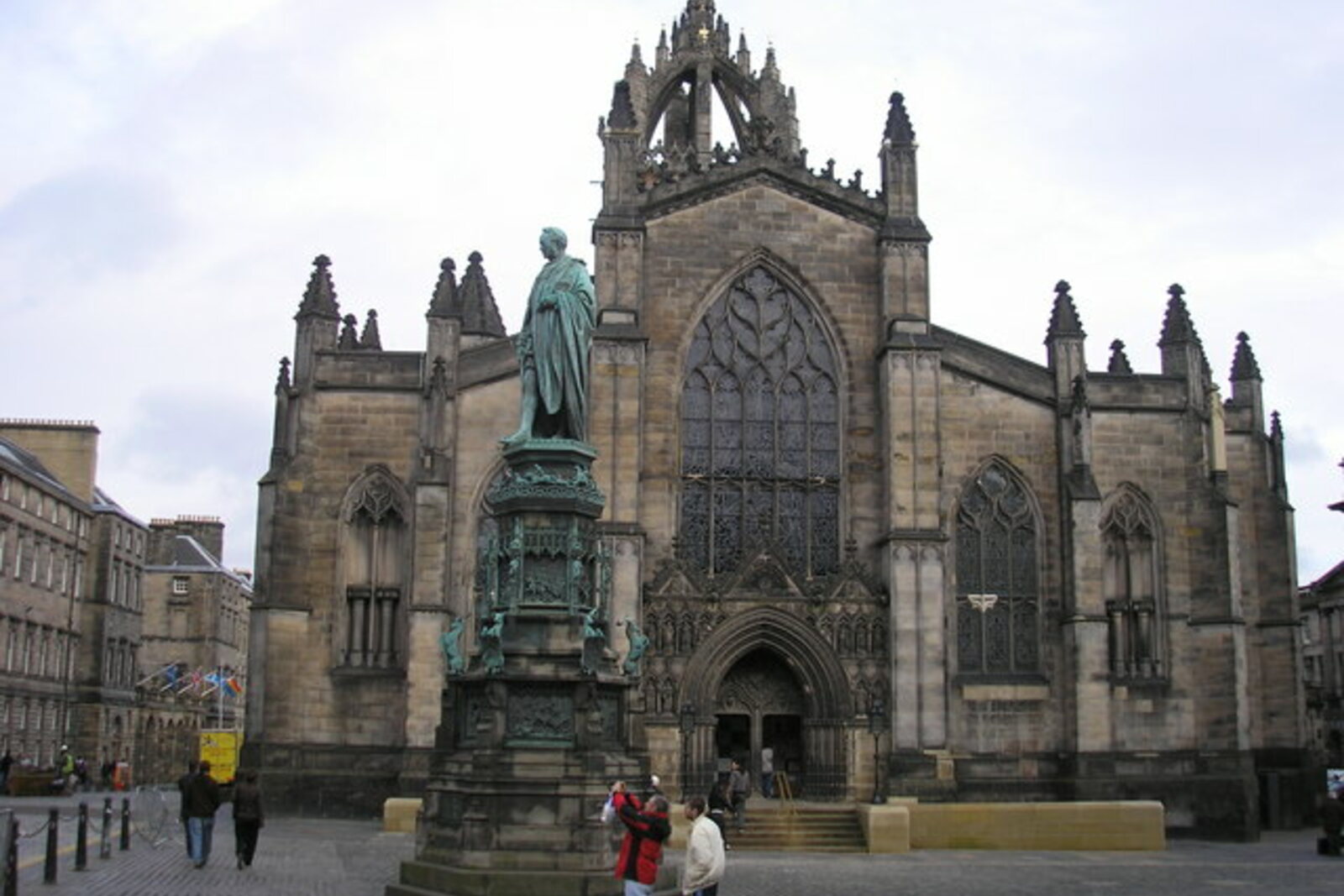
Look around first
What to notice
- The word “Cathedral” above the entrance
- Two memorial plaques
- A bronze three-legged stool
The story of the place
The word “cathedral” stands above the entrance, but St Giles' Church has no bishop. Today it is an active Presbyterian church and Edinburgh’s principal church. It is governed without an episcopal hierarchy—through assemblies of clergy and elected parishioners. Yet it was once the attempt to install a bishop here that made the building a cathedral.
The medieval church, founded around eleven twenty-four, was dedicated to Saint Giles. According to tradition, he was a hermit from southern France; later he was venerated as the patron saint of people with leprosy and those who were lame. The connection with the sick was quite practical: King David I granted the revenues of the Edinburgh parish to the hospital of the Order of Saint Lazarus, where the brothers cared for people with leprosy. After the Scottish Reformation, the veneration of saints here ceased, but Giles’s name was retained.
In sixteen thirty-three, King Charles I created the Diocese of Edinburgh and made St Giles' Church its cathedral church. The king wanted to bring Scottish worship closer to English worship: to strengthen the role of bishops and introduce a single prayer book. Many Scottish Presbyterians believed that the monarch was restoring rites too similar to the Catholic Mass and governing their church without its consent.
In the summer of sixteen thirty-seven, the dean, James Hannay, was assigned to conduct a service here publicly for the first time using the new prayer book. There were no permanent pews then: parishioners brought small folding stools and took them home after the service.
What followed is known in two versions. The disturbances in the church and resistance to the prayer book are confirmed by documents. But the first throw is a legend. According to it, Jenny Geddes, a street vendor, heard Hannay reading, shouted, “Don’t you dare say Mass in my ear!” and hurled her stool at the dean. Other parishioners raised a shout, and more stools flew after it. The clergy had to be led out of the church, and services were suspended for a week.
It has not been possible to establish reliably whether that very Jenny Geddes was a real instigator. A person with that name lived in Edinburgh, but the story of the vendor and her throw was recorded later; there is even a version that apprentices in disguise were hiding beneath women’s dresses. Jenny herself disappears from reliable evidence after this episode.
The protest that began at Saint Giles continued beyond its walls. The following year, opponents of the royal church innovations signed the National Covenant—a pledge not to accept them without the consent of the Church of Scotland. Then a church assembly abolished the prayer book and did away with bishops. Charles I sent troops against the Covenanters, supporters of the National Covenant, but was defeated in two Bishops' Wars. To raise money for a new campaign, he had to summon the Parliament of England after an eleven-year break. The dispute with Parliament grew into civil war; in sixteen forty-nine, Charles was executed.
Bishops were later briefly restored, but in sixteen ninety they were abolished for good. Since then, St Giles' Church has technically no longer been a cathedral, though the historic name remained. Inside, two cautiously worded memorial plaques name both Hannay and Geddes. And in nineteen ninety-two, forty Scottish women gave the church a bronze sculpture of a three-legged stool. Outside, the word “cathedral,” bestowed by Charles I, has survived; inside stands a stool in memory of the protest against his prayer book.
Useful on site
Mon–Fri 10:00–18:00, Sat 09:00–17:00, Sun 13:00–17:00; an active church, so access changes for services, concerts, and ceremonies. As of the verification date, entry is by donation, with a recommended donation of £10; from September 2026, a paid admission model has been announced for most visitors.
Checked: June 15, 2026. Check the official source before visiting.Outside, the church’s connection with the street is visible; inside, keep quiet and bear in mind that services may limit viewing.