 Guide On Map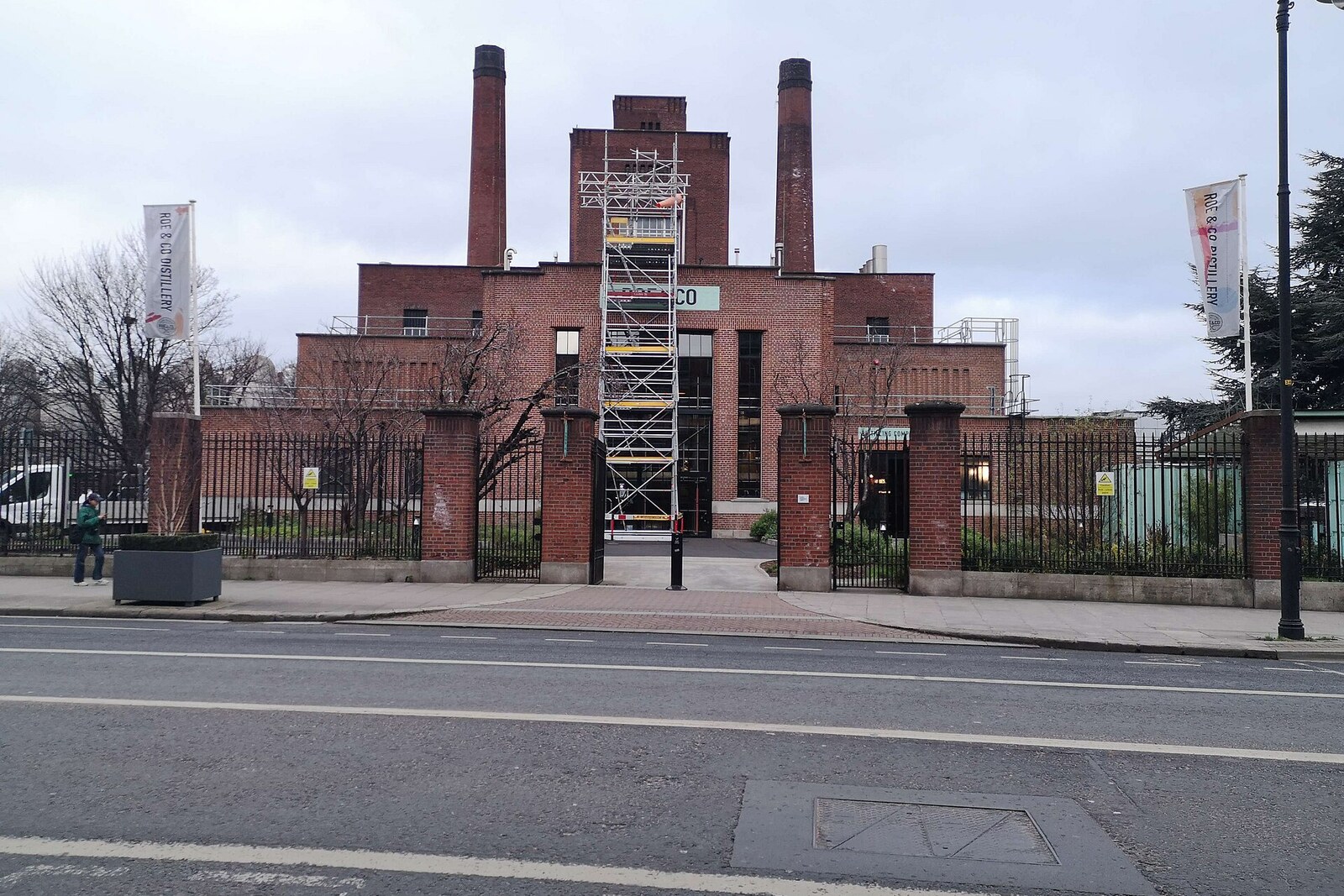
Look around first
What to notice
- The brick building of the former power station
- The windmill tower without its sails
- The old pear tree
- The copper pot stills
The story of the place
This brick building supplied the Guinness brewery with electricity and steam. Today, copper pot stills occupy the turbine hall, and a distillery and visitor center operate in the building. Around it survive rare remnants of a large industrial district: a windmill tower without its sails and an old pear tree. The name Roe & Co appeared on the façade later than its walls were built.
The Thomas in the name Thomas Street is Thomas Becket, Archbishop of Canterbury, who defended the right of church courts to hear cases involving clergy. King Henry II sought to transfer such cases to the royal court. After their quarrel, four knights killed Becket directly inside Canterbury Cathedral. In the eleven seventies, Henry ordered the Abbey of St Thomas the Martyr to be founded on the western road out of Dublin—this was what the canonized Becket was called. The monastery stood closer to today’s St Catherine’s Church and controlled this road and diverted water from the River Poddle, which powered the nearby mills. The abbey buildings disappeared, but the street retained the name.
The brick Roe & Co building is connected with a much later history. A distillery and visitor center operate inside today, but the Roe family never distilled whiskey in this building.
The firm itself traced its lineage to seventeen fifty-seven, when a certain Peter Roe supposedly bought a small distillery on Thomas Street. The company’s business papers have not survived, and the identities of several Roes became confused in later accounts, so this date still needs to be confirmed. A reliable chain begins in the early nineteenth century. The merchant Peter Roe invested in whiskey production together with the Dublin distiller Sylvester Costigan. The partners agreed that whoever outlived the other would receive their shared premises, but would pay the deceased person’s executor seven thousand five hundred pounds. Costigan died in eighteen seventeen. Peter paid the money, and Costigan’s distillery on Thomas Street became the core of the future Roe enterprise.
Nine years later, Peter also died. His son George Roe took over the business—a distiller who brought the family’s production sites and warehouses together into one complex. The firm was called George Roe and Co because George was its chief manager; his brother Henry remained a co-owner. By the end of the century, the holdings covered seventeen acres, from Thomas Street almost to the River Liffey. Covered walkways ran between the buildings, which crossed two streets, and annual output approached two million gallons.
In the early eighteen fifties, the ailing George decided to step back from production. Under an agreement, management and most of the premises passed to his brother Henry and his nephews Henry Roe Jr. and George Roe Jr.; they were to continue the business. In return, George secured himself a lifetime annuity of two thousand five hundred pounds a year.
Ten years later, George’s will showed that the family had parted differently. He accused the people managing the distillery on Thomas Street of misconduct, made his wife Mary his sole heir, and did not mention his brother or nephews at all. The documents do not explain what exactly happened between them. In eighteen sixty-two, according to a surviving deed, the relatives returned the distillery premises to George. But after his death, control nevertheless went to the nephews. Documents that definitively explain this transfer have not yet been found. George had no children, so the common story that his sons peacefully inherited the firm is wrong.
In the end, the enterprise was run by the nephew Henry Roe Jr. With money earned here, between eighteen seventy-one and eighteen seventy-eight he gave about two hundred twenty thousand pounds toward rebuilding Christ Church Cathedral. The donation coincided with a downturn in trade and overburdened both his personal finances and the firm’s resources. In eighteen eighty-nine, the company was liquidated and sold. Henry died five years later in England; his estate contained about five hundred ninety pounds.
The new owners combined the Roe enterprise with other Dublin distilleries, but production on Thomas Street ceased in the nineteen twenties. After the company’s final liquidation, the Guinness brewery acquired the site and demolished most of the old complex.
The present building was constructed in nineteen forty-eight as a Guinness power station: electricity and steam for the brewery were generated here. Diageo, the current owner of Guinness, returned the Roe name to the label in two thousand seventeen, and two years later opened an operating distillery in the former engine hall. Nearby, a windmill tower without its sails and an old pear tree remain from the former Roe enterprise. The copper pot stills of today’s Roe & Co stand in the former turbine hall of the neighbors who once bought the land of the closed company.
Useful on site
Thomas Street is always accessible. Roe & Co: Powerhouse Bar and Flavours Experience / Beyond The Blend have different hours; visits are best booked, and the minimum age for tour visits is 18+.
Checked: June 26, 2026. Check the official source before visiting.Do not mistake the present distillery for a completely preserved Roe plant: the historic complex covered a much larger area. The production spaces are visited separately, and outside it is best to stay on the public street.