 Guide On Map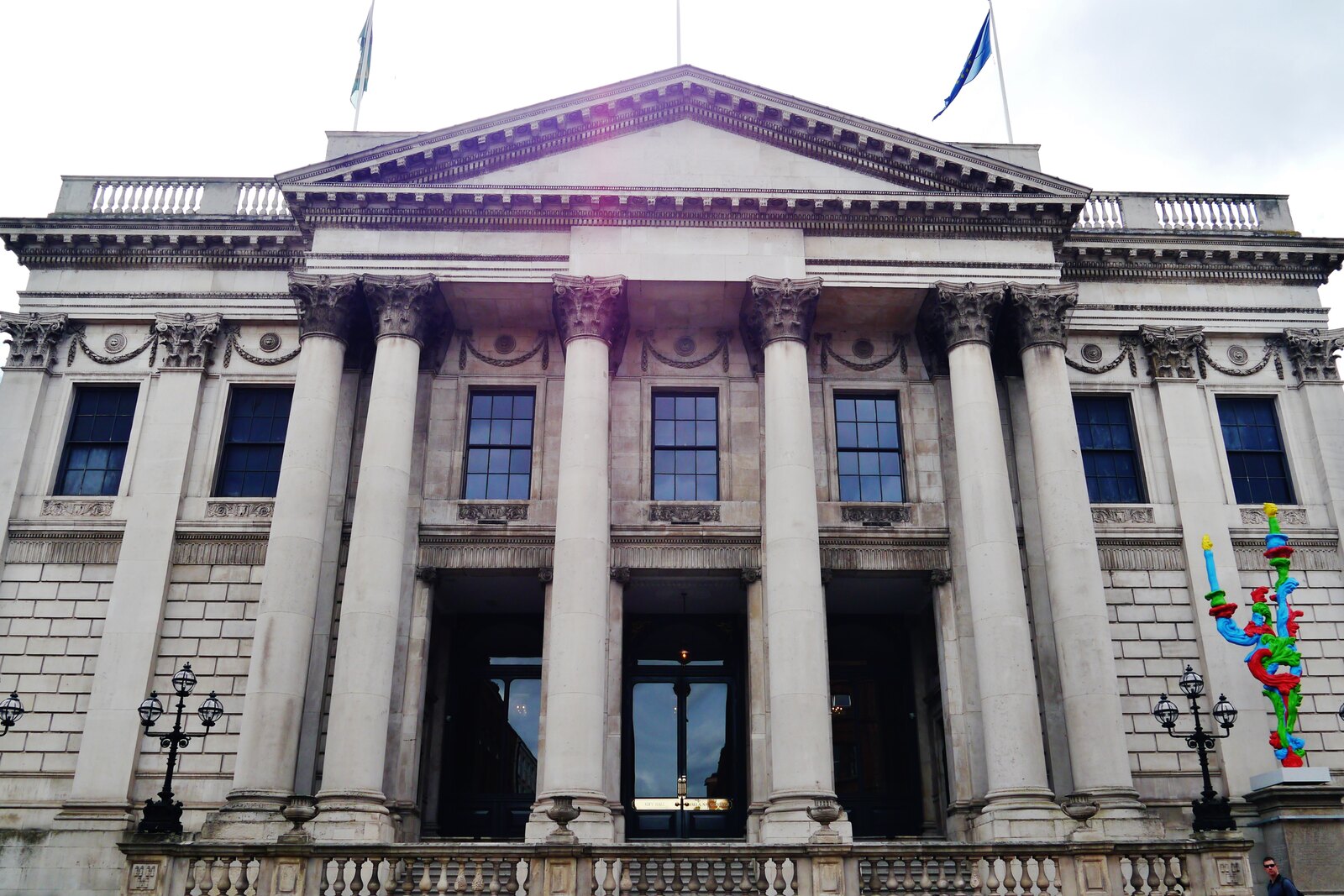
Look around first
What to notice
- Side portico
- Upper Gate of the castle
- Bronze memorial plaque
- Round hall
The story of the place
The upper halls of the building still bring together the mayor and elected councilors, while below is the round hall, above which the coffee rooms once stood. Before it became the municipal city hall, the Royal Exchange operated here: merchants made deals and exchanged Irish money for sterling. They returned to this site when Parliament Street linked the commercial bank of the River Liffey with the castle and an effort was made to keep the old center commercial. Behind the side portico, the castle's Upper Gate stands almost directly beside the building, and a bronze memorial plaque is mounted on the façade.
The name Cork Hill remains from Cork House, the Dublin town house of Richard Boyle, first Earl of Cork. At the beginning of the seventeenth century, the landowner established his Dublin residence here. The house disappeared, but its name became attached to the rise leading to the gates of Dublin Castle.
In the garden of Cork House, merchants built an exchange on columns as early as sixteen seventy. A century later, they returned to the same site: the new Parliament Street connected the commercial district by the River Liffey with the castle, and the guild hoped to keep business life in the old center. In seventeen seventy-nine, the Royal Exchange opened here. Merchants made deals, exchanged Irish money for sterling, and talked in the coffee rooms above the round hall.
After the Irish and British monetary systems were united, the exchange lost its former occupation. Dublin Corporation bought the building and opened Dublin City Hall—a municipal city hall—in it in eighteen fifty-two. Today, the mayor and elected councilors meet in the upper halls.
On April twenty-fourth, nineteen sixteen, Seán Connolly came to Dublin City Hall. On weekdays, he worked in the city vehicle registration department and had a key to the building. That Monday, Connolly commanded a detachment of the Irish Citizen Army, an armed organization that took part in the Easter Rising for independence. Using his work key, the municipal employee opened Dublin City Hall for his detachment.
The target was behind the neighboring wall. Connolly had too few men to occupy and hold all of Dublin Castle, so they intended to block its gates and prevent the garrison from using the complex to advance. At the Upper Gate, police officer James O'Brien tried to close the leaves of the gate. Connolly shot him; six fighters seized the guardroom and disarmed the soldiers there. The others occupied Dublin City Hall and neighboring houses, from which they could watch the exits from the castle and the approaches along Dame Street.
Connolly ordered men posted on the roof of Dublin City Hall. Soon he went out to them himself and walked upright, although everyone had been told to keep low. A sniper from the castle side hit him. Doctor Kathleen Lynn, who was responsible for first aid in the detachment and had brought medical supplies here, tried to help, but Connolly died almost immediately.
His deputy, John O'Reilly, took command; he too was killed in this building. British reinforcements entered the castle, and after dark, soldiers entered Dublin City Hall through a rear window. The remaining fighters, women, and the wounded man were led through the castle yard to the barracks on Ship Street. Lynn spent about eight days there under arrest.
A bronze plaque hangs on the façade of Dublin City Hall in memory of Connolly and three of his comrades who died. Behind the side portico is still the castle's Upper Gate: Dublin City Hall, where Connolly worked, and the gate he intended to block stand almost directly beside each other.
Useful on site
For this route, this is an outdoor stop with no dependence on opening hours.
Checked: June 26, 2026. Check the official source before visiting.Choose a spot on the wide sidewalk from which you can see both Dublin City Hall and the direction toward the castle at once. Do not listen to the account at the edge of the roadway.