 Guide On Map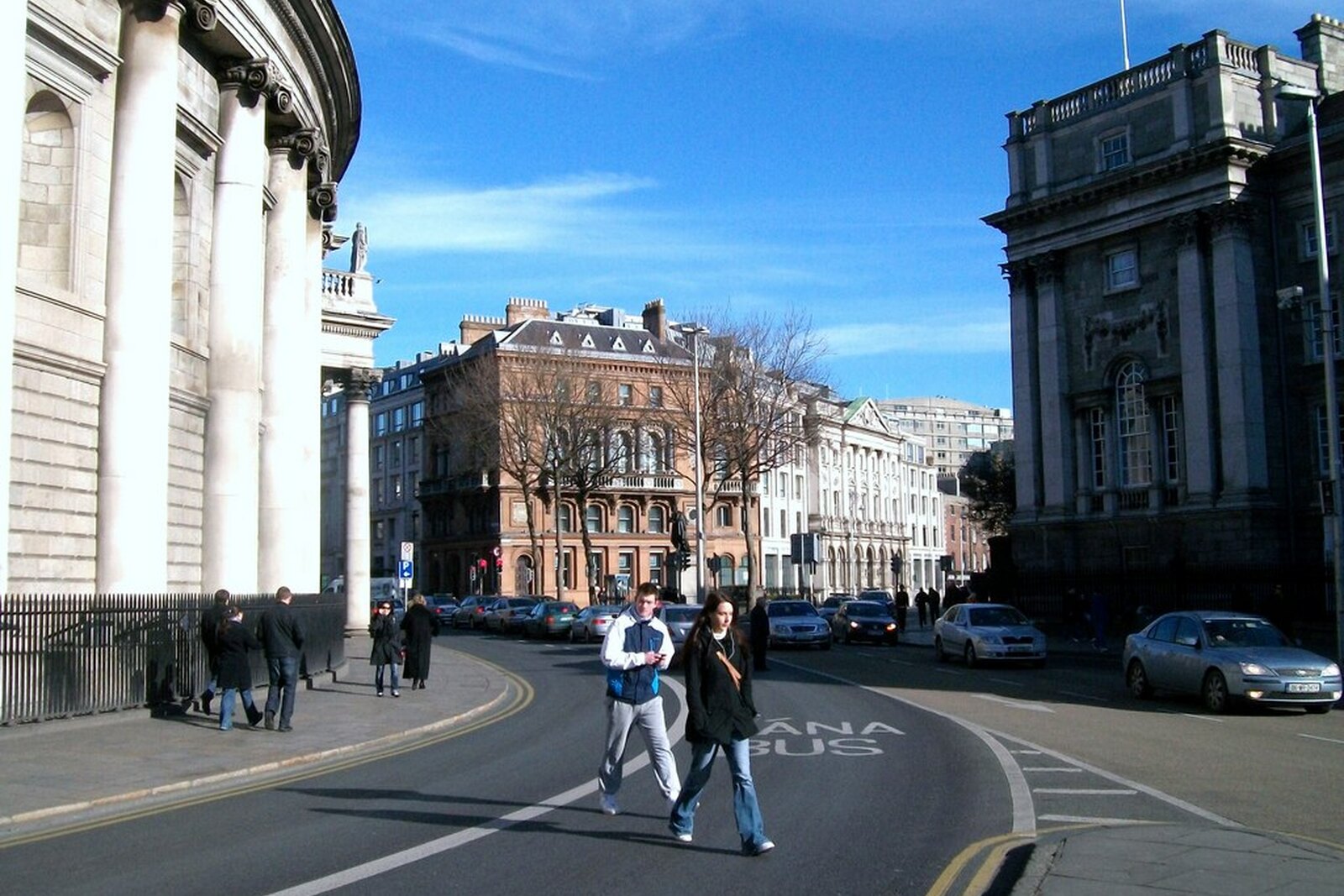
Look around first
What to notice
- Henry Grattan Monument
- Raised bronze hand
- Facade of the Bank of Ireland
- Gates of Trinity College Dublin
The story of the place
College Green began as the open Hoggen Green—a meadow at the edge of Dublin as it then was; after Trinity College Dublin was founded, its present name took hold. By the end of the seventeenth century, a separate building for the two chambers had been erected opposite the college buildings, and the former outskirts became a ceremonial space between the university and the legislators. On the traffic island in the middle of the square, the bronze figure with its raised hand still joins these two sides of city life in its gaze.
On the traffic island in the middle of College Green, the bronze figure of Henry Grattan raises one hand, as though asking to speak once again. In front of him are the gates of Trinity College Dublin; behind him is the Bank of Ireland. Before it became the bank, the Irish Parliament met here, and the chamber in which Grattan delivered the most important speeches of his life stood inside this building.
The square acquired its name after Trinity College Dublin was founded. Before that, the open space in front of it was called Hoggen Green. By the end of the seventeenth century, the name College Green—“the green by the college”—had taken hold. A purpose-built building for the two chambers of Parliament was then erected opposite the college buildings, and the former outlying meadow became a ceremonial space between the legislators and the university.
Grattan came here in seventeen seventy-five as a Protestant lawyer and member of Parliament for the tiny constituency of Charlemont. He did not receive his seat through a modern electoral contest: it was given to him by his patron, the Earl of Charlemont. Most of Ireland's inhabitants, Catholics, could not sit in the Irish House of Commons. Grattan sought one very specific change: laws for Ireland were to be passed by a Parliament in Dublin, while the British Parliament could no longer repeal them or enact laws of its own.
The opportunity arose from the war in America. British troops were sent overseas, and landowners and townspeople formed volunteer units to defend Ireland against a possible French invasion. These were armed, predominantly Protestant units. Once the immediate danger had passed, the volunteers demanded legislative autonomy. Their Dungannon Convention declared that only laws passed by Ireland's own king, lords, and commons could bind Ireland.
On April sixteenth, seventeen eighty-two, Grattan introduced this demand in the Irish House of Commons on College Green. The British government, weakened by defeats in America and unwilling to argue with armed volunteers as well, gave way. First, the Parliament in London repealed the law asserting its right to legislate for Ireland, and the following year that renunciation was made final.
This was legislative autonomy, not the independence of the modern state. The monarch remained shared, ministers were not appointed by Dublin members of Parliament, and Catholics still could not take seats in Parliament. Yet for the following eighteen years, laws were passed in the building behind the monument, and this period came to be called Grattan's Parliament.
The reward shows how much the life of the member of Parliament himself had changed. Parliament offered him one hundred thousand pounds. Grattan refused half of it but accepted fifty thousand—an enormous sum that made him financially independent. With this money, he bought land and the house of Tinnehinch in County Wicklow. The man who had begun his career with a seat bestowed by a patron now lived on his own estate, bought with Parliament's gratitude.
Eighteen years later, he returned here to defend the order he had created. After the uprising of seventeen ninety-eight, the British prime minister, William Pitt the Younger, decided to unite the two kingdoms and abolish the Parliament in Dublin. To win support for the union, owners of electoral seats were promised compensation, offices, pensions, and titles.
Grattan was seriously ill at the time and took almost no part in politics. According to the recollections of his wife, Henrietta Grattan, she reminded her husband that he had received much from the country and now had a duty to spend his money—and, if necessary, his blood—on its defense. In January eighteen hundred, he was elected at night as a member of Parliament for County Wicklow. At dawn, Grattan was brought to the Irish House of Commons in a covered chair, wrapped in blankets. Fearing an attack, he brought loaded pistols with him.
He entered the chamber in the blue uniform of a volunteer—the very organization whose support had helped him win concessions in seventeen eighty-two. Because of his weakness, the members allowed him to speak while seated. His speech lasted about two hours, but he lost the vote. In March, both chambers agreed to the union, and on January first, eighteen oh one, the Irish Parliament ceased to exist. Grattan returned to Tinnehinch; later, he sat in London and campaigned for political rights for Catholics.
The Bank of Ireland bought the empty building in eighteen oh three. Chief Secretary Charles Abbot recorded that he had sought a private arrangement: the former parliamentary chambers were to be remodeled so that public debates could never be held there again. The Irish House of Commons, where Grattan had spoken in seventeen eighty-two and eighteen hundred, was divided and dismantled to make way for bank premises. The Irish House of Lords survived.
The monument was erected in eighteen seventy-six. The bronze figure of Grattan remained outside; behind him, the facade of Parliament survived, while the room toward which his raised gesture is directed no longer exists.
Useful on site
This stop is entirely outdoors. The main constraint here is not opening hours, but heavy traffic and the need to take in the space from a safe edge.
Checked: June 26, 2026. Check the official source before visiting.Traffic is heavy here: view the opposite facades from the sidewalks, and change sides only at a pedestrian crossing. The former Parliament is now occupied by Bank of Ireland.