 Guide On Map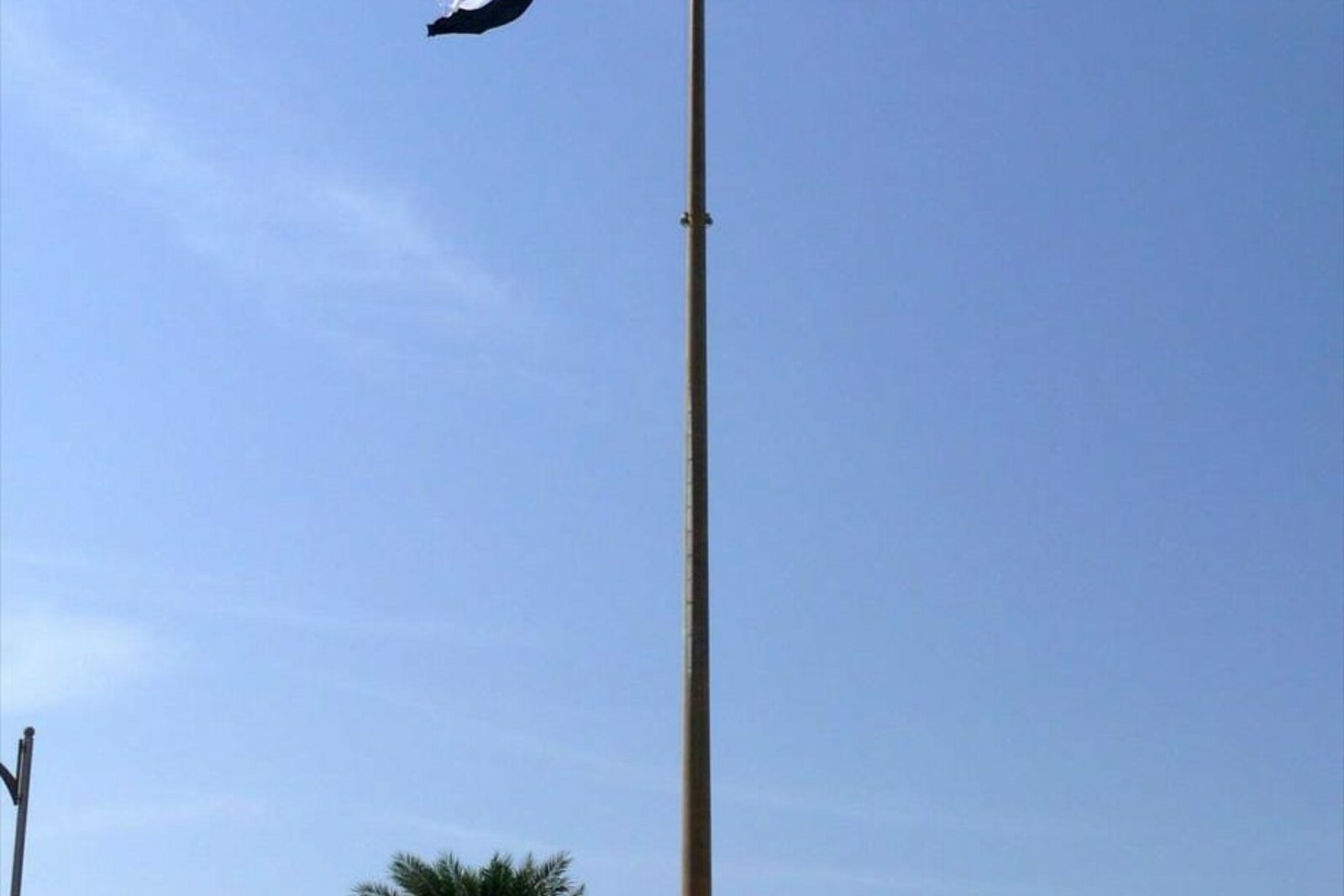
Look around first
What to notice
- The round volume of the Union House, the tall flagpole, and the four color fields of the UAE flag.
The story of the place
The Union House looks more modest than the event that took place here. A round building, a horseshoe-shaped table, several TV cameras, microphones—and the morning after which six emirates became a single state. On December 2, 1971, history was made here not only through solemn decisions but also through haste, accidents, delays, and people who did not yet know which moments would become historic.
Sheikh Zayed left the Al-Mankhoul Palace the day before, even before nightfall. On the way, he stopped by a bonfire in the Samha desert, and in the morning, he himself took the wheel of a white Mercedes equipped with special desert tires. Following him was a Land Rover carrying his personal secretary, Hajj Al-Mehairbi, and advisors. Among them was Ahmed Al-Suwaidi—the man who would read the declaration establishing the new state just hours later.
Television cameraman Mohammed Al-Qudsi arrived here at two in the morning. Filming such an event left no room for a second take. One camera was set up near the future flagpole, two inside the building, and another on the roof. Everything had to be prepared in the dark, pre-selecting vantage points from which the country would see itself for the first time.
At ten in the morning, the rulers and advisors took their seats around the horseshoe-shaped table in the round room. The full roster was not yet present. The ruler of Umm Al Quwain fell ill, so his crown prince attended instead. The ruler of Ras Al Khaimah was present as an observer; his emirate would join the federation only in February of the following year.
Ahmed Al-Suwaidi read the declaration live on the radio station 'Voice of the United Arab Emirates.' It is symbolic that the radio station itself began operations that same morning. The new state gained its voice literally on the day it came into being.
Then, the Supreme Council elected Sheikh Zayed as President, Sheikh Rashid as Vice President, and Sheikh Maktoum as the first Prime Minister. After the official part, a closed session was supposed to begin. But the microphone was left on, and the first minutes of conversation continued to broadcast over the airwaves. Even the birth of a state is not without small technical mishaps. That day, they only underscored how new everything was: a new federation, a new radio station, new roles, and people learning on the fly to speak for an entire country.
At half past eleven, Mahdi Tajir handed the flag to Sheikh Zayed. The banner slowly rose up the pole, accompanied by twenty-one gun salutes. This moment became the defining image of December 2: the white building, the rulers standing by the tall flagpole, and four colors that for the first time represented not just one emirate but the entire union.
The solemn ceremony was supposed to have an honor guard. They had been specially prepared for this day, but the soldiers were late. The cause was the Maktoum Bridge. Dubai authorities raised its drawbridge to prevent a crowd of protesters against the Iranian occupation of islands from approaching the beachside palace. The guard remained on the other side of the creek and arrived only when the ceremony was already in full swing. Thus, in one short episode, a festive morning, anxious regional politics, and a simple urban obstacle—a raised bridge span—were combined.
Hajj Al-Mehairbi particularly remembered Sheikh Zayed’s gaze as the flag rose. He conveyed the meaning of that look with brief words: now we are independent. Faisal bin Sultan Al Qasim stood opposite the President. Later, he said he had come here as a man from Abu Dhabi but in this moment felt like a citizen of the United Arab Emirates. Legal formulas had already been spoken inside the Union House, but the true sense of change came from outside, when the fabric unfurled in the wind.
Photographers Ramesh Shukla and Nour Ali Rashid worked nearby. When the flag reached the top, people began to embrace. For the photographer, these were seconds during which he could not lower his camera, even if he himself wanted to join the general jubilation.
Meanwhile, at the gate, Taru, Ramesh Shukla’s wife, waited. She spent about three hours there because she had her own role in the ceremony: immediately transporting the exposed film to the studio. Shukla came out with more than a dozen rolls of film, handed them to his wife, and returned to continue shooting. Digital photography did not yet exist; results could not be seen on a camera screen, and a failed shot could not be retaken. Between the historic moment and its image lay the road to the studio, a darkroom, chemical solutions, and patience.
The next day, Taru printed one photo in large format. It showed Sheikh Zayed speaking into a reporter’s microphone. Ramesh took the photograph under his arm, met the ruler, and asked for an autograph. The signature appeared in green ink. Of all the frames taken on the day of the state's founding, Shukla called this one his favorite. Perhaps because in it, official history remained a living human episode: the president of the new state, a reporter with a recorder, and a photograph that still needed to be developed, printed, and brought for signing.
The flag itself also appeared due to haste. Its designer, Abdullah Mohammed Al Maine, was only nineteen years old. There were only one or two days left before the competition deadline, and the necessary materials were not at hand. In one night, he drew six variants, compiled them into an album, and barely managed to submit his work.
A total of about 1,030 projects were submitted to the competition. The commission selected six finalists, and newspapers printed them in black and white. Because of this, Al Maine could not tell if his drawing had won: color, the flag’s main feature, disappeared on the newspaper page.
He received a response only after the union was announced. The next day, the young man went to the Mushrif Palace in Abu Dhabi, saw the raised flag, and immediately recognized his own work. He recalled that everyone around was rejoicing at the unification, but he was the happiest of all. Perhaps it is hard to imagine a more unusual feeling for a nineteen-year-old: one sleepless night suddenly becomes part of the daily life of an entire country.
Al Maine explained the colors simply and clearly. He associated black with oil, green with fertility, and took red and white from previous emirate flags. The new symbol did not erase the past but gathered familiar colors into a unified form. The vertical red stripe seems to hold together the three horizontal ones—green, white, and black. In this design, one can easily see an image of the federation itself: different lands retain their names but now exist within a common frame.
Therefore, the flagpole near the Union House is not just a ceremonial site. Around it converge stories of very different people: rulers around the round table, an advisor at the radio microphone, a cameraman who arrived in the middle of the night, the delayed guard, a photographer with a dozen rolls of film, his wife at the gate, and a young man who recognized his drawing only after it had already risen above the country.
The most solemn events are often remembered as flawless pictures. Here, the picture was alive: the microphone remained on, the guard was held up by the raised bridge, the film was rushed to be developed, and the flag’s designer did not know about his victory until the last moment. But it is precisely from these imperfect details that the morning came together when the new state gained a president, a voice on the airwaves, and its own colors.
Deeper into the story
Signing of the Federation
On December 2, 1971, six emirate rulers met in this hall, and later Ras Al Khaimah joined them. They agreed on a constitution and raised the new flag. Chronicles show how difficult it was to reach an agreement—negotiations lasted several years and included issues of economy, defense, and power distribution.
Flagpole
The first flagpole here was 120 meters high, but in 2019 it was replaced by a modern 123-meter mast. It is among the tallest flagpoles in the world. In the evenings, its lighting plays with the colors of the flag, and the sandy square fills with people taking photos with the national symbol.
Useful on site
The square is open at all times; entry into the house is not allowed.
Checked: June 17, 2026. Check the official source before visiting.The flagpole and the exterior appearance of the complex allow you to understand the place without entering the buildings. Do not cross the barriers and choose a listening spot away from walkways.