 Guide On Map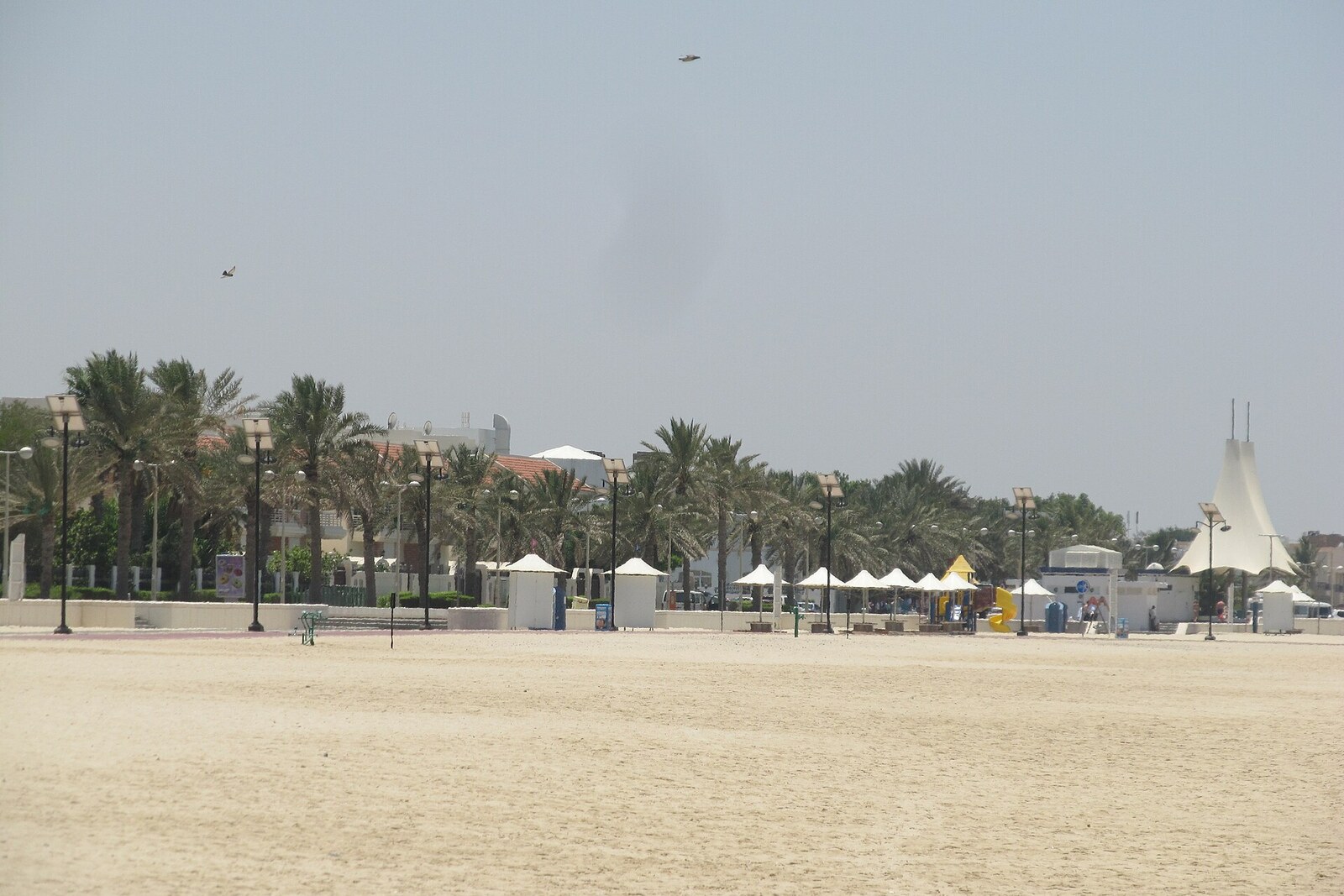
Look around first
What to notice
- Pale sand, an open horizon, boats or piers along the shore, and the constant movement of water.
The story of the place
Along Jumeirah's open horizon stretches a pale strip of sand, where the water constantly reshapes the edge of the shore and boats and piers keep it at a working scale. Two offshore oil storage tanks once stood by a neighboring stretch, and a tall crane could be seen from far away from the road along the coast. Later, villas, a hotel, children's play areas, sun tents, and barbecues grew up nearby. Of that arrangement of the shore, the pier leading to the restaurant at the Al Qasr complex has survived.
Today, Jumeirah can easily seem like a place where the sea exists primarily for leisure. Pale sand, warm water, hotels, restaurants, an even shoreline. But not so long ago, this sea was not scenery but work, a road, and a daily risk. The old people of Jumeirah remembered a time when there was only desert and water all around, people walked to the market, and a car was a rarity available to sheikhs.
Bilal Khamis spoke about his age with disarming simplicity: he was born in Jumeirah, but did not know exactly when. Whether he was sixty, seventy, or eighty did not matter much. In his family, dates of birth were not recorded: life was measured not by the calendar but by seasons, catches, wind, and the return of boats.
His father dived for pearls. Before oil rigs, resorts, and glass towers, pearls were one of the main riches of this shore. A diver went underwater without a tank, with a nose clip and a weight that helped him reach the bottom faster. There he had to gather shells and get back to the surface in time. Jellyfish appeared in the water, and sharks might pass nearby. It was always frightening, but fear did not cancel hunger. As Bilal said, people dived for money, for food, simply in order to live.
Most of the shells brought up yielded nothing. Some contained a small, irregular pearl, and only rarely did they hold a find capable of changing the fate of a boat owner or a merchant. The diver himself usually did not become richer. His share was hard work, salt on his skin, pain in his ears, and hope for the next descent. The sea fed Jumeirah, but it never promised an easy life.
This memory remained for a long time in the fishermen's majlis by the harbor. Early in the morning, at around six, elderly men left their sandals at the entrance, settled onto mats with coffee and dates, or sat on a wooden bench in front of the boats. Here they discussed the catch, the weather, and the news, telling stories that everyone present had already heard more than once but still received like old friends.
Mohammed Khamis, who was over seventy, pointed to his boat. Once he himself went out on a dhow; later, he began hiring fishermen and selling the catch at the Umm Suqeim market. Amid serious conversations, he might wink and admit that he thought he had once seen a mermaid. The others immediately laughed and assured him that they too had encountered mermaids. For people who had spent decades beside the sea, the boundary between truth and a good tale was as shifting as the water at the shore.
Once, a European family looked in through the majlis window. The fishermen immediately invited the visitors inside. They had no common language, but there were gestures, laughter, coffee, and boats, which became the subject of a small tour. The hosts explained that they knew their own stories by heart. They wanted to hear other people's stories. In this scene was all of old Jumeirah: not wealthy, curious, and hospitable without ceremony.
Eighty-year-old Ahmed Ali said that the old life had been very hard but good: then a person felt that he was living, whereas now he only eats, sleeps, and gets fat. Bakhit Al Falasi also could not name the exact year of his birth. He believed that the heart determines a person's age. Perhaps this was a convenient explanation for the lack of documents. But it sounded like the conclusion of an entire era in which a person was known by family, boat, trade, and character, not by the number on an identity card.
Another stretch of coast developed a memory of its own. It was called Chicago Beach. The name sounded as though a piece of a distant American city had accidentally ended up among the sands of Jumeirah. In fact, it all began with the enormous sign of the Chicago Bridge & Iron Company. It was building two offshore oil storage tanks nearby, and its tall crane became a landmark for people traveling over the sand from Dubai toward Jebel Ali and Abu Dhabi.
The name stuck. In the nineteen seventies, the Chicago Beach Hotel and a village of about one hundred villas appeared here. It was a small world by the water, where neighboring children knocked on one another's doors without invitations, barbecues and sun tents stood near the beach, and ordinary childhood disasters occurred on the playground. Joan Westeng's daughter once ran into a metal frame and lost her front teeth. The family memory of a paradise-like life by the sea was not a postcard but a story of blood, fright, and an urgent trip for help.
The village had more peaceful incidents as well. Residents bought turtles at markets, and the turtles showed a remarkable talent for escape. Villa numbers began to be painted on their shells so that a found traveler could be returned to her owners. Living parcels with return addresses slowly wandered along the paths.
Joan's son caught a pufferfish from the pier for the first time. The fish was so strange that no one understood what to do with it. On Fridays, a whale shark sometimes appeared in the shallows—enormous and almost unbelievable beside playing children. And children were forbidden to touch sea snakes washed onto the sand, even if they seemed dead. The sea remained a close neighbor here: beautiful, generous, and not entirely safe.
In nineteen ninety-seven, residents lined up on the pier and watched the old Chicago Beach Hotel being demolished. Five years later, the village disappeared as well. Another Jumeirah, more famous and luxurious, rose in its place. Of the former world, the pier remains; it now leads to the Pierchic restaurant at the Al Qasr complex.
That is how the shore changed its occupations and names. Divers searched for pearls, fishermen went out on dhows, an oil crane served as a road sign, children returned turtles by villa numbers, and neighbors met the dawn over coffee and dates. Sand keeps almost no traces: the tide and wind quickly erase them. But behind today's beach remains another Jumeirah—a place where people did not know their own age, yet knew the sea without fail.
Deeper into the story
Historic shore
Until the middle of the twentieth century, Jumeirah's beaches were used for repairing boats and drying nets. Residents fished and harvested pearls. The modern, developed beach is the result of a program to develop public spaces, but the shore has retained its natural breadth and openness.
Coastal dune ecosystem
Saltworts and shrubs grow along the sandy strip, holding the dunes against erosion. Preserving them is important: they protect the beach from storms and create a habitat for migrating birds. Please do not walk through areas with vegetation.
Useful on site
Open twenty-four hours; lifeguards are on duty until 18:00, and swimming after sunset is not recommended.
Checked: June 17, 2026. Check the official source before visiting.The shore is exposed to sun and wind, so keep water close at hand and follow local swimming notices. There is no need to enter the water for this stop.