 Guide On Map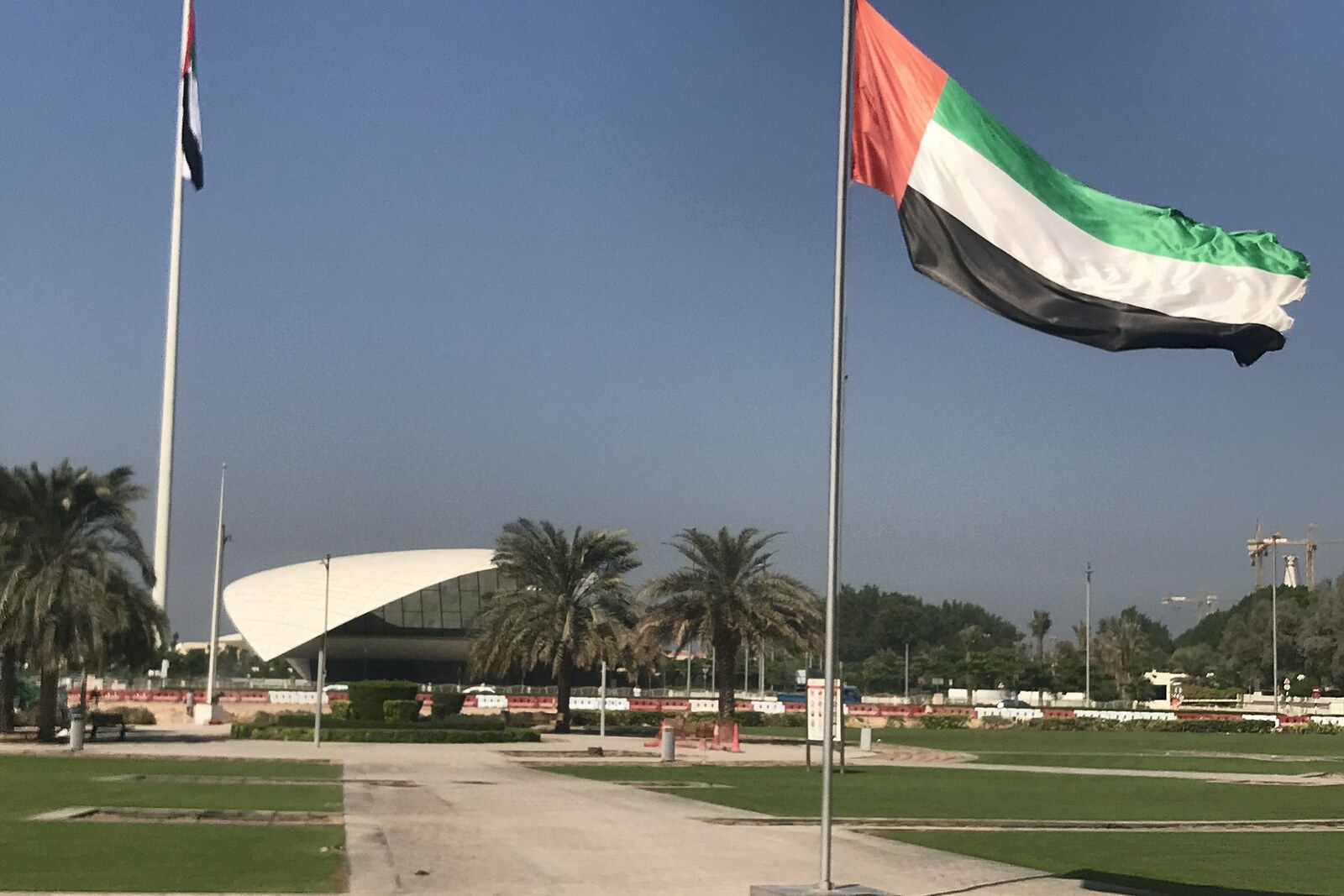
Look around first
What to notice
- Letters, passports, stamps, pocket watches, glasses, rings, and the preserved Jumeirah Guesthouse.
The story of the place
The museum exhibition is assembled from letters, passports, stamps, glasses, rings, and pocket watches: objects through which state decisions entered everyday life. It preserves a guesthouse with the personal majlis of the Dubai ruler; before the signing ceremony, rulers met here, and the dining room seated three hundred people. Advisers, staff, attendants, and guests worked alongside those making the decisions.
The story in this museum does not begin with a ceremonial hall or a state document. First, there were two tents in the middle of the desert near Saih Al Sedira. In February nineteen sixty-eight, one served to receive guests, while in the other Sheikh Zayed and Sheikh Rashid spoke without outsiders.
Even the people accompanying the rulers of Abu Dhabi and Dubai did not know how this meeting would end. They waited outside, among the sand and cars, while inside the tent a question was being decided that had simply not existed until recently: could neighboring emirates become a single state?
Among those waiting was Salah Farah, a Sudanese judge and legal adviser to Sheikh Zayed. He had arrived in Abu Dhabi a year earlier and assumed he would handle ordinary judicial work: settling disputes, interpreting rules, and issuing decisions. Instead, he had to create laws for a country that did not yet exist on any map.
After their long conversation, Sheikh Zayed and Sheikh Rashid emerged from the tent. Farah recalled that the assignment came at once: to draft a declaration on a union between Abu Dhabi and Dubai and invite five more emirates, as well as Qatar and Bahrain, to join it.
The idea was far broader than a fine gesture of friendship. It involved a single flag and a common currency, joint defense and internal security, and a common foreign policy. Unified visas and coordinated healthcare and education were planned. The territories had to be brought together, each with its own rulers, interests, habits, and relations with its neighbors.
From that moment, the desert meeting became the work of lawyers. Salah Farah represented Abu Dhabi on the commission and, together with the Dubai lawyer Adi Bitar, prepared a common text and a draft constitution. Every phrase had to answer a practical question. Who makes decisions? How are powers divided? What remains with the individual emirates? What becomes shared? Even a few words could mean balance or a new dispute.
The negotiations stretched over forty-seven months. The original group of participants gradually changed, positions diverged, and agreed decisions had to be discussed again. The future state emerged not in one confident stroke of a pen, but through dozens of meetings, objections, and compromises.
At one point, the emir of Qatar called Salah Farah a foreigner. For the negotiations, this was a serious slight: it suggested that one of the authors of the country’s future structure had no right to speak on its behalf. According to Farah’s own recollections, Sheikh Zayed replied immediately. He said that the adviser belonged to Abu Dhabi, not Khartoum, and called him a member of the ruling family.
That reply explains much about the history of the Union. Unity here was understood not only as shared territory or origin. It was born of trust, personal loyalty, and a willingness to work for a whole that had not yet taken shape. Farah later received citizenship by special decree for his service to the country. He became an adviser to the president, retired in nineteen ninety-one, and remained in Abu Dhabi. His large family grew up here: ten children, sixteen grandchildren, and then great-grandchildren appeared. A man who had come for an ordinary legal post became part of the state’s history through his own life.
There is another recollection of those two tents. Sheikh Mohammed bin Rashid was in Britain at the time. His father summoned him back and told him to prepare to spend a day in the desert, away from the eyes of people who did not want the Union to emerge.
Young Mohammed probably expected to witness a difficult dispute over power. But inside the tent, the two rulers argued quite differently. Sheikh Zayed proposed that Sheikh Rashid should lead the union. Rashid smiled and replied that Zayed should lead. It was a rare scene in which neither demanded first place for himself, but yielded it to the other.
When the meeting ended, Sheikh Rashid told his son that he would be responsible for defending the Union. The state did not yet exist, negotiations were only beginning, yet responsibility for its future was already being passed to the next generation.
The museum assembles this story from things that are easy to mistake for ordinary. Old passports recall a time when a common belonging was only beginning to take official form. Letters preserve the course of the negotiations. Stamps turn a state decision into everyday life: they were used not in ceremonial halls, but on ordinary envelopes.
Personal objects appear beside them—rings, glasses, pocket watches. They restore a human scale to historical figures. Behind the names of rulers, advisers, and authors of the constitution, we glimpse people who had to wait, grow tired, reread documents, and keep track of time. Pocket watches are especially fitting for this story: nearly four years passed between the first agreement and the creation of the state.
The preserved Jumeirah Guesthouse also belongs to the working rather than ceremonial side of events. Before the signing ceremony, rulers met here. The house contained Sheikh Rashid’s personal majlis—a space for conversations and decisions, where matters of state inevitably stood alongside customs of hospitality. The dining room was designed for three hundred people. That size reveals the scale of the meetings: the Union was created by a few key figures, but advisers, attendants, staff, and guests were already gathering around them.
The exhibition covers the years from nineteen sixty-eight to nineteen seventy-four. It is a short period, yet it contains the transition from a conversation in a tent to functioning state institutions. A document became a constitution, an invitation to a union became a new country, and an assignment to a few lawyers became the foundation of a shared political system.
The ceremonial signing day lies ahead, as does the story of the flagpole that became one of this place’s main symbols. Here, what came before the ceremony is heard especially clearly: the silence of two tents, the long months of negotiations, the careful choice of words, and the unexpected dispute in which two rulers offered power not to themselves, but to each other.
Deeper into the story
Architecture as a document
The museum was designed by the Canadian architects Moriyama & Teshima. The shape of a scroll and the “feathers” of the columns refer to a historical document, while the ornate pavilion flows smoothly onto the square, connecting past and present. Eight halls are hidden underground, each devoted to a stage on the way to the union—from the rulers’ meeting to the signing.
The composition of the union
On December 2, 1971, the rulers of Abu Dhabi, Dubai, Sharjah, Ajman, Umm Al Quwain, and Fujairah signed an agreement establishing the United Arab Emirates. The seventh emirate, Ras Al Khaimah, joined on February 10, 1972. The museum recounts the negotiations and the difficulties of this process in detail.
Useful on site
Mon–Thu, Sat–Sun 10:00–20:00; Fri 14:00–20:00; changes are possible on holidays.
Checked: June 17, 2026. Check the official source before visiting.The full set of objects is visible only in the exhibition, so plan your entry separately and check current conditions. Without a ticket, the audio will provide the necessary context for the next stop.