 Guide On Map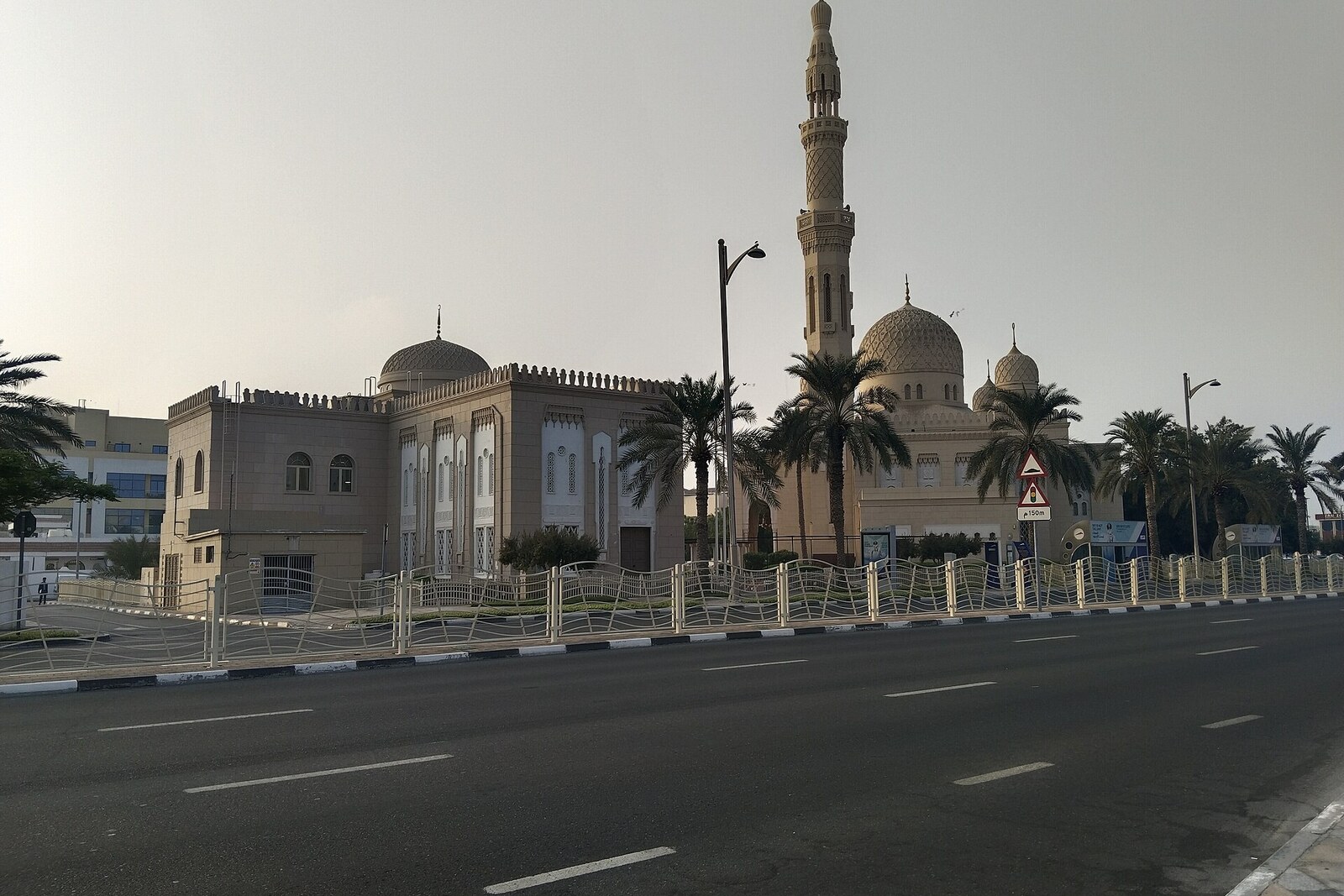
Look around first
What to notice
- Light stone, slender verticals, columns, and space for communal prayer.
The story of the place
Jumeirah Mosque has a rare quality for a big city: it feels both solemn and open. Light stone separates it from the street traffic, slender lines lift the building above everyday bustle, and the whole composition reminds us that the mosque was designed not just as an architectural landmark. Here people pray, welcome guests, and talk about things that are often hard to discuss without tension.
Construction began in 1975 by order of Dubai's ruler, Sheikh Rashid bin Saeed Al Maktoum. The client wanted the mosque's appearance to reflect a broader Middle Eastern tradition, so examples were sought in Syria and Egypt—lands where stone religious architecture had evolved over centuries.
Inside the mosque hangs a photograph taken in 1977. It lacks that familiar sense of completion: scaffolding surrounds the building, work is underway all around. Such a photo brings the mosque out of the world of eternal monuments into very recent history. Dubai was changing rapidly then, and this new temple grew alongside the city.
The mosque opened for prayer in 1979. It became a gift from Sheikh Rashid to his son and heir—Sheikh Mohammed. This gesture combined family continuity with state significance. The ruler passed on not a palace or a monument to himself, but a place of communal prayer. Here, stone spoke of the continuation of power, but even more strongly, of the continuation of tradition.
Over time, the mosque took on another role. It became one of those places where Dubai learned to talk to its new residents. By the end of the 20th century, the city had gathered people from many countries. They worked side by side, lived on neighboring streets, met in shops and business districts, but rarely understood each other's customs.
In 1998, Abdullah bin Isa Al Sarkal and several volunteers began inviting foreigners living in Dubai to Ramadan at Emirati homes. Introduction started not with lectures or official speeches, but with hospitality. An Emirati home became a place where one could ask simple questions, observe family life, and feel the rhythm of the evening after a day of fasting.
A year later, Jumeirah Mosque hosted its first Ramadan tent. Guests were welcomed with dates, water, and Arabic coffee. These refreshments followed their own sequence: first a few sips and a bite of something sweet after a long day, then the evening prayer, and afterward—communal Iftar.
Machboos, saloona, thareed, and margook appeared on the table. The names sounded unfamiliar to many guests, but the order of the evening was clear without translation. People who had recently known each other mainly through rumors sat together and shared one meal. A conversation about religion began not with proofs, but with a cup of coffee and a dish passed to a neighbor.
By 1904, these gatherings moved to a historic house with a wind tower in the Al Fahidi district. But it was the tent near Jumeirah that remained in memory as the start of public Ramadan—the time when traditional home hospitality reached out to strangers.
Later, the character of these meetings was vividly embodied in Nasif Qayyed's tours. He was Kuwaiti but spent a significant part of his life in the United States. From 1981 to 2007, Qayyed lived in North Carolina, was married to an American woman, and raised six children.
In 2000, he opened a center there for dialogue between Muslims and their neighbors of other faiths. After the September 11 attacks, attention toward him intensified sharply. Journalists, churches, universities, and the Federal Bureau of Investigation reached out. Some tried to understand what was happening; others sought explanations for their fears.
But along with questions came suspicion. According to Qayyed, his wife and children faced insults. The family eventually left. Thus, a man who had spent years trying to explain one community to another found himself inside the painful rift between them.
In Dubai, he continued that same conversation—right here, at Jumeirah Mosque. Four times a week, without pay, Qayyed sat with guests on carpets between columns. He left architecture for later. First, he suggested setting aside everything heard on CNN and BBC to focus on facts.
For the guide, this was a bold start. It immediately freed up space for uncomfortable questions. There was no need to pretend that visitors had no doubts or prejudices. On the contrary, they could be spoken aloud.
Once someone asked why Islam leads to intolerance and extremism. The question sounded so sharp that other guests, embarrassed, began staring at the ceiling. Qayyed did not get angry. He answered that radicalism is born from social distress and personal deprivation, not from religion.
Perhaps the meaning of such meetings was not for everyone to leave fully convinced. Much more important was something else: a difficult question did not destroy the conversation. A person asked it directly, received a direct answer, and the dialogue continued.
After the tour, Qayyed usually stayed for another half hour or so. He answered those who hadn't dared to speak in front of everyone and took photos with guests. He expressed the meaning of this work simply: perhaps he could touch someone's heart.
Thus, two histories formed around the mosque. One is carved in stone and begins with Sheikh Rashid's order, scaffolding, and a gift to the heir. The other left almost no material traces: a tent, dates, coffee, conversations on carpets, awkward silence after a sharp question. But it is this second history that explains why Jumeirah became more than just a noticeable religious building.
Its stone appearance sought inspiration in Syria and Egypt, while its public life responded to the questions of new Dubai—a city where people with different languages, habits, and perceptions of each other found themselves side by side. Here, hospitality turned into a way of talking, and the mosque became a place where unfamiliarity ceased to be a wall.
Deeper into the story
Open Doors
The "Open Doors, Open Minds" program of Sheikh Mohammed Centre for Cultural Understanding was created to break down stereotypes. Mosque staff answer any questions—from the ritual of ablution to the role of Muslim women. Unlike many places of worship, this mosque emphasizes not just architecture but dialogue.
Fatimid Style
The mosque was built in the late 1970s and styled after medieval mosques of Cairo. Narrow minarets, faceted domes, and decorative bands repeat motifs from the Fatimid era. Despite its youth, the building is included in the list of cultural heritage of the Emirates as an example of traditional architecture of the modern era.
Useful on site
Saturday–Thursday at 10:00 and 14:00, registration 30 minutes prior; closed on Friday.
Checked: June 17, 2026. Check the official source before visiting.You can view the building from the outside without participating in the program. For entry, choose modest clothing and check the conditions for guest visits in advance.