 Guide On Map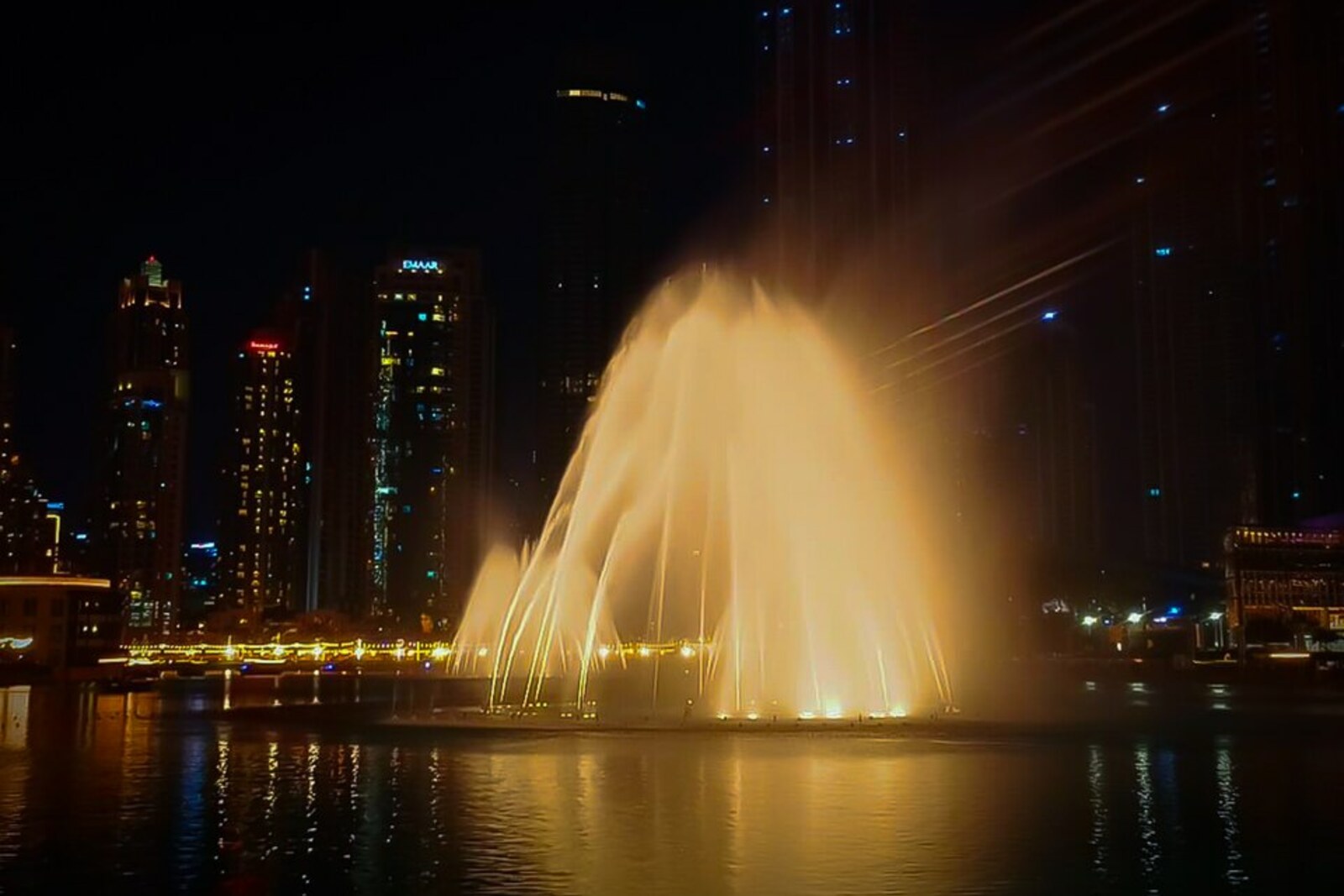
Look around first
What to notice
- Lines of nozzles, fans of jets, light accents, and patterns emerging on the lake's surface.
The story of the place
Lines of nozzles stretch along the lake's edge: they raise water to different heights, while light picks individual splashes out of the darkness. The performance is visible from several sides at once, so the pattern has to come together across the entire surface, not from just one point on the shore. Behind this apparent ease lies the work of pumps, spotlights, and the control room, from which every performance is adjusted.
This fountain has two authors. The first controls the water: making the jets soar, bend, fan out, and gather into patterns. The second author is music. It is music that turns a complex hydraulic system into a performer that seems to hear the rhythm and know when to hold a pause.
But even this performer's name did not originate in an advertising agency's office. In the summer of two thousand eight, Emaar announced a competition among residents of the United Arab Emirates. One hundred thousand dirhams were promised for the best name—a sum substantial enough to spark a real collective brainstorming session across the country.
More than four thousand entries came in. They were submitted by people of more than one hundred nationalities. Formally, only residents of the Emirates could take part, yet suggestions still arrived from abroad. Apparently, the future fountain had not yet been completed, but had already become an international attraction.
The jury had to sort through thousands of options: surely among them were grand metaphors, Eastern images, and names promising majesty, light, wonder, and eternity. The simplest one won: “Dubai Fountain.”
Then an intriguing detail emerged. Fifteen people had proposed this name independently of one another. It was impossible to choose a single winner, so the prize was divided among all fifteen authors who held valid residence visas. Thus, the fountain acquired not only a collective name but collective authorship as well. Emaar chairman Mohamed Alabbar called it a gift to the city. And the city, in a sense, signed that gift itself.
After receiving a name, the fountain needed character. It was created not by pumps, nozzles, and spotlights alone. Chief choreographer Peter Kopik worked with the water in the control room and selected pieces as though assembling the repertoire of a grand theater. Only instead of a ballet company, he had jets; instead of a stage, a lake; and instead of human bodies, a mass of water that cannot be made to freeze in midair even for a moment longer than the laws of physics allow.
The musical choice therefore became an artistic decision. A song's popularity alone guaranteed nothing. Once, Kopik was asked to create a number to the global hit “Gangnam Style” by the South Korean performer Psy. He refused. In his words, the fountain would have turned into a laughingstock. His comparison was almost courtly: it would have looked as though the English queen had suddenly decided to perform this song.
That strictness did not mean a ban on Korean pop music in general. Later, a number to “Power” by EXO appeared in the repertoire. The musicians came to Dubai, and the fountain's performance became part of a major event. It follows that the choreographer rejected not the country or the musical genre, but a particular mood. In his view, the water had a dignity of its own. Not every famous tune suited its stage image.
The most difficult test for Kopik was Michael Jackson's song “Thriller.” At first glance, the choice seems ideal: a composition everyone knows, a distinct rhythm, famous movement. But it was precisely that familiarity that created the problem.
The beat in the song hardly changes. Moreover, viewers remember not only the music, but also the video—the crowd of zombies, sharp turns, synchronized movements, outstretched arms. The human dance there is inseparable from makeup, costumes, and plot. The fountain has neither faces nor hands, nor the ability to step forward. Kopik had to translate the recognizable choreography into a language of rises, falls, bends, and sudden water accents.
Usually, creating one number took two to four weeks. First, a computer model was built in the United States. There, the pattern of the jets could be tested and the future production seen without real water. Then the team flew to Dubai and began adjusting it on site.
It was here that it became clear where computer precision collided with a living element. Water has weight and inertia, wind changes its trajectory, and the enormous pattern has to work equally convincingly for viewers standing on different sides. “Thriller” took five weeks—longer than any other number. The famous dance had to be not copied, but composed anew for a performer with thousands of jets instead of a body.
The encounter with Arabic music was even more difficult. At the beginning of the work, the team sought help from the Dubai Culture and Arts Authority. The choreographers' Western experience was not enough here. They needed to understand another musical tradition, its rhythms, gestures, and ways of moving.
Instead of simply repeating the strong beats, they began looking in the water for images of the geometric ornaments of Islamic art. The jets could spread out symmetrically, form repeating lines, create the likeness of a pattern, and immediately destroy it in order to assemble a new one a second later. An ornament that usually exists in stone, ceramics, or carving became fluid here and vanished as soon as it appeared.
Thus the fountain is constantly engaged in translation. It translates human dance into the movement of water. Musical rhythm into the height and direction of jets. Geometric design into a brief luminous composition. Even global hits undergo strict selection, as though competing for a role in a theater with a very demanding director.
Behind the apparent ease of such a performance lie weeks of rehearsals, team flights, computer models, and endless adjustments. But all this work disappears at the moment of performance. What remains are water and music, as though they had always understood one another.
And that is why “Dubai Fountain” has such an exceptionally precise name. It is simple, almost obvious, chosen at once by fifteen people. It gives no hint of which tune to expect or what pattern will arise next. But it contains Dubai itself—a city where people of more than one hundred nationalities could devise a name at the same time, an American team learned to hear the Arabic tradition, and Korean music and Michael Jackson acquired a new language. A language without words, in which water tells different stories every evening.
Deeper into the story
Water as the district's schedule
Dubai Fountain turns a short walk into an event with anticipation. People claim the edge in advance, restaurants sell the view, bridges grow crowded, and the water begins to command time more strongly than the map.
Useful on site
Free viewing from the promenade; Boardwalk usually 17:45-22:45, AED 25, ticket for a specific date/time.
Checked: June 27, 2026. Check the official source before visiting.Check access to the floating Boardwalk separately. If it is unavailable or unnecessary, listen to the story from the shore: the main composition is visible from there as well.