 Guide On Map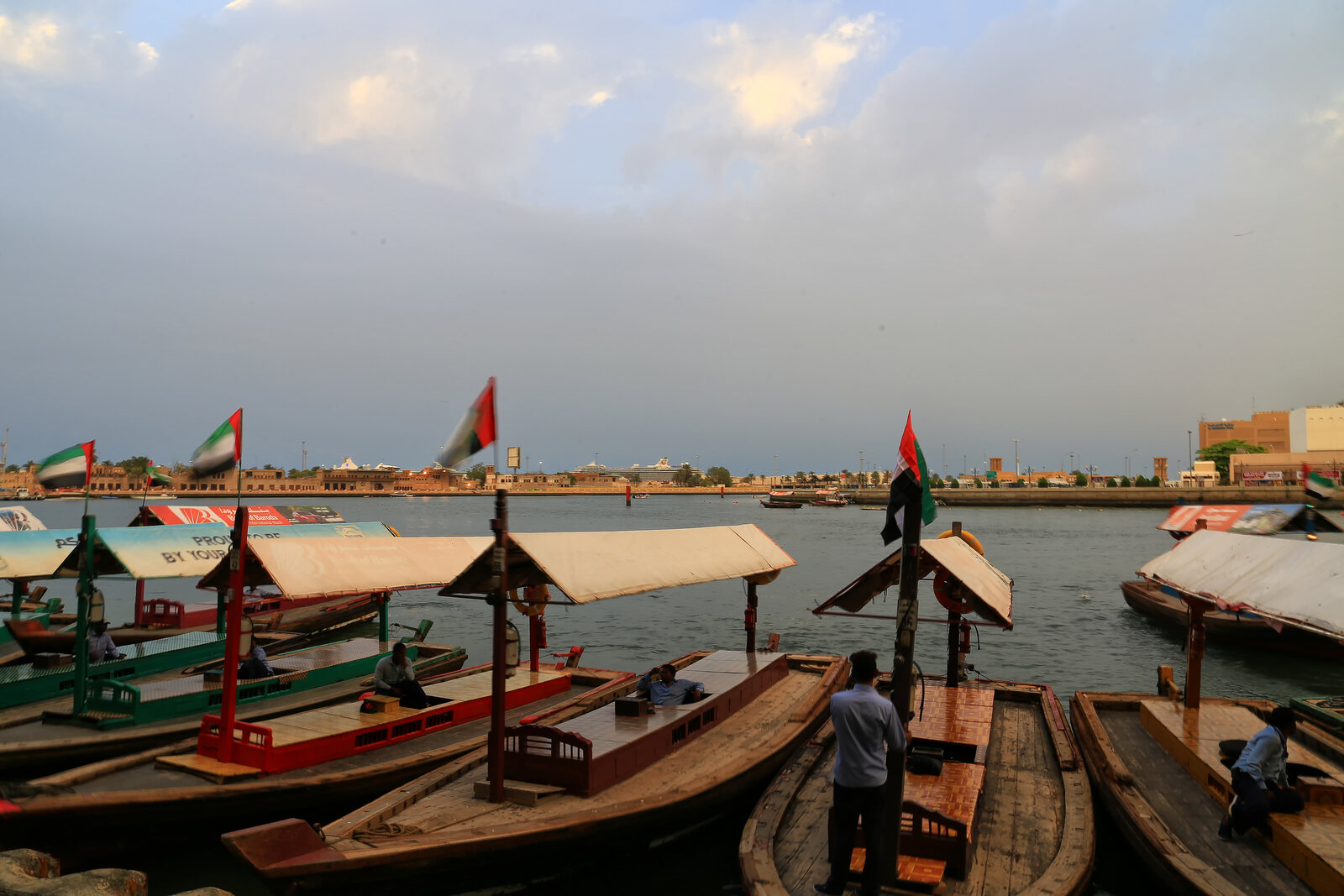
Look around first
What to notice
- Wooden sides, open passenger seats, the work of the helmsman, dhows, and a dense line of built-up banks.
The story of the place
The market has a water door. Instead of steps, there is a pier; instead of a street, the Dubai Creek; instead of a bus, a wooden abra. It approaches the shore, takes on passengers, and almost immediately frees up space for the next one. In this simplicity, it is easy to miss the main point: here, water does not separate one part of the city from another. It connects them faster and more naturally than many roads.
Passengers sit shoulder to shoulder around the open space of the boat. A merchant with a bag, an employee with a phone, a family with shopping, someone who crosses the Creek every day, and a traveler for whom these few minutes become a whole event. No separate cabins and almost no distance. In a city of skyscrapers, this is one of the most direct forms of public transport: one boat, one helmsman, and people who simply need to get to the other side.
For Musa Ali Wahadi, this crossing was a job for nearly his entire life. He came to Dubai with his family as a ten-year-old child. He started in a laundry, then spent half the day helping an Emirati family at home, while spending the rest of his time on a dhow. At some point, it became clear that the boat brought more income, and water turned from a side job into a profession.
Wahadi began transporting passengers across the Creek in 1972. His abra, number ninety-four, was considered by other boatmen to be one of the oldest on the water. The workday started around eight in the morning and ended late in the evening. He took fruit, nuts, and water with him, and put his earnings into a lockable box. Before his eyes passed the whole city every day—not the parade version, but the ordinary one: people rushing to work, returning from the market, carrying purchases, news, and fatigue.
Wahadi remembered a completely different shore. Where banks and dense urban development later appeared, there was a fish market, and beyond that began almost emptiness. About forty boats crossed the Creek then. Later, their number grew to over one hundred fifty. The shores changed, traffic increased, new abras appeared. Fuel became more expensive, daily rental ate into part of the earnings, and competition became more noticeable. But recalling those earlier years, Wahadi did not complain. He explained it all with one short phrase: he liked transporting people.
In that statement lies not only love for the boat. A ferryman on such a crossing subtly becomes the keeper of the city's rhythm. He recognizes regular passengers, notices who is late today, who is carrying an unusually heavy bundle, and who hasn't appeared in a long time. For one person, the trip takes a few minutes, but for the boatman, these minutes add up to years. The city ages before him one voyage at a time.
However, the Creek was not always so accessible to vessels. According to the memories of Suresh Shaholia, son of an early local jeweler, there were only two rowing abras here before the channel was deepened. The boatman worked with oars, and the crossing depended on his strength, the current, and the weather. Water already linked the shores but could not yet pass the flow of goods and people required by the growing trading city.
Sheikh Rashid made the decision to change the riverbed in 1959. The deepening was entrusted to an Austrian company, and the work took six months. For the Creek, this became a nearly surgical event: the previous waterline was made deeper so that larger vessels could enter the city. Thus, geography that seemed given by nature turned into part of the urban plan.
After that, completely different scales appeared on the water. Old resident Len Chapman recalled huge barges from McDermott company. They passed through the Creek with steel structures for oil fields. Next to them, wooden dhows and abras looked almost toy-like. When such a barge entered the channel, all shallow traffic had to immediately yield way. Delaying was dangerous: a heavy vessel could not turn deftly and might simply sweep away a boat.
For a few minutes, the familiar crossing changed character. Boatmen pressed against the edges, engines fell silent or hurriedly steered abras aside, while in the middle of the water slowly passed a steel giant. In one channel met two Dubais. One held on to wood, manual labor, markets, and familiar faces. The other was already being built from metal, oil, engineering calculations, and cargo whose sizes were previously hard to imagine.
In 1975, the bottom was deepened again. Simultaneously, banks were reclaimed, creating space for new roads, piers, loading, and unloading. The Creek was not just adapted to the city—around it, the city itself was reassembled. Where water had previously defined the limit, engineering works created new land. But the old way of crossing the channel did not disappear. On the contrary, the abra survived all these changes and remained necessary.
Therefore, the short path from one bank to another contains much more than it seems. Beneath the boat lies a channel that was deepened for the future. Along this same water went fishing vessels, rowing abras, trading dhows, and heavy oil barges. And among them for decades moved abra number ninety-four, with Musa Ali Wahadi opening his coin box, taking out water, and again taking on passengers.
The surrounding banks became denser, higher, and more expensive. Where emptiness once stood, buildings grew; the number of boats increased several times over; and the city learned to lay roads even where there was previously only water. And yet one of its most resilient lines remains aquatic. Here public transport does not hide underground nor separate passengers from the city with glass. It passes directly on the surface of the Creek—between the market, piers, and the memory of people who simply liked transporting others to the opposite shore.
Deeper into the story
The Creek as a Street, Not a Backdrop
Visit Dubai describes the abra crossing as a classic experience of old Dubai, but it is more useful to view it pragmatically: this is a short link between two banks of one trading system. As the boat pulls away, you see not a 'view of the city,' but infrastructure of trust: people, cargo, purchases, and money cross the water faster than a land detour would explain this route.
Useful on site
RTA: CR1 Bur Dubai Abra Station - Deira Old Souq Abra Station 06:00-00:00; fare 1 AED cash. CR2 Dubai Old Souq - Al Sabkha listed as 24 hours.
Checked: June 28, 2026. Check the official source before visiting.Prepare small cash, free your hands before boarding, and note that traditional abras are not adapted for step-free access.