 Guide On Map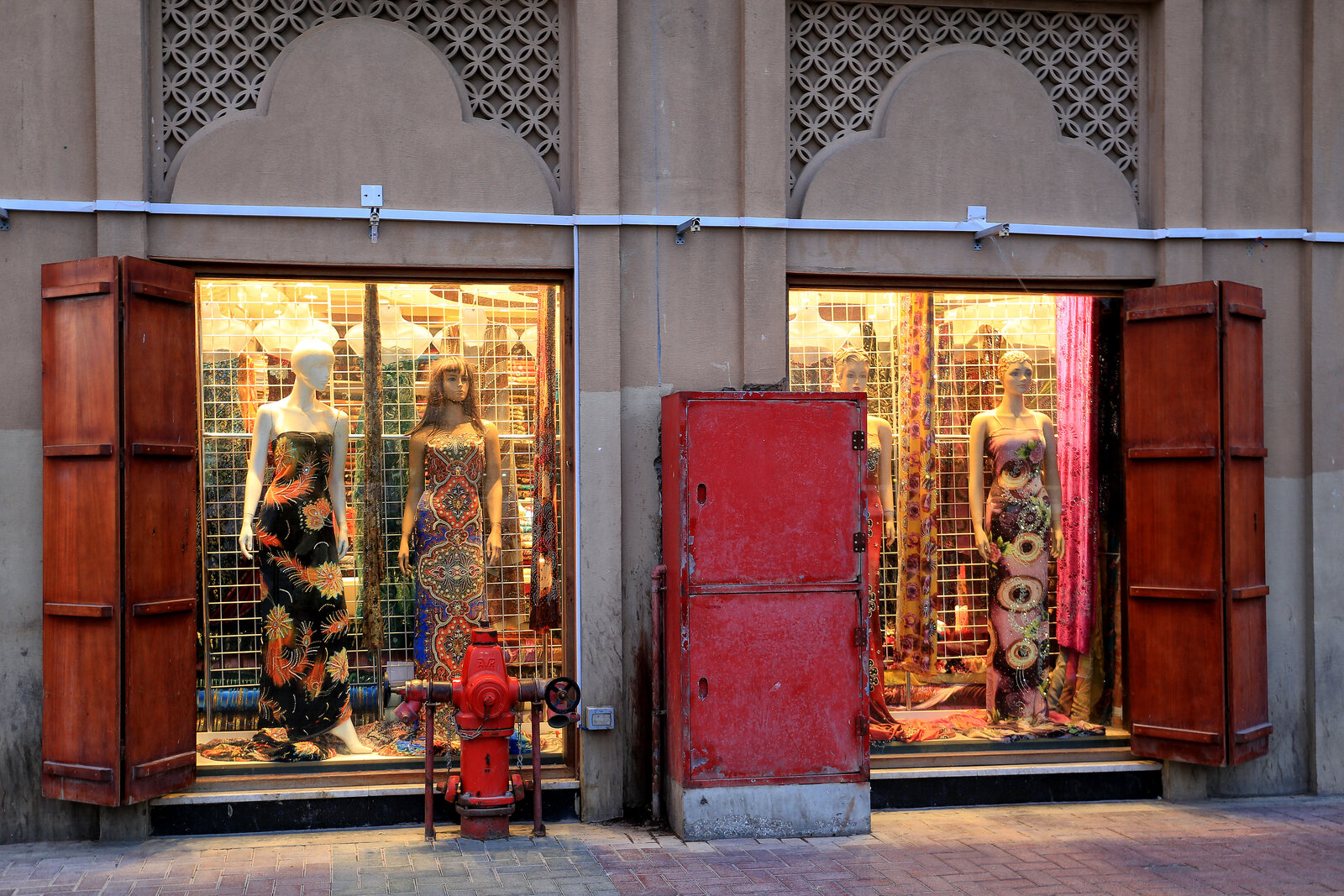
Look around first
What to notice
- Bolts in shop doorways, the edges of fabrics held to the light, narrow passages, and goods set out for customers.
The story of the place
Along Dubai Creek stretches the old Textile Souk. Once, shops operated below, while merchants slept in rooms one floor above; the passages left between the buildings were so narrow that people carrying goods found it hard to pass each other. Even now, bolts stand at entrances and along the passage, closer to customers. Fabric reached this waterfront row on boats from India, while drinking water also came from Basra: local wells quickly ran dry and yielded brackish water.
The Textile Souk has its own way of speaking. Here, you do not have to know the other person's language right away. It is enough to unroll the edge of a bolt, run the fabric between your fingers, hold it up to the light. Thick or thin, festive or everyday, expensive or something you can buy without much thought—the goods begin the conversation themselves. The price comes a little later.
Once, this silent language helped change the fate of an eleven-year-old orphan named Uttamchand Tulsidas Bhatia. He came to Dubai from Sindh in the nineteen twenties and worked for a relative. The boy carried heavy bolts of fabric on his shoulders, including to the ruler's palace. The work was beyond a child's strength, and his employer treated him cruelly.
At the palace, servants noticed the thin porter. The story reached Sheikha Hessa bint Al Murr, the wife of Dubai's ruler, Sheikh Saeed bin Maktoum Al Maktoum. She asked Uttamchand why he did not open a business of his own.
The answer was brief: he had no money.
The Sheikha promised to help, but set one condition—Arabic first. So for a time, the palace became a school for the boy. The Sheikha herself and people from her circle taught him. There, Uttamchand also became friends with her son Rashid, the future ruler of Dubai. Rashid gave him the nickname Vattra—something special.
It was as if his entire later biography had already been hidden in that nickname. In less than a year, Uttamchand spoke Arabic, and by the age of fifteen he had already opened his own textile shop by Dubai Creek. It was called Vattra's shop.
The first goods clearly show how the market worked in those days. Wealthier customers asked for khadi cotton cloth brought from Karachi and Bombay. In Dubai, it was called kalak al-Gandhi—after Mahatma Gandhi, for whom home spinning and Indian cloth became symbols of self-reliance. Less well-off customers chose cheap madar paat. One counter connected different worlds: the palace and the cramped house, the wealthy client and the person who counted every coin, the seaports of India and a small trading town on the Arabian coast.
The market itself was much tighter then than it is today. Shops stood below, with gurfas—rooms where merchants lived—above them. The shops by the creek stood opposite one another so closely that only about four feet, a little more than a meter, remained between them. Two people carrying bolts of fabric could turn the passage into a negotiating room. Here they met, bargained, argued, learned the news, and decided who could be trusted with goods or money.
Paper bureaucracy had not yet grown up around every deal. Agreements were confirmed by word, reputation, and the ruler's own signet ring. In such a city, a merchant's name worked almost like a bank guarantee. One mistake could cost not one sale, but all future deals.
Even the water reminded people how fragile this trading life was. Local wells yielded brackish water and quickly ran dry. Drinking water was brought by sea from Basra in four-gallon containers. Along with fabric, pearls, and letters, the necessities of life arrived on boats. The creek was at once a road, a warehouse, and a lifeline.
Uttamchand soon went far beyond his textile shop. He leased boats and sent divers for pearls to the shores of Basra and Bahrain. Trade brought him a fortune and another nickname—Banyaan Lulu, an Indian pearl merchant. The Bhatia family story says that other merchants came to him for loans. The former boy porter himself became a man who gave others the chance to start a business.
And the nickname Vattra did not disappear. Sheikh Rashid bin Saeed Al Maktoum, after becoming Dubai's ruler, continued to call his childhood friend that until the end of his life. The scale of the city, its quays, and its trade routes changed, but between the two men remained a word coined long ago in the palace courtyard.
This story sounds almost like a fairy tale: a cruel employer, a kind Sheikha, palace lessons, friendship with a future ruler, and a boy who became a wealthy merchant. But one practical detail is especially important. Help begins not with a bag of coins, but with language. The Sheikha seemed to understand that money could open a shop, but conversation with customers would keep it alive. For trade, it is not enough to have fabric. You need to hear what people came looking for.
The market preserves this logic today. Mahesh Advani came to Dubai at the age of eighteen in nineteen eighty-two. For six years he worked at a textile firm, learning about goods, customers, and the unwritten rules of the place. In nineteen eighty-eight, he opened his own business at Al Fahidi market. His shop is still in a building from nineteen fifty-two.
Another merchant, Raja Narwani, remembers his arrival with the precision of a boarding pass: October seventh, nineteen eighty-nine, flight seven hundred one from Delhi to Dubai. For the market, such dates become a personal calendar. There is life before the first day behind the counter, and everything that began after it.
Sunderlal Bhatia, whose parents came to the Emirates in nineteen sixty, tells another telling detail. Sometimes, after closing, goods are left outside the shop, and no one takes them. Here, a bolt of fabric becomes not only something for sale, but also a small test of shared trust.
That is why the market rests on more than walls and display windows. Its true architecture consists of acquaintances, debts, nicknames, family memory, and precisely named arrival dates. Fabric passes from hand to hand, and with it passes the right to be one of their own. Once, this required learning Arabic in the palace. Now dozens of languages are heard around you, but the market's first question remains the same: what exactly do you need—and will we be able to understand each other?
Deeper into the story
Trade You Can Touch
The Textile Souk works well as a transition from architecture to goods. In Al Fahidi, you saw how the city protected itself from the sun; here, you can see how it displayed quality. Fabric requires a gesture: it is opened up, placed in your hand, held to the light, compared by thickness. This is a slow form of advertising that has survived both port logistics and the tourist display.
Useful on site
A trading area with individual shops; hours vary by seller, and the Friday opening may be later. Checked against the official Visit Dubai market profile.
Checked: June 28, 2026. Check the official source before visiting.Do not stand in the middle of the passage, confirm the price before buying, and ask permission before photographing a seller.