 Guide On Map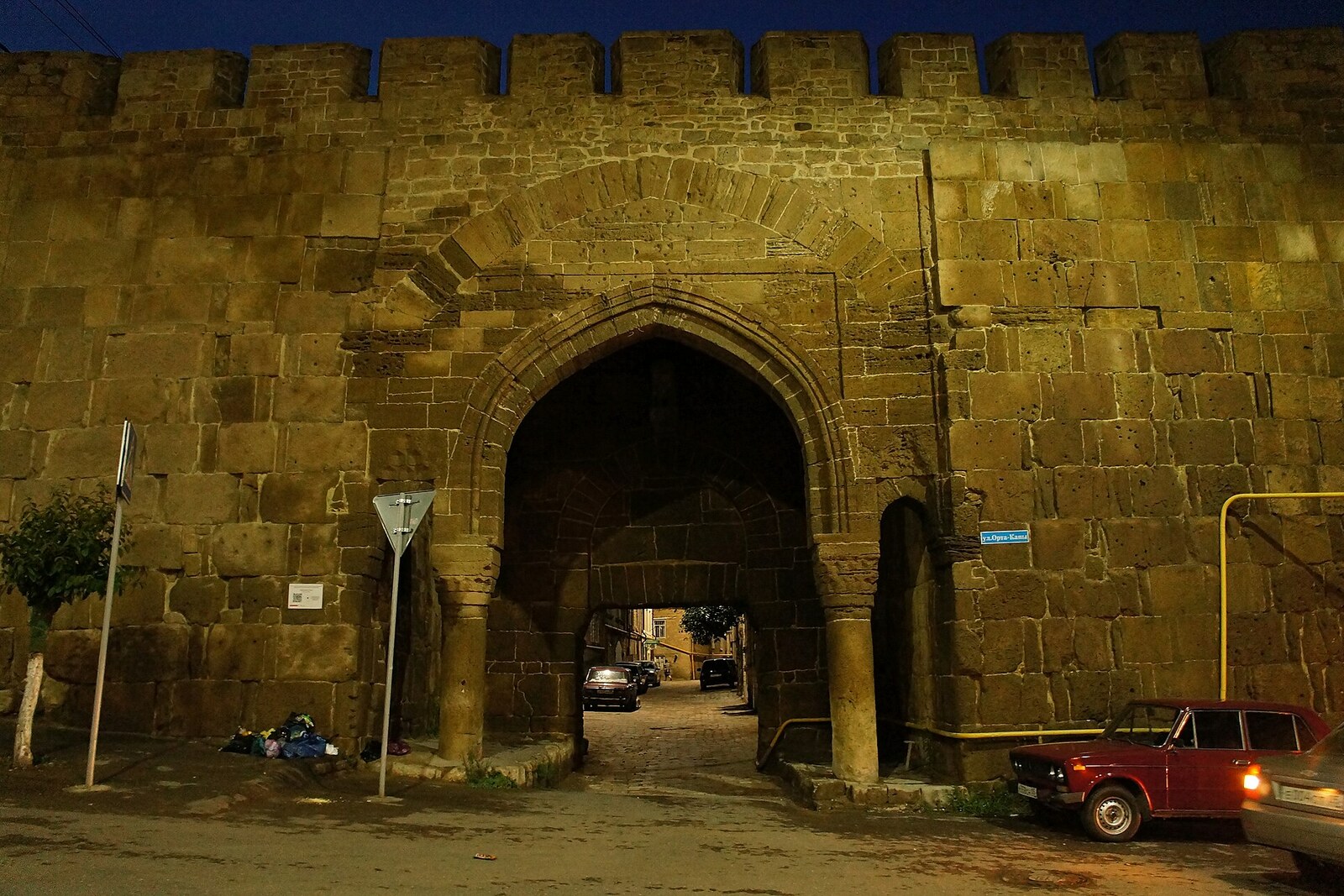
Look around first
What to notice
- Pointed arch
- Carved stalactite capitals
- Upper masonry with loopholes
The story of the place
Through this passage, the route from the south entered upper Derbent and then continued toward the exit through the northern wall. Under the high pointed arch, caravans and travelers underwent inspection: the narrow entrance allowed the guards to decide whom to let into the city. Ornate carved capitals have survived on the façade that met arrivals by the road. In Turkic, the name Orta-Kapy means Middle Gate and is connected with the neighboring Middle Hill.
In eighteen eleven, military engineer Karpov was assigned to put Derbent’s fortifications in order. Russian troops had occupied the city five years earlier, while the treaty confirming its transfer to the Russian Empire had not yet been signed. Derbent was listed as an active fortress. Karpov needed sound walls, passages, and positions for the garrison.
Orta-Kapy was especially important. Through this gate, the road from the south entered the upper part of the city and continued toward a passage in the northern wall. Caravans and people were allowed through here, and they could also be stopped here before the narrow arch. An ornate façade with a large pointed arch and carved stalactite capitals met arrivals where the guards checked whom to let into the city.
Karpov received a structure that had been repaired long before his time. Specialists date the gate’s foundation to the sixth through eighth centuries. A damaged Arabic inscription above the opening gives the four hundred thirty-fifth year of the Hijra—one thousand forty-three or one thousand forty-four. This is the date of another reconstruction: the passage already existed by that time. The decorative wall in front of it is dated mainly to the fourteenth and fifteenth centuries.
The military engineer preserved the lower sections and ordered the upper part to be raised with loopholes. The stonemasons carried out his design: a position appeared above the ceremonial entrance, from which soldiers could defend the approaches to the gate. In this way, Karpov adapted the medieval façade for a garrison of the early nineteenth century.
The following year, the war with Napoleon began. Funds intended for Derbent’s major restoration stopped arriving. The engineering team managed to complete only urgent work, and then the funds were directed to the Naryn-Kala citadel, where soldiers and military services were based. Karpov and his subordinates were not allowed to complete the planned repair of the city walls. The added upper section of Orta-Kapy remained one of the sections they did manage to finish.
The gate’s name is not connected with its age. In Turkic, “Orta-Kapy” means “Middle Gate”; nearby was the urban district of Orta-Tepe—Middle Hill. Above the pointed arch, the upper masonry with loopholes is still visible. It is the work of Karpov’s men, placed above a foundation from the sixth through eighth centuries, an inscription about one of the repairs of the eleventh century, and a façade from the fourteenth and fifteenth centuries.
Useful on site
Exterior viewing from a publicly accessible street; there are no separate visiting hours.
Checked: date not specified. Check the official source before visiting.View the details from the publicly accessible side and do not approach fenced-off sections of masonry, especially after heavy rain.