 Guide On Map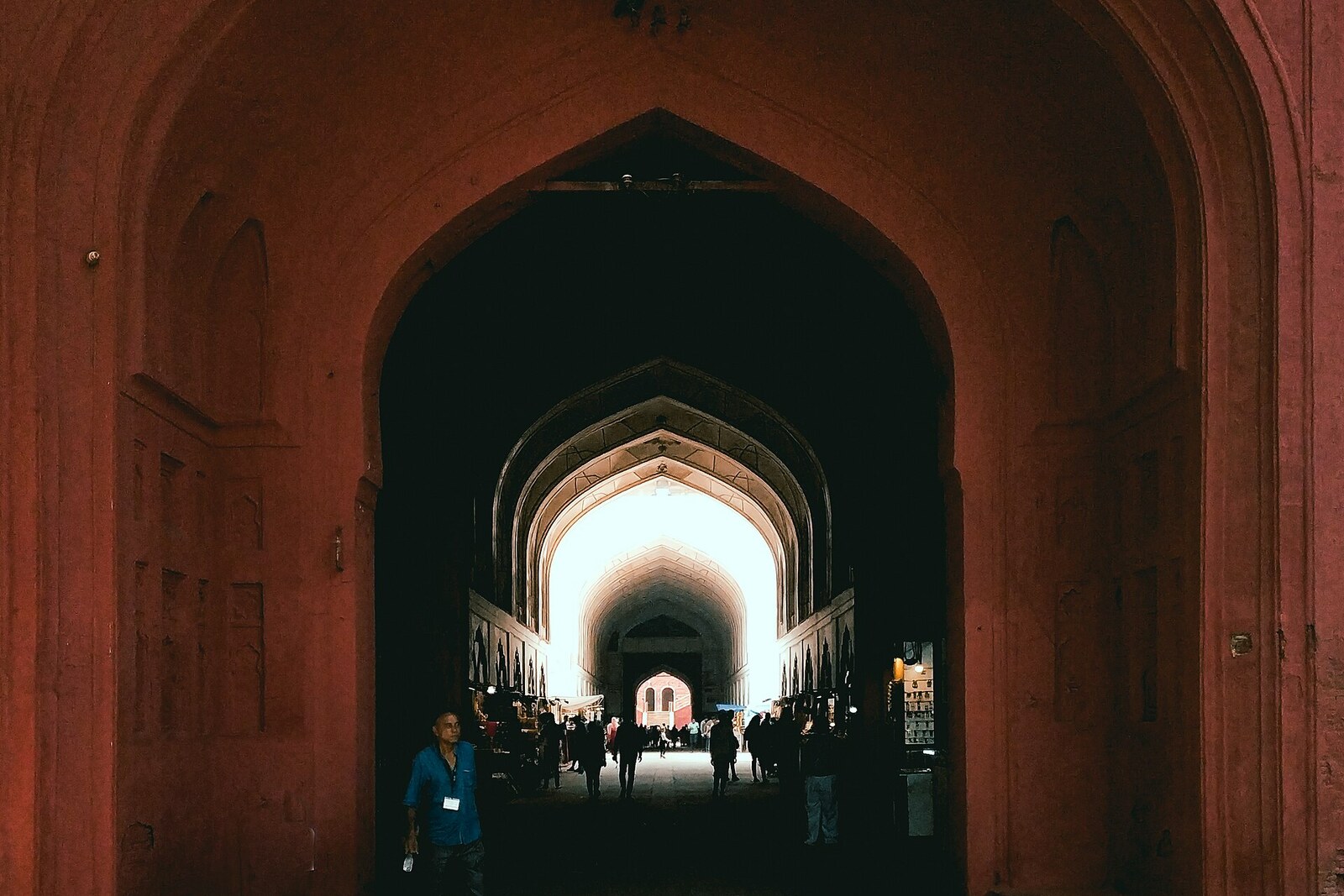
Look around first
What to notice
- The red outer wall
- The northern arch of the barbican
- The gate's three-story facade
The story of the place
The outer red wall in front of the main entrance is younger than the gate itself. It makes you turn toward an arch at the side, although the road originally approached the fort directly. Aurangzeb, the son of the man who built the Red Fort, commissioned this turn.
Emperor Shah Jahan was moving the capital from Agra to the new Shahjahanabad—today's Old Delhi. He made Lahori Gate the main entrance to the palace-fortress. Its name indicated the direction: the western road ran through the city toward Lahore, one of the largest cities of the Mughal Empire, now in Pakistan.
From Chandni Chowk, a bridge crossed the moat and led directly to the gate's three-story facade. The route then continued through Chatta Chowk, a covered market passage, and the drum chamber to the Hall of Public Audience. There the emperor received petitioners and dealt with affairs of state. Anyone entering traveled along a single line from the city street to the place where Shah Jahan sat.
In sixteen fifty-seven, the emperor fell seriously ill. Among the Mughals, the throne did not automatically pass to the eldest son: every adult prince could try to take it with his own army. Aurangzeb, governor of the southern provinces of the Deccan, sought the crown. His main rival was his elder brother Dara Shikoh, Shah Jahan's favorite son and commander of his father's troops. For the loser, it was a matter of life and death: earlier Mughal disputes over succession had ended in blinding, imprisonment, or execution.
Aurangzeb defeated Dara Shikoh's army, occupied Agra, and confined his recovered father in Agra Fort. Dara was executed after his capture. In sixteen fifty-eight, Aurangzeb ascended the throne.
Soon the new emperor ordered the two main entrances to the Red Fort to be fortified. A barbican—an outer wall about ten and a half meters high—was built in front of Lahori Gate. The entrance was moved to its northern side, so the direct approach became a protected turn. A rider or a detachment could no longer gather speed from Chandni Chowk and pass in a straight line to the palace chambers.
Shah Jahan is attributed with a letter from confinement: “Dear son, you have made the fort a bride and covered her face with a veil.” Aurangzeb did not dismantle the wall. The father died in Agra Fort in sixteen sixty-six, and the son ruled for another four decades.
The barbican remains in front of the gate. Even now, those entering first turn toward the northern arch, walk along the outer wall, and only then find themselves before Shah Jahan's facade. From the street, the first thing you encounter is the fortification erected by the son; the gate built by the father opens beyond it.
Useful on site
You can experience this stop entirely from outside. Visiting the inside of the fort will require separate time and checking the current entry rules.