 Guide On Map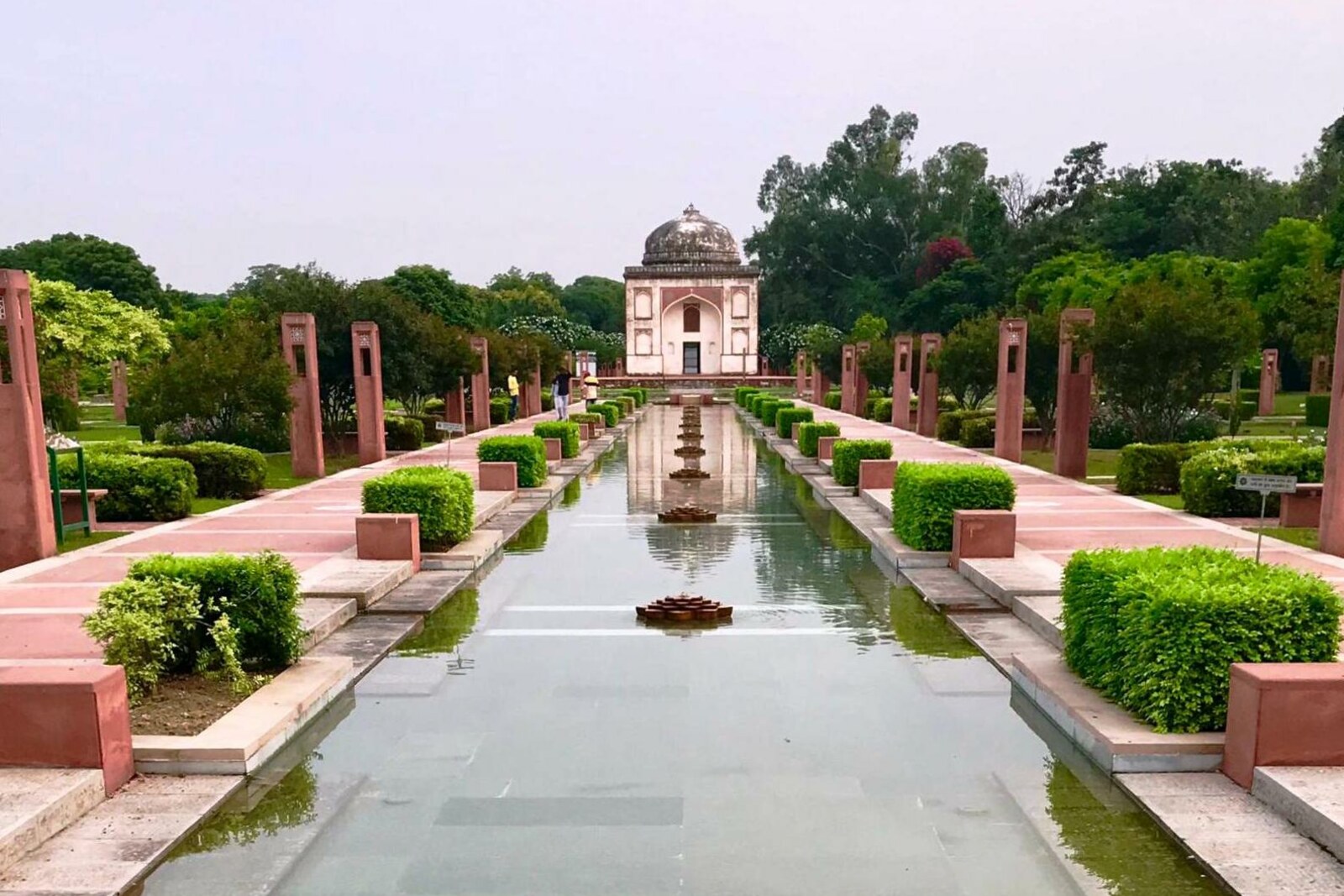
Look around first
What to notice
- Central avenue
- Stone paths
- Water bodies
- Beds of the working nursery
The story of the place
Many trees and flowers for Delhi's avenues began their journey in the nursery, whose grounds are now part of Sunder Nursery Park. Plants were brought here from different parts of India and from abroad, tested to see whether they could withstand the local heat, and suitable species were propagated for the capital's gardens. Stone paths and water bodies run among formal plantings and old tombs, while working beds still stretch along the edges of the site. Saplings continue to be grown and sold here.
In two thousand eight, landscape architect Mohammad Shaheer was given a site where three institutions protected different things. The Central Public Works Department needed a working nursery. The Archaeological Survey of India was responsible for the medieval tombs. The Aga Khan Trust for Culture intended to turn ninety acres of land into an urban park. By then, less than one tenth of the territory was used for growing plants; partly ruined tombs stood among beds, thickets, and construction debris.
The nursery appeared here in the early twentieth century, when the new capital was being built. Plants were brought here from different parts of India and from beyond its borders, tested to see whether they could withstand Delhi's heat, and suitable ones were propagated for the city's avenues and gardens. The word “Sunder” in the name was taken from Sunderwala Burj, which stands on the site. So the park's name joins a tomb with a thoroughly practical establishment where saplings were grown.
Shaheer had to preserve both parts. He earned his living designing public spaces, taught landscape architecture, and had already worked with the Aga Khan Trust for Culture for many years, including at neighboring Humayun's Tomb. Here, he was required to produce a detailed working plan: where paths and channels would run, where beds would be moved, how irrigation would be laid out, and what to do with trees that had grown up without an overall plan.
Around the tombs, Shaheer laid out formal gardens with stone paths, flowerbeds, and water. He aligned the central avenue with the old Grand Trunk Road, toward the gates of Azimganj Sarai. In the other areas, the established tree thickets were preserved, and plants from Delhi's four natural zones began to be planted alongside them: the rocky ridge, the river floodplain, the dry alluvial plain, and the wetland lowland. Nursery workers received twenty acres of new beds along the northern and western boundaries. Shaheer produced drawings down to individual stone details and came to explain them to the craftspeople on site.
He did not live to see the park completed. In November two thousand fifteen, sixty-seven-year-old Shaheer suddenly died in his sleep. Architects, gardeners, stonemasons, carvers, and plasterers continued the work according to his plans. On February twenty-first, two thousand eighteen, the partners opened Sunder Nursery to the public. By then, twenty thousand saplings had been planted, water bodies had been created, and monuments had been restored.
A separate management trust was created to maintain the site: revenue from tickets and events was to be returned to caring for the park. And the nursery was not closed. Plants are still grown and sold in its northern and western sections—there, the name “Sunder Nursery” remains literal.
Useful on site
Open daily from 7:00 to 22:00; last entry at 21:00. Ticket: 50 INR for adults (India/SAARC), 25 INR for children aged 5–12, 200 INR for international visitors; children under 5 and people with special needs enter free.
Checked: June 28, 2026. Check the official source before visiting.The park has its own visiting rules, unrelated to Humayun's Tomb Complex. Stay on the paths in the natural zones, and do not try to cover every side path in a single walk.