 Guide On Map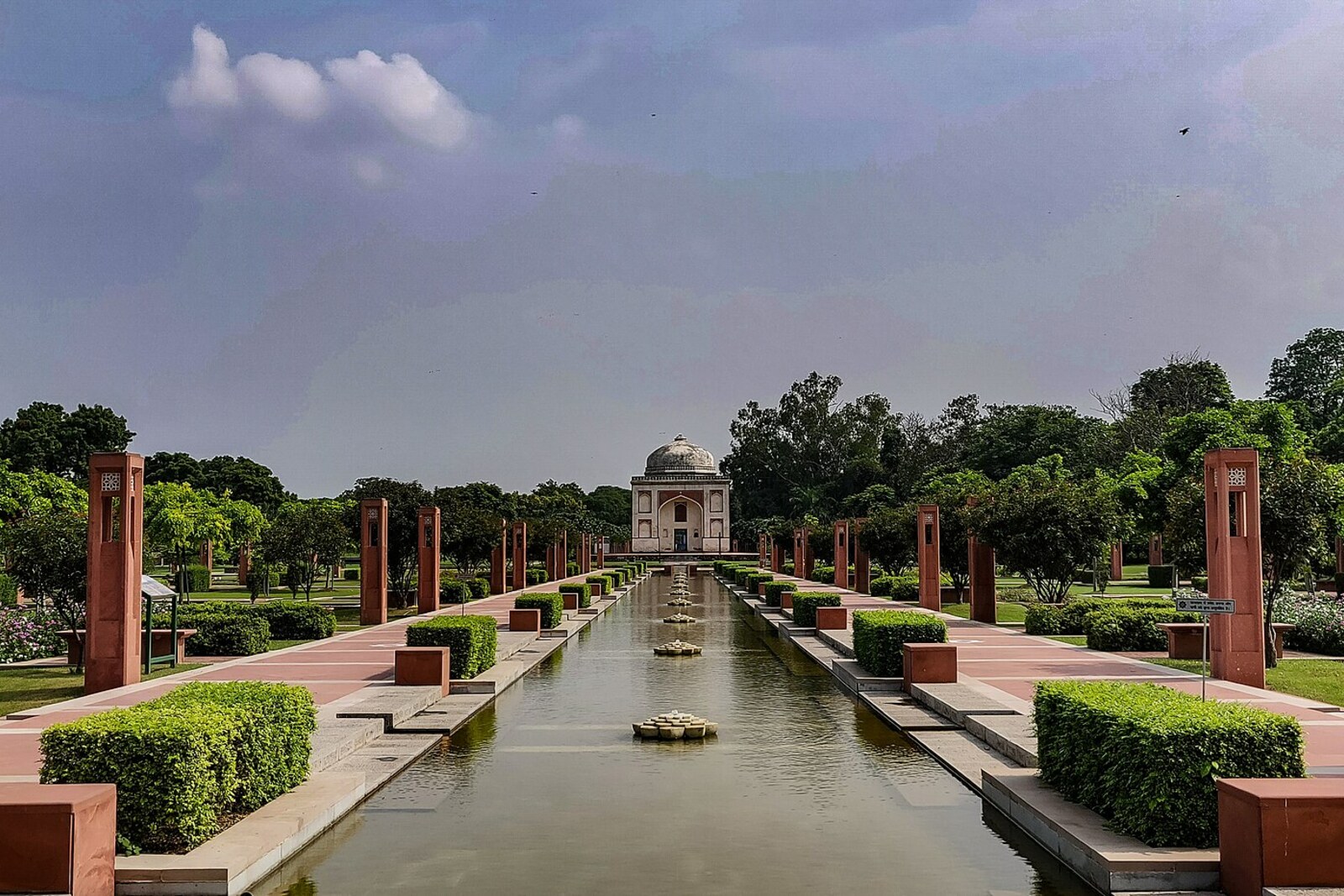
Look around first
What to notice
- The Qur'anic inscription above the doorways
- Stars in radiating circles
- The carved stone dome
- Unreconstructed sections of ornament
The story of the place
Sunderwala Burj was built as a garden tomb in the early Mughal period. It was placed beside the Nizamuddin dargah and surrounded by a separate garden; its rich decoration suggests the burial of a person of high rank. The stone dome is carved to resemble a Persian wooden ceiling, a Qur'anic inscription runs above the openings, and among the starry circles are sections of ornament that restorers chose not to redraw by guesswork.
In nineteen thirty-six, the epigraphist Muhammad Ashraf Husain published a corpus of inscriptions on protected monuments in Delhi. His work was to decipher old calligraphy and record the text while plaster and stone still allowed it to be read. He described Sunderwala Burj with complete honesty: “an unknown tomb, locally called Sunderwala Burj.”
The building was erected in the first half of the sixteenth century, at the very beginning of the Mughal period in Delhi. It is a mausoleum once surrounded by its own garden. Its proximity to the Nizamuddin dargah and its costly decoration suggest that a person of high status was buried here. Documents do not say who commissioned the tomb or who lies in the grave.
The craftsmen did, however, leave another text inside. Above the doorways, they ran the first nine verses of the sixty-second surah of the Qur'an—“The Congregation”—along every wall. In the last of these, believers are called on Fridays to leave trade and go to prayer. Higher up, plasterers arranged stars in radiating circles. The stone dome looks like a carved wooden ceiling from Persia: such work could have been paid for by a family wishing to mark the rank of the deceased even without a portrait or statue.
But neither the Qur'anic band nor the medallions bearing the symbol of faith names the deceased. Historians allow that the name may have been on a lost marble slab: after the plundering of the nineteenth century, many tombs here lost their grave markers and inscriptions. This is a supposition, not an established fact. Husain himself found no historical inscription here, although he was able to read the religious text almost in full.
By the beginning of the restoration in two thousand seven, water and earlier repairs had damaged some of the letters. The team from the Archaeological Survey of India and the Aga Khan Trust for Culture invited a calligrapher from the neighboring Nizamuddin Basti. He had to continue another person's hand from four hundred years earlier: restore the missing words in the same script without turning conjecture into an original. Specialists in the Qur'an checked the text. The missing letters were restored, while ornament in places where its pattern could not be proved was left unreconstructed.
The name, too, tells us nothing about the person buried here. “Burj” means tower; “Sunder” can be translated as “beautiful,” but the origin of the local nickname is unknown, and sources name no person called Sunder here. Later, the nursery laid out around the old tomb adopted this name. The inscription inside can be read again, the name of the deceased remains lost, and Sunderwala Burj now gives its name to all of Sunder Nursery.
Useful on site
The monument is inside Sunder Nursery; it follows the same opening hours and ticket arrangements as the park.
Checked: June 28, 2026. Check the official source before visiting.Look at the ceiling from the floor, and do not touch the cleaned plaster. If entry is not allowed, appreciate the restored proportions and surroundings from the permitted distance.