 Guide On Map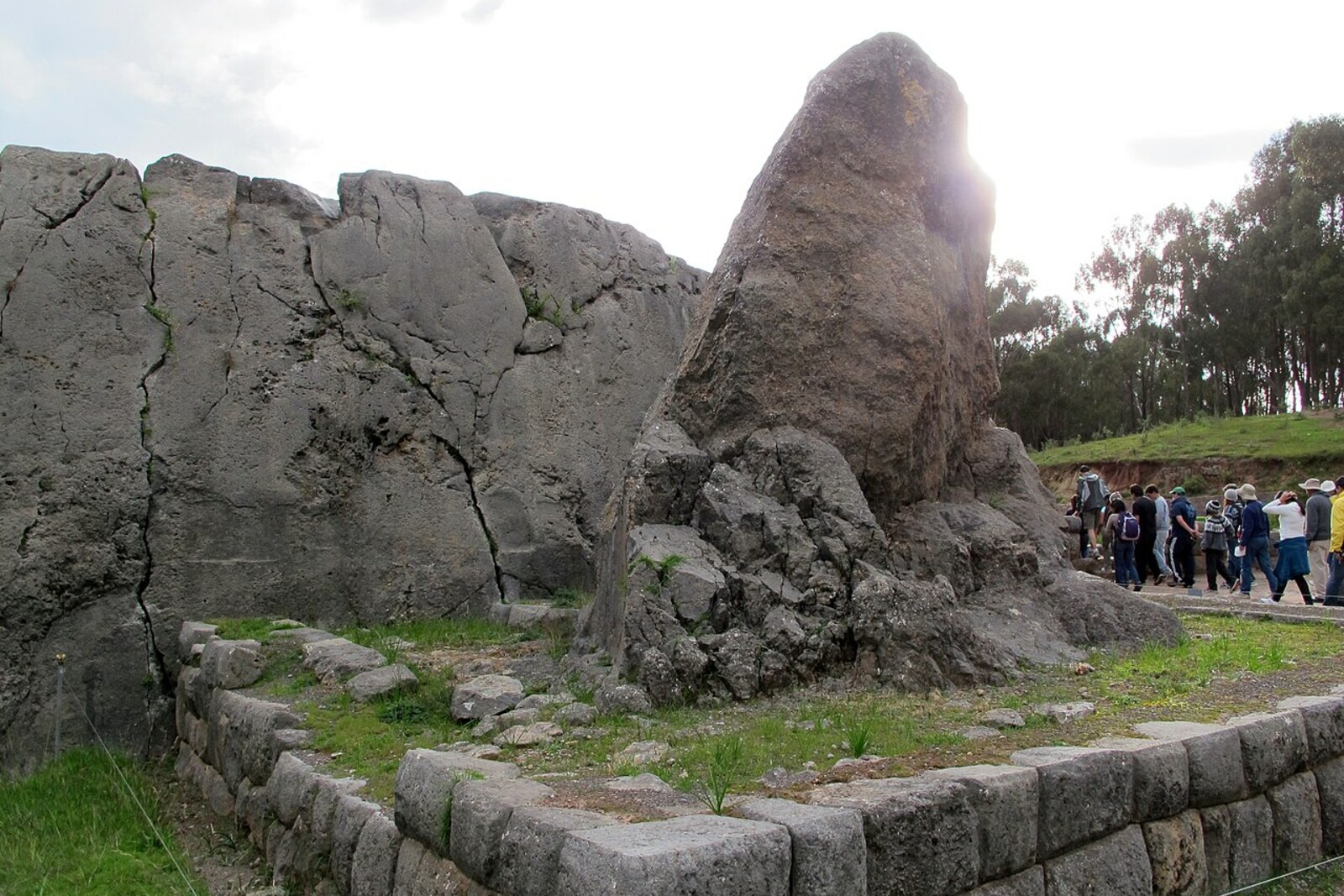
Look around first
What to notice
- Zigzag channel
- Semicircular terrace
- Stone niches
- Passage inside the rock
The story of the place
The semicircular terrace by the rock used to be more confined: the walls around it rose about two meters above the present level. Participants in the rite may have gathered in the stone niches, or ancestral mummies may have been placed there, although archaeologists have not proved this. A channel for ritual libations runs across the top of the rock: liquid followed a broken course, then divided into two channels, probably used for divination. Deep inside, the Incas widened a natural crack, smoothed its walls, and carved a niche, making the rock part of the ceremonial space.
The name Q'enqo appeared only after the Incas. It means “bend” or “zigzag” and describes the channel carved across the top of the rock. What the sanctuary was called by its creators is not known for certain. Archaeologists suggest that this is part of Patalacta—the country estate of the ruler Pachacuti. Early chroniclers place Patalacta on this hill, beside the Pilcopugio spring, and say that Pachacuti built houses here for sacrifices, then died in one of them.
Pachacuti turned the holdings of Cusco into a vast empire. Toward the end of his life, he had to decide what would become of his body and property. The office of ruler passed to his son, while the estates of the deceased remained with his panaca—the lineage that lived off these lands, supported servants, and maintained the ancestor cult. The dead man's mummy took part in ceremonies and received offerings; people addressed it through priests when the consent of the royal lineages was required.
As he was dying, Pachacuti ordered his son and heir, Tupac Inca Yupanqui, to place his body in the houses of Patalacta. According to the chronicler Juan de Betanzos, relatives dressed the deceased, laid him in a large new clay urn, and set a golden image of Pachacuti on top. It stood in for the ruler before those who came to pay homage. His successors continued to make sacrifices here for the health and well-being of the reigning Inca. Thus, one person's order gave his descendants both a possession and a duty: to live off the deceased man's estate while also maintaining his posthumous court.
The surviving layout of Q'enqo fits this arrangement. The semicircular terrace was once much more confined: the walls enclosing it rose about two meters higher than they do today. Selected participants in the ceremony may have sat in the niches, or ancestral mummies may have been kept there, although that can no longer be proved. A pacha—a channel for ritual libations—was made on the rock. Liquid ran along a zigzag, then split between two grooves; probably, divination was performed by its course. Archaeology has not established what exactly was poured here: water, chicha, or the blood of a sacrificial animal.
Inside the rock, the Incas widened a natural fissure, polished the stone surfaces, and cut out a niche. In nineteen thirty-five, the archaeologist Luis Valcárcel found human remains and a metal plate in this chamber. The discovery confirms the ritual use of the passage, but it does not prove the popular story of a “table for human sacrifices.” It is also unknown whether Pachacuti's mummy was kept specifically in the underground chamber: Patalacta covered a far larger area than the rock open to visitors.
After the Spanish conquest, Pachacuti's lineage lost first the ruler's golden double, and then his body. The mummy was moved from Patalacta to Tococache—the present-day district of San Blas, where the panaca itself was also resettled. In fifteen fifty-nine, the corregidor of Cusco, Juan Polo de Ondegardo, who had been charged with ending the veneration of dead Incas, found the body and took it from the descendants. At the beginning of the following year, the mummy was sent to Lima and placed in the Hospital of San Andrés. There it was shown to Spaniards, but kept away from the Indigenous population.
Three decades later, the Jesuit José de Acosta still saw Pachacuti's gray hair, gold plates in place of eyes, and the mark of an old wound on his head. He also recorded that the bodies of the Incas had already badly deteriorated. The last report of them dates to sixteen thirty-eight; later searches at the hospital found nothing. At Q'enqo, nothing remains of Pachacuti's posthumous court: neither the body, nor the golden image, nor the houses. The zigzag channel survives—the feature from which the place received its present name, when the name Patalacta had already ceased to be undisputed.
Useful on site
DDC Cusco lists the hours for Sacsayhuamán Park as 07:00-17:30; before leaving, check the current schedule and the COSITUC ticket.
Opening hours by day
Move slowly through the narrow passages, let people coming the other way pass, and watch the surface underfoot. Do not remove stones or touch vulnerable carved details; in low light, limit yourself to the outside section.