 Guide On Map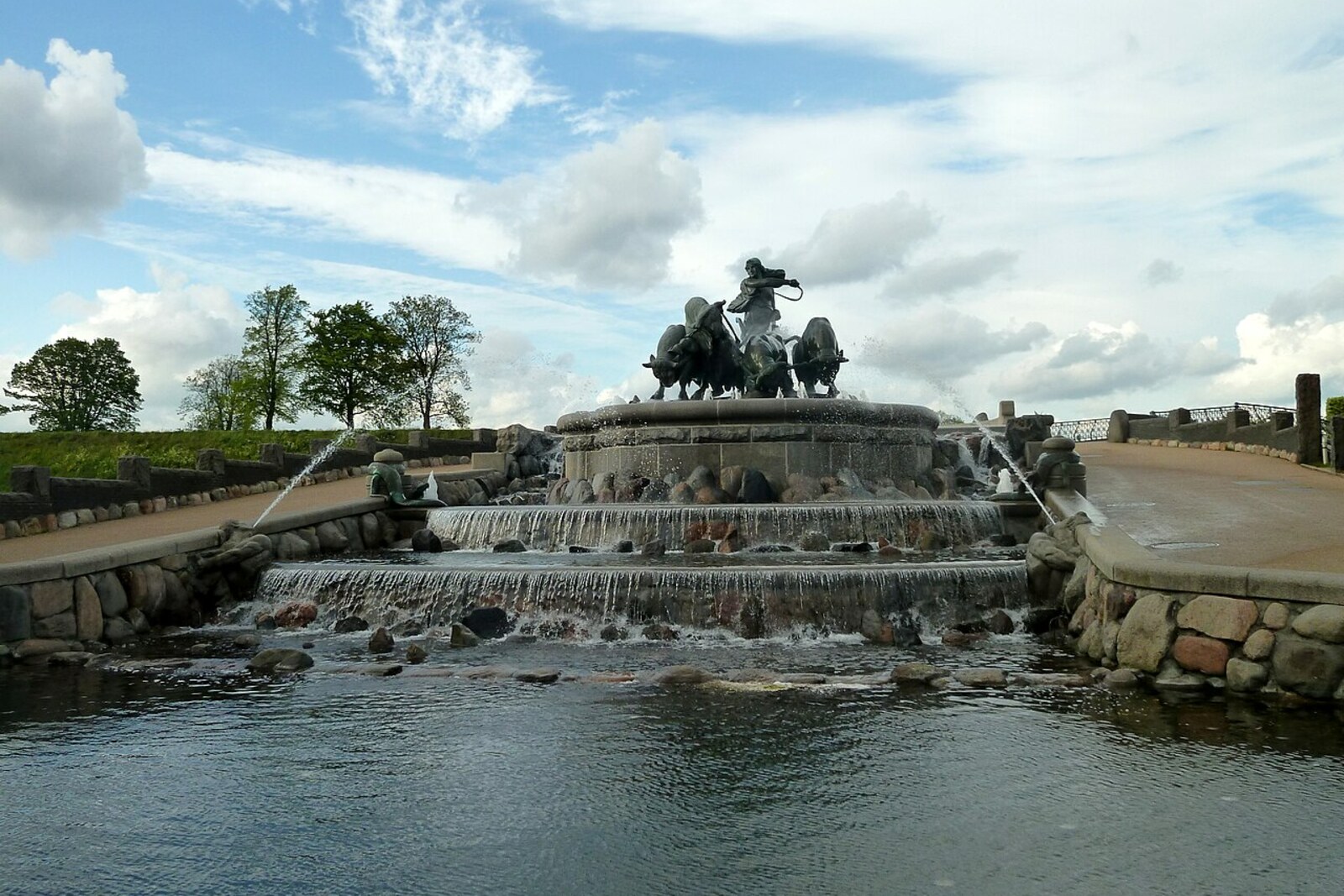
Look around first
What to notice
- Four bronze oxen
- The fountain cascade
- Gefion's plow
- The Little Mermaid on a coastal rock
The story of the place
At the Langelinie waterfront, water gathers in a cascade around four bronze oxen harnessed to a plow. Nearby, on a coastal rock at the entrance to the harbor, sits the small Little Mermaid. These two sculptures made this stretch of shore a place visited by both Copenhageners and newcomers: one rises above the water as an entire mythological group, while the other nearly disappears against the harbor. By the oxen, stone and jets of water continue the movement of the plow, as though the shore has not yet had time to solidify.
Gefion Fountain appeared here thanks to a brewery. For its fiftieth anniversary, the Carlsberg Foundation offered Copenhagen fifty thousand kroner for a large public fountain. City councilors added the same amount and announced a competition. The sculptor Anders Bundgaard won it with a group intended for what is now Dantes Plads. The committee responsible for public art chose another site—Langelinie by the harbor. After several years of approvals and a trial installation of a full-size plaster model, the bronze fountain was completed in nineteen oh eight.
Its official name recounts the entire scene: “Gefion Ploughing Zealand with Her Oxen.” It is an ancient legend recorded in medieval Scandinavian texts. The Swedish king Gylfi promised Gefion as much land as she could plow in a day and a night. Gefion brought her four sons, whom she had borne to a giant, turned them into mighty oxen, and harnessed them to a plow. They cut so deeply into the earth that they tore it away from Sweden and pulled it out into the sea. According to the legend, this piece became Zealand—the island on which Copenhagen stands. That is why exactly four oxen rise above the water here: they are Gefion's sons, while the stones and streams beneath their hooves depict the birth of the island.
When The Little Mermaid was installed nearby five years later, the fountain remained Langelinie's main attraction. Only several hundred casual onlookers gathered for the unveiling of the new statue.
The Little Mermaid was commissioned by Carl Jacobsen, owner of the Ny Carlsberg brewery, who spent part of his earnings on sculptures and museums for Copenhagen. In nineteen oh nine, he saw a ballet based on a fairy tale by Hans Christian Andersen at the Royal Danish Theatre. Ellen Price performed the leading role—a Royal Danish Ballet dancer who lived for the stage and built her success with her own body—but she refused to pose nude for the monument.
The sculptor Edvard Eriksen preserved Price's image in the face, while his wife Eline posed for the body. The ballerina's decision remained in the bronze itself: the mermaid received the features of one woman and the figure of another. Jacobsen intended her for the entrance to Copenhagen Harbour and gave her to the city on August twenty-third, nineteen thirteen.
It was the staff of the Danish Tourist Association who then brought crowds to the small monument. In the nineteen thirties, they studied why foreigners came to the country and found that Andersen meant more to visitors than many official attractions, while The Little Mermaid was more popular than the National Museum of Denmark. After that, Andersen's fairy-tale Copenhagen appeared in guidebooks, and the tourist association began producing souvenirs with this figure. By the end of the decade, foreign writers were already calling her the embodiment of Denmark.
On the night between April twenty-fourth and twenty-fifth, nineteen sixty-four, unknown people sawed off The Little Mermaid's head and carried it away. The artist and professional provocateur Jørgen Nash claimed responsibility only thirty-four years later, after the statute of limitations had already expired; officially, the crime remained unsolved.
That same day, city employees took the headless statue to a foundry workshop. Eriksen's nineteen thirteen mold was still kept there. A new head was cast from it, and The Little Mermaid was returned to her rock. The missing head was never found: the body before the harbor remained from Jacobsen's gift, while the face was recast after that night.
Useful on site
Accessible around the clock; free.
Checked: June 28, 2026. Check the official source before visiting.View the fountain from several sides, then walk to The Little Mermaid and take in her actual scale against the harbor. Both works are outdoors.