 Guide On Map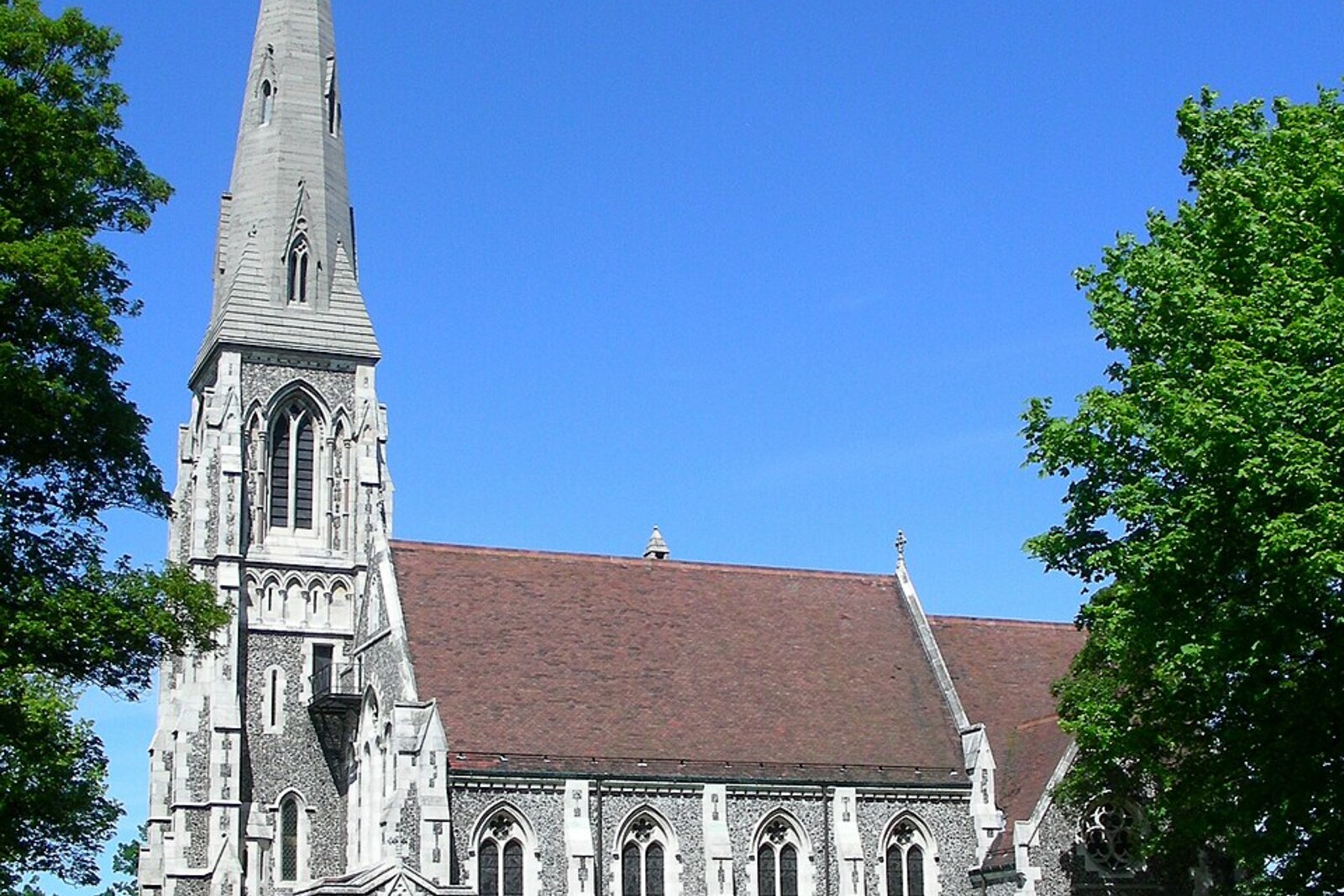
Look around first
What to notice
- Pointed stone spire
- Lancet windows
- Western stained-glass window
- Brass memorial plaque
The story of the place
The church bears the name of Saint Alban, the earliest British saint, and stands by Kastellet, on a strip of land in front of the fortress moat. Copenhagen's English-speaking congregation gathered here, especially important to sailors serving at the nearby harbor. The tall stone spire and narrow lancet windows bring a familiar English parish look to the Danish ramparts. Above the western entrance, a stained-glass window brings Alban together with revered saints of England and Denmark.
Four days before this church's consecration, the man who had worked for its creation for almost half a century died.
Robert Stevenson Ellis, Copenhagen's Anglican priest, wanted to give the local English-speaking community a permanent church. When he arrived here in eighteen thirty-four, public worship by another denomination required separate royal permission. The Anglicans obtained that permission and rented a hall on Store Kongensgade. The congregation supported itself: parishioners made written promises to pay contributions for at least two years, and each of the nineteen pews bore the name of a donor.
The Constitution of eighteen forty-nine permitted the free practice of religion. Under Ellis, a building committee was formed, which began raising money and looking for a site. In eighteen fifty-seven, the owner refused to renew the lease on the hall. The Anglicans had to use a prayer room on Stormgade, available only on Sunday mornings. Appeals to the king and the Ministry of War brought no land, and fundraising in Denmark and in British newspapers proceeded slowly.
The situation changed after the marriage of Danish Princess Alexandra of Denmark to Edward VII, then the British heir and Prince of Wales, who would later become king. Alexandra of Denmark set out to help the congregation, raised funds, and sought permission to build. The committee asked for a site by the harbor: many parishioners were sailors who needed a church near their place of service. The Ministry of War eventually assigned land on an open strip in front of Kastellet. That is how the church came to stand by the fortress moat, far from the district where parishioners had previously rented rooms.
By eighteen eighty-five, committees in Copenhagen and London had raised two hundred thirty-five thousand kroner. On September nineteenth, Alexandra of Denmark laid the first stone here. Two years later, she returned with Edward VII for the consecration of the already completed building.
The church was dedicated to Saint Alban, Britain's earliest Christian martyr. According to church tradition, in Roman times he sheltered a persecuted Christian priest, then exchanged clothes with him and allowed him to escape. Alban was arrested in the priest's place; he refused to renounce the new faith and was beheaded. A detailed account of this was written down only several centuries later, so the change of clothes and the escape belong to tradition. For an English church in Copenhagen, they chose the name of the earliest British saint. In the western stained-glass window above the entrance, Alban is depicted beside Saint Edward the Confessor, Saint Cnut, and Saint George.
Ellis left his post in eighteen eighty-three after forty-nine years of service. He died four days before the consecration scheduled for September seventeenth, eighteen eighty-seven. The parishioners raised money once more and installed in his memory the stained-glass window nearest the organ. It shows the aged Simeon holding the infant Christ—a scene from the prayer “Now lettest thou thy servant depart.” A brass plaque beneath the window states exactly how many days Ellis fell short of living to see the church opened.
Useful on site
April–September: Monday–Saturday 10:00–13:00, Sunday 13:00–16:00. October–March, the church is closed to visitors. Access is limited during services.
Checked: June 28, 2026. Check the official source before visiting.First look at the church from outside. If it is open, go inside briefly and do not interrupt a service or a private event.