 Guide On Map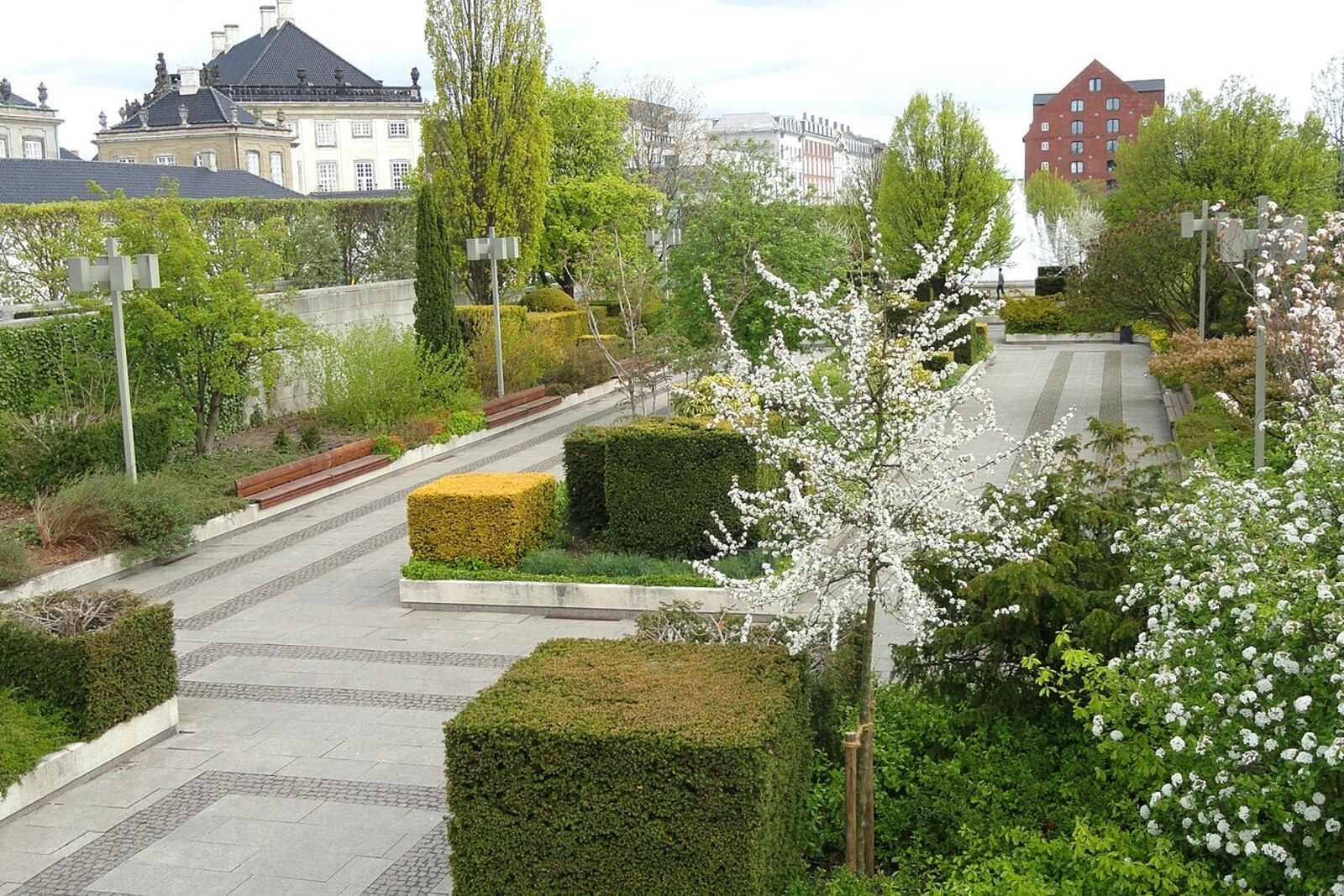
Look around first
What to notice
- Central circular basin
- Bronze columns
- High hedges
- Raised platforms
The story of the place
Today's flowerbeds and high hedges occupy the former Larsens Plads pier. First, a shipyard and lumberyard were noisy here; then a steamship-line terminal operated by the water, from which Danes left for America without changing ships through foreign ports. Ships took passengers about once every two weeks, and their trunks carried clothes, tools, and everything with which a family intended to begin life across the ocean. The circular basin and bronze columns stand above the place where people once said goodbye to those they often saw for the last time.
In nineteen eighty, the A.P. Møller and Chastine Mc-Kinney Møller Foundation bought this stretch of waterfront for one purpose: to create a public garden between Amalienborg and the harbour. The foundation was headed by Mærsk Mc-Kinney Møller, a shipowner who turned the family shipping company into an international conglomerate. He wanted to give the garden to the Danes and commissioned the Belgian architect Jean Delogne to design it.
The gift immediately sparked controversy. The foundation selected the architect without a competition, discussions with residents, or the involvement of Danish landscape specialists. Professionals believed they had been excluded from deciding the fate of a key waterfront site. They disliked the high walls, strict symmetry, and Arnaldo Pomodoro's bronze reliefs. City residents accepted the garden much more calmly: among the walls and hedges, they could sit by the water while remaining close to the palace square.
In May nineteen eighty-three, Møller opened Amaliehaven and handed it over to the Danes. The state and the City of Copenhagen became its owners. Forty-one years later, the garden required a major renovation: the fountains, lighting, water supply, and structures beneath the raised platforms had worn out. The same family foundation made a new contribution, and after the restoration, Ane Mærsk Mc-Kinney Uggla, the shipowner's daughter and the foundation's new chair, opened the garden. The plantings were restored to the original design, the walls were repaired, and the fountain equipment was replaced. The central circular basin and the bronze columns before it belong to that same gift which her father opened here in nineteen eighty-three.
The choice of site was also connected with the Møller family's trade. Before the garden, this was Larsens Plads, a pier named after the shipowner and shipbuilder Lars Larsen. At first, he maintained a shipyard and a lumberyard here. Later, the financier Carl Frederik Tietgen established a terminal for the Thingvalla Line steamship service on the vacated site.
Before this line appeared, Danish emigrants usually reached America through German or British ports. Tietgen proposed a direct route from Copenhagen to New York, calling at Christiania—present-day Oslo—and Kristiansand. Steamships left Larsens Plads about once every two weeks. The company emphasized that passengers would not have to clear customs at connecting ports or look for an interpreter: officers, doctors, and staff spoke Scandinavian languages, and baggage could be checked through to a further destination.
For farmhands, maids, artisans, and impoverished peasants, this made practical sense. Their trunks held clothes, tools, and the rest of the belongings a family could take with it. In Edvard Petersen's painting Emigrants at Larsens Plads, painted in eighteen ninety, people say goodbye beside such baggage while a transatlantic steamship is being loaded behind them. Many passengers later reached the agricultural states of America, where they founded farms and Danish settlements; for those seeing them off at this pier, departure often became the last meeting.
Passenger voyages to America ended in nineteen thirty-five. Nothing remains of the terminal or warehouses beneath today's flowerbeds.
The name “Amaliehaven” means “Amalia's Garden” and comes from neighboring Amalienborg. The palace itself was named after Sophia Amalia, the Danish queen for whom the country residence Sophie Amalienborg was built nearby. It burned down in sixteen eighty-nine. The garden now bears the queen's name, while the name of the shipbuilder Lars Larsen remains with the waterfront promenade that runs along the water.
Useful on site
Open around the clock; free admission.
Checked: June 28, 2026. Check the official source before visiting.Stop closer to the water and compare today's quiet with the story of the shipyard and the boarding of emigrants. The full meaning of the place reveals itself from the outside.