 Guide On Map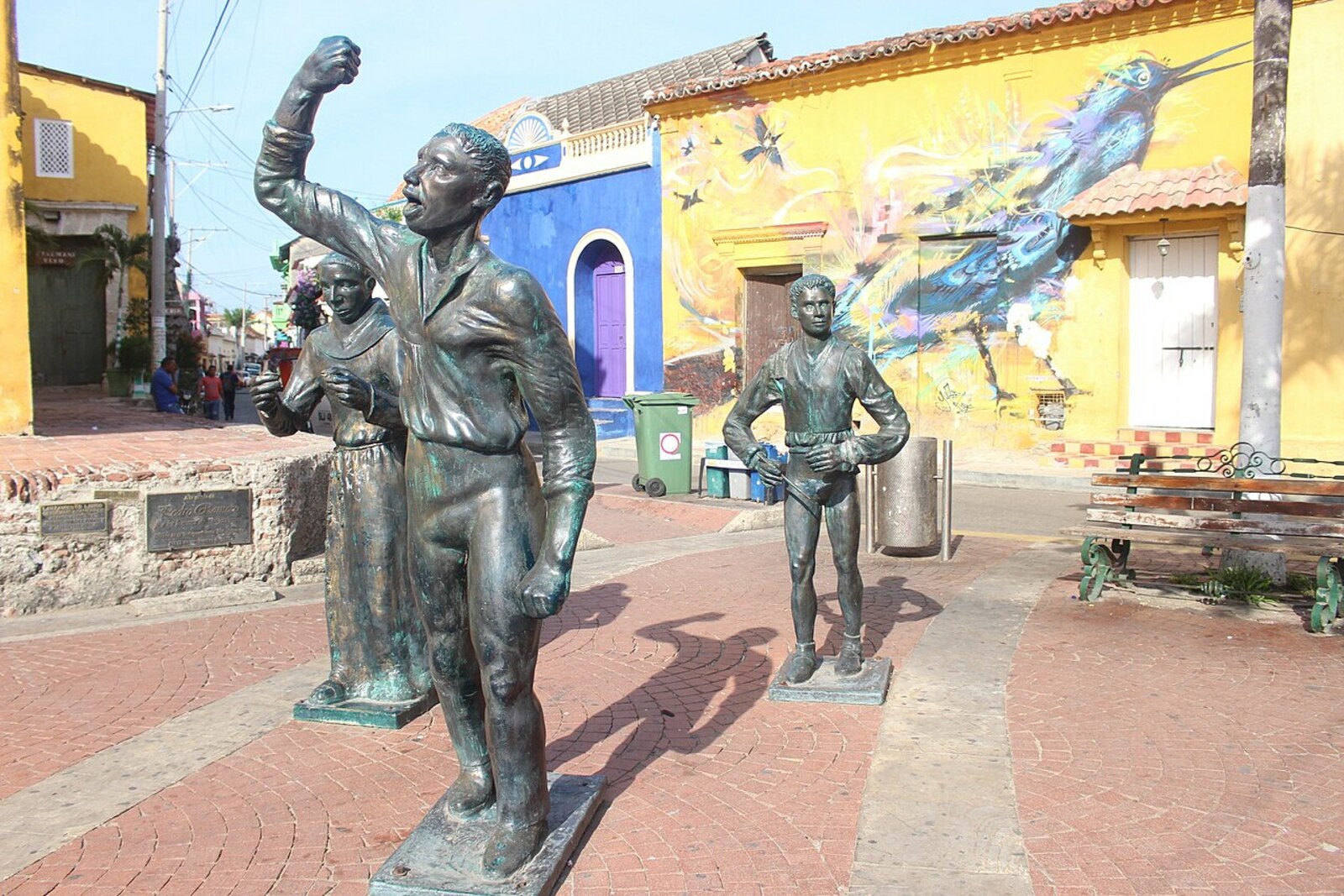
Look around first
What to notice
- Church steps
- Façade of Iglesia de la Santísima Trinidad
- Sculptural group with a raised hand
The story of the place
Plaza de la Trinidad lies at the heart of Getsemaní, by the façade of Iglesia de la Santísima Trinidad. The steps in front of the church form its most prominent edge, and a sculptural group stands nearby: a man with a raised hand among the Lanceros. This figure has no reliably known face: only one unclear image survives of the person it depicts, so what stands before us is not a documentary portrait but a later urban memory.
Today, in Plaza de la Trinidad, residents and visitors sit on the steps, watch street performers, buy food from vendors, and talk in the open air. For Getsemaní, this is the familiar main square—a smaller neighbor of Plaza Mayor in the old center. It received its present name from Iglesia de la Santísima Trinidad on one side.
On Monday, November eleventh, eighteen eleven, Cartagena's artisans agreed not to open their workshops. From early morning, they gathered here, at the steps in front of the church. The city was already governed by a junta, but it still recognized the Spanish king. Supporters of a complete break with Spain were preparing to demand that the junta declare independence.
One of the leaders was Pedro Romero, a master foundry worker and commander of the neighborhood militia, Lanceros de Getsemaní. Most of his men were free Black people and residents of mixed descent who worked in the workshops of the naval arsenal. Their habit of working in crews gave them an organization already in place: the masters knew their people, and the people were used to following orders.
Romero himself was risking a position he had worked for over decades. He began as a blacksmith, then received a major arsenal contract, supervised other craftsmen, and bought houses. Yet even he had to ask the Spanish king to make an exception for his son: the young man's ancestry prevented him from studying law. Now Romero was leading against the colonial order people whose cannons, guns, and iron parts he had previously helped produce.
While those assembled waited in the square, messengers kept watch on the junta's meeting in the government palace. They returned with the news that the independence proposal was being postponed and that the meeting might end without a decision. Romero and the other leaders then ordered the march to begin.
The column left here along Calle Larga. The Lanceros took several fortifications, blocked the approach from the Spanish garrison, and seized the weapons depot. Armed representatives of the crowd entered the junta's chamber. They demanded a break with Spain, the abolition of the Spanish Inquisition, and the right to appoint commanders of color as officers in units of people of color. That same day, the junta's members signed an act declaring the Province of Cartagena a free and sovereign state.
Seven months later, Pedro Romero was already sitting among the authors of the Constitution of the Free State of Cartagena and signed it. The constitution established equality before the law and prohibited the importation of enslaved people, although it did not abolish slavery itself. The Republic of Cartagena lasted four years. After the Spanish reconquest, Romero's houses were confiscated; he left Cartagena and soon died in exile in Haiti.
After the declaration of independence, Cartagena City Council renamed this space Plaza de la Libertad, specifically in honor of the residents of Getsemaní who gathered here on November eleventh. Later, the name Trinidad returned. At the edge of the square now stands a sculptural group by Nora Luz Quintana: a man with a raised hand depicts Romero among the Lanceros. His face cannot be considered a documentary portrait—only one unclear image of Pedro Romero survives.
Useful on site
Public square; free access, evening crowds and events vary by day.
Checked: June 30, 2026. Check the official source before visiting.The square remains a lively stage rather than a quiet memorial; in the crowd, keep passageways clear and do not disrupt local activities.