 Guide On Map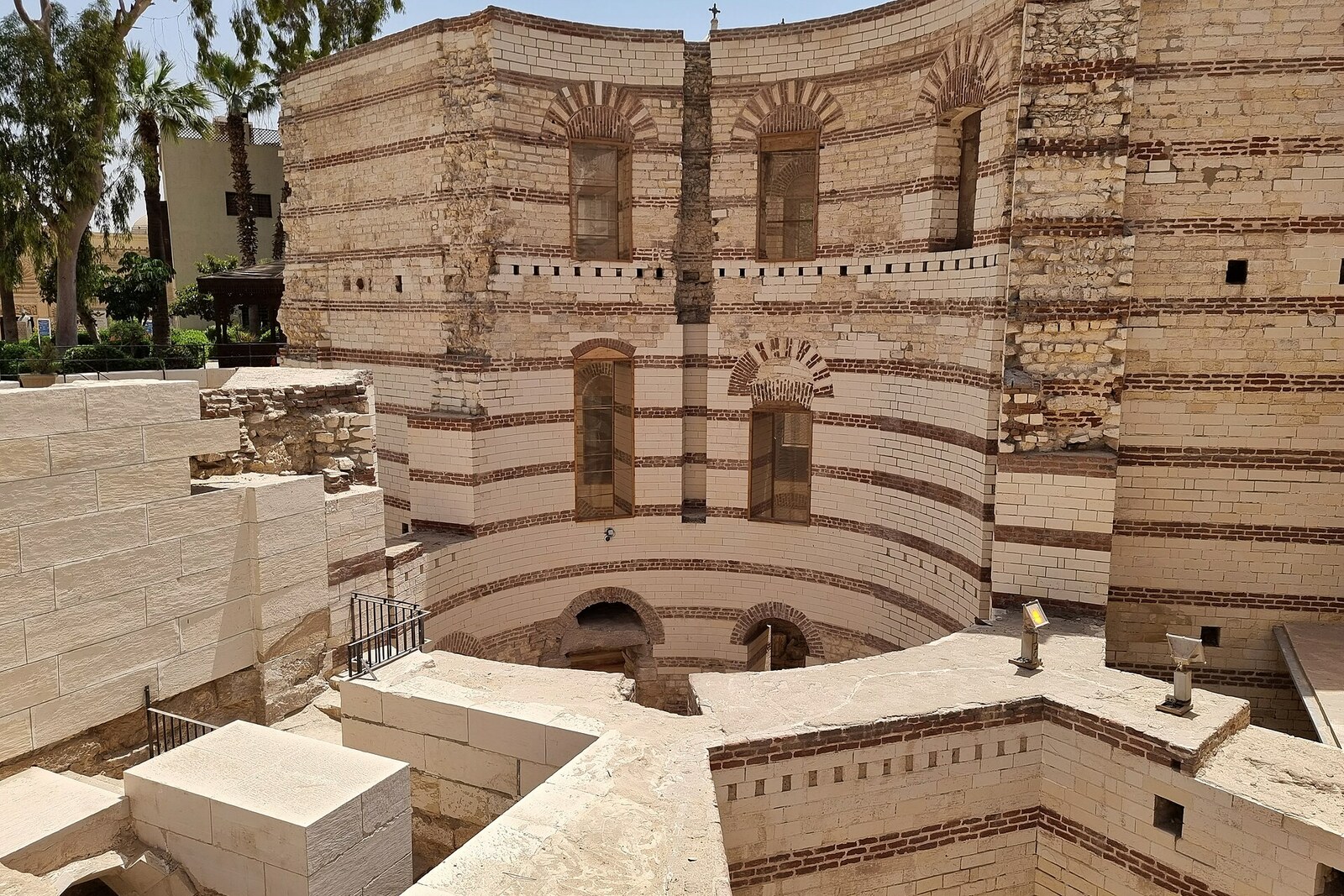
Look around first
What to notice
- Two round towers
- Roman stonework
- Southern gate
- The lowered level of the ancient pavement
The story of the place
Two round towers with Roman stonework stand on either side of the place where the water entrance to the fortress once stood. At the beginning of the second century, Emperor Trajan established a stone harbor here beside a canal linking the Nile with the Red Sea. About two centuries later, Emperor Diocletian ordered the harbor enclosed by walls; the canal ran through the fortification, and the towers guarded the entrance from the water. The canal has disappeared, but one tower was incorporated into the Church of Saint George, the Hanging Church stands above the southern gate, and the Roman pavement lies several meters below the present-day street.
In the autumn of six forty, Cairo did not yet exist. Amr ibn al-As, commander of the Arab army, came here to conquer Egypt. The fortification blocked the crossing of the Nile near Giza, the road south, and the approaches to the delta. As long as the Eastern Roman garrison remained behind the walls, Amr could not safely move toward Alexandria.
This position had been chosen long before him. At the beginning of the second century, the Roman emperor Trajan established a stone harbor here at the entrance to a canal linking the Nile with the Red Sea. About two centuries later, Emperor Diocletian ordered the harbor surrounded by fortress walls. The canal ran through the middle of the fortification, and two enormous round towers guarded its mouth.
The name “Babylon” is older than these walls. The ancient historian Diodorus Siculus recorded a story about Babylonian captives who supposedly captured a fortified place on the Nile and named the settlement after their homeland. This is a tradition, not a confirmed founding history. Another version derives the name from an ancient Egyptian expression connected with Hapi, the god of the Nile, and the city of On. Historians have no exact answer.
The siege lasted about seven months. Amr's army was supplied through requisitions of livestock, fodder, and food in Egyptian villages: every additional month beneath the walls required fresh provisions. The garrison, too, awaited the outcome of negotiations. Cyrus, the emperor-appointed civil governor of Egypt and head of the official church, tried to end the war on terms of surrender. He owed both offices to Emperor Heraclius, so an independent agreement put his position at risk.
Cyrus arrived in Babylon and concluded a preliminary agreement with Amr, which Heraclius was to approve. The emperor refused, summoned Cyrus to Constantinople, and accused him of cowardice. The negotiations did not save Cyrus, and the garrison had to continue resisting.
In February of six forty-one, Heraclius died. When the news reached Babylon, the defenders lost hope of help. Amr increased the pressure, and in the spring the garrison capitulated. The commander promised not to kill the soldiers. They surrendered their weapons and military supplies, received the right to leave, and took with them only a small amount of gold.
Later, Cyrus was restored to office and sent to Egypt, now with permission to conclude a final peace. The treaty was signed here as well, in Babylon. The Eastern Roman troops were given eleven months to withdraw from the country. Cyrus died before the evacuation was complete, and Amr established a permanent military settlement beside his siege camp. It received the name Fustat and became the new capital of Egypt.
There is no longer a canal between the round towers. One tower was incorporated into the Church of Saint George, the Hanging Church stands above the southern gate, and the Roman pavement lies hidden several meters below the modern ground level. Between the surviving towers was that very water entrance, which the garrison guarded and for which Amr's army remained beneath the walls for seven months.
Useful on site
The exterior sections are visible from the route; access to individual fragments depends on security and restoration work.
Checked: June 28, 2026. Check the official source before visiting.View the walls only from accessible walkways: the lower sections and archaeological excavations may be fenced off. It is easier to imagine the former scale if you remember that the ancient level lies noticeably lower.