 Guide On Map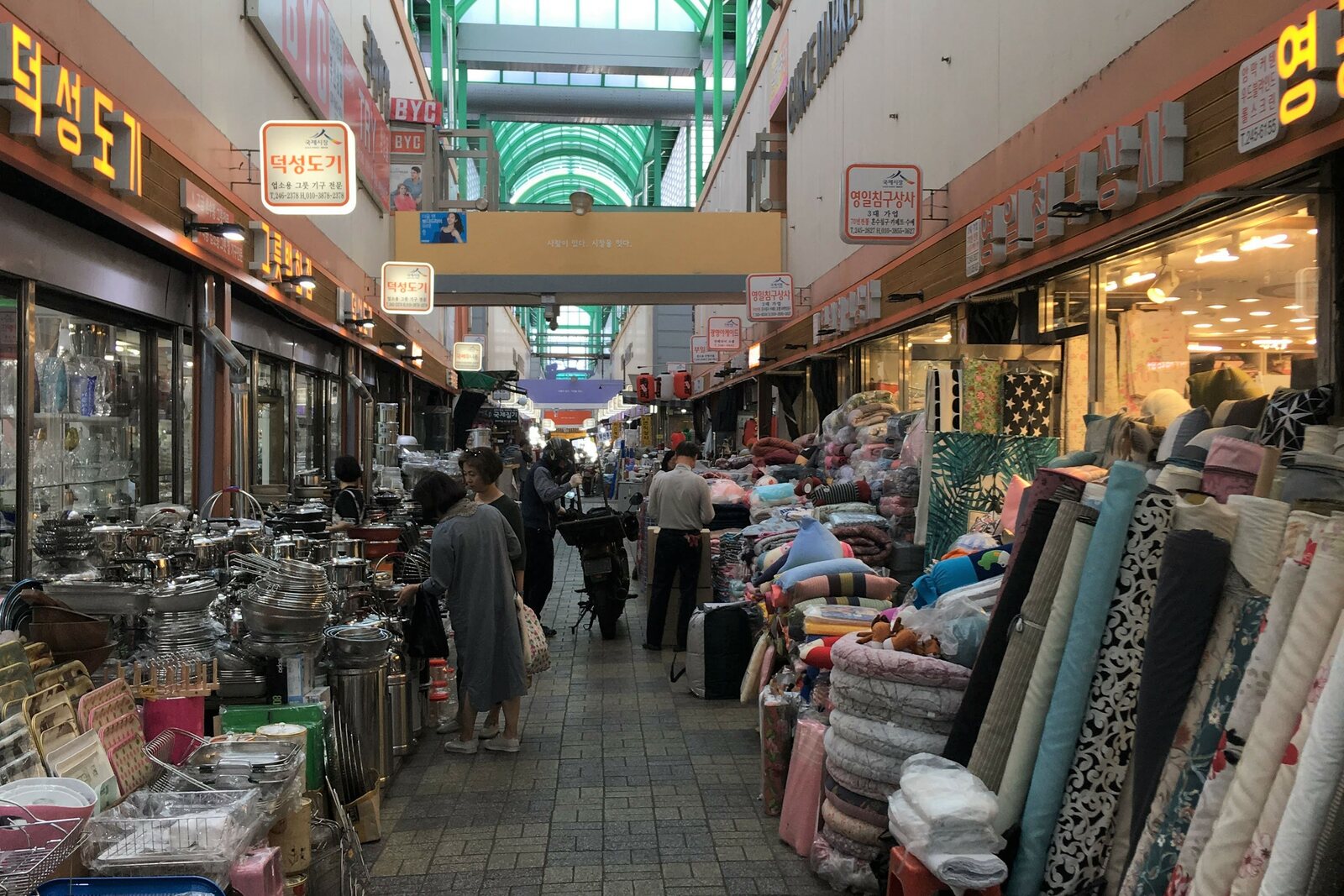
Look around first
What to notice
- Two-story market rows
- Buildings A and B
- Wide passageways between the rows
- Uninterrupted market streets
The story of the place
Trade here does not fit into a single covered square: it stretches along uninterrupted streets, where two-story buildings stand row after row. Official Gukje is divided into six sections, and Buildings A and B make up its main built-up area. Wide passageways were left between the rows; beyond them, the signs of neighboring Sinchang Market, Changseon Market, and Bupyeong Market continue the same commercial maze, so Gukje’s own boundary almost dissolves.
In the final months of Japanese rule, there were no market rows on this site. The military ordered the wooden houses here demolished: the empty strips along the streets were meant to stop fires if American aircraft bombed central Busan. No raid struck this neighborhood, and the cleared land remained.
After Japan’s surrender, Koreans who had previously lived overseas began returning to Busan. Many arrived without work or housing. On the vacant lot, they laid out goods left behind by departing Japanese people and items from Japanese factories that were closing down. Large lots were sold whole, without sorting; this trade gave the place the nickname Dottegi Market.
In May nineteen forty-six, the merchants formed a self-governing cooperative. They needed a permanent market where a stall could not be lost after another order or street clearance. Two years later, they built twelve wooden pavilions with one thousand two hundred shops and named them Liberty Market. In May nineteen fifty, the present name, Gukje Market, meaning International, became established. It described the origin of the goods: American and Japanese items were sold alongside Korean ones.
The Korean War multiplied the number of sellers many times over. Refugees took up trading because a stall required neither a factory nor land nor former connections. By February nineteen fifty-two, there were about one thousand one hundred fifty permanent shops here and more than two thousand illegal stalls. Almost all of the street vendors and peddlers were refugees. American military property, humanitarian supplies, and goods brought through the port passed through their hands and then moved on across the country.
On the evening of January thirtieth, nineteen fifty-three, a kerosene lamp was knocked over in a restaurant on a street in Sinchang-dong. The fire destroyed the market and neighboring blocks: about one thousand six hundred structures burned down, and eight thousand five hundred eighteen people were listed as fire victims. Along with their shops, the merchants lost their goods, often bought with borrowed money.
Forty-eight leaders of the market cooperative and major merchants formed a reconstruction committee. They paid for construction themselves. People whose stock of goods had already been taken by the fire borrowed at high interest and sold household belongings to obtain a new place. By July seventeenth, the market had been rebuilt, the passageways widened, and the market rows made two stories high for the first time.
The twelve wooden pavilions of Liberty Market are no longer here: they burned in that fire. Officially, today’s Gukje consists of six market sections with two-story Buildings A and B. In everyday speech, the same name also refers to the neighboring Sinchang Market, Changseon Market, and Bupyeong Market, so it is almost impossible to notice Gukje’s boundary amid the uninterrupted market streets.
Useful on site
Usually 09:00–20:00; hours vary by shop. The Visit Korea portal lists closures on the first and third Sunday of the month.
Checked: June 27, 2026. Check the official source before visiting.Do not interfere with trade, and ask before taking close-up photos of people or goods. Walking through the publicly accessible rows is enough for this account.