 Guide On Map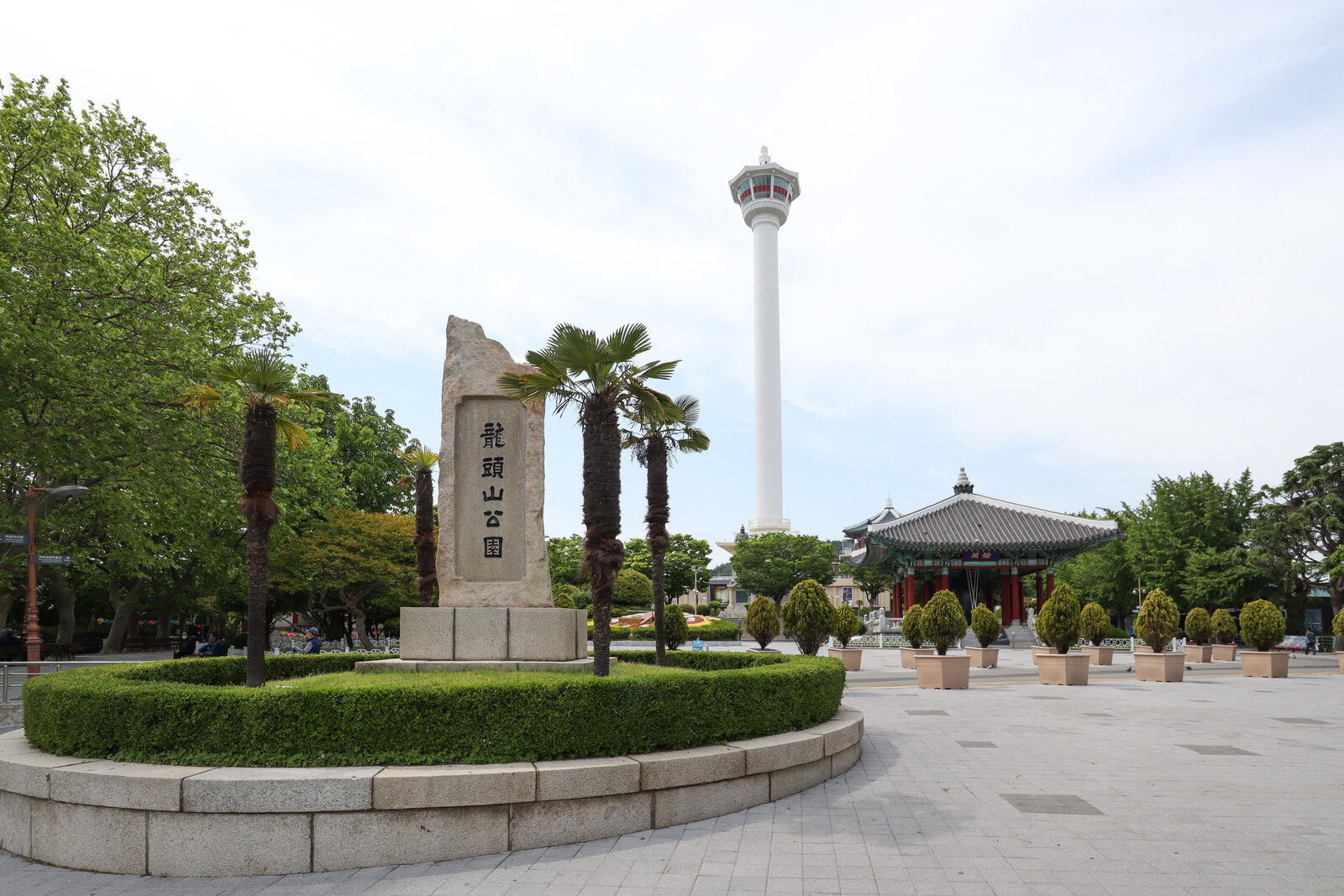
Look around first
What to notice
- Octagonal pavilion
- Four stone stelae
- A stele with a carved talisman
- Trees on the slope
The story of the place
The name Yongdusan translates as “Dragon Head Mountain”: the low ridge was compared to the head of a dragon facing the sea. The park was laid out here as early as nineteen sixteen, around a Shinto shrine of Busan's Japanese community. After Korea's liberation, the shrine burned down, and then the war began—and this rise in the city, near the port and markets, became a place where people could put up housing without land or money.
At 40 Steps, separated families searched for one another. On the slopes of Yongdusan, many of them tried to go on living. Refugees built shacks pressed tightly together, all the way to the summit. They made walls from boards and heavy cardboard, and roofed them with flattened tin cans. They earned a living as porters at the port, day laborers, and street vendors on the streets near Gukje Market. In winter, they heated their rooms with coal briquettes. What let them survive the cold made the entire slope vulnerable to a single fallen spark.
At dawn on December tenth, nineteen fifty-four, a fire began in the home of a clothing merchant: a coal briquette set it alight. Between the tightly packed buildings, the flames spread faster than people could carry out their belongings. Four hundred thirty-five shacks and hundreds of neighboring buildings burned down. Four people died, and about six thousand were left homeless.
Sixteen days later, another part of the settlement caught fire. A burning candle had been left on the second floor of one of the shacks. The second fire destroyed another two hundred ninety-eight homes; one person died, and one thousand four hundred twenty residents were once again left without housing. By the end of December, almost nothing remained of the neighborhood that had covered Yongdusan up to its summit. The old pines for which the mountain had once been known also burned.
Housing was not rebuilt here. In the spring of nineteen fifty-five, people began planting trees on the burned slope and laying out the park again. That is why the present green space appeared not where the city had preserved an empty corner, but where two December fires destroyed an entire residential district.
Behind the octagonal pavilion, among the shrubs, stand four old stelae. One of them was erected as early as January nineteen fifty-five by members of the civic Society for Prayers for Protection from Water and Fire Disasters, with the support of the governor and the mayor. A talisman and an appeal to a water deity were carved into the stone. Yongdusan was chosen specifically for it: the mountain's name already contained a dragon associated with water, and people had just twice watched fire sweep across the entire slope.
This stone is called the Yongdusan Spirit Stele. Behind it grow trees planted after the fires. In photographs taken before December nineteen fifty-four, roofs crowd together from the foot to the summit; not a single one remains in the present park.
Useful on site
The park is open year-round and free; Busan Tower has separate hours that depend on the weather and the operator.
Checked: June 27, 2026. Check the official source before visiting.Do not look for preserved shacks or a temple: the point of this stop is the present landscape, which grew up after they disappeared.