 Guide On Map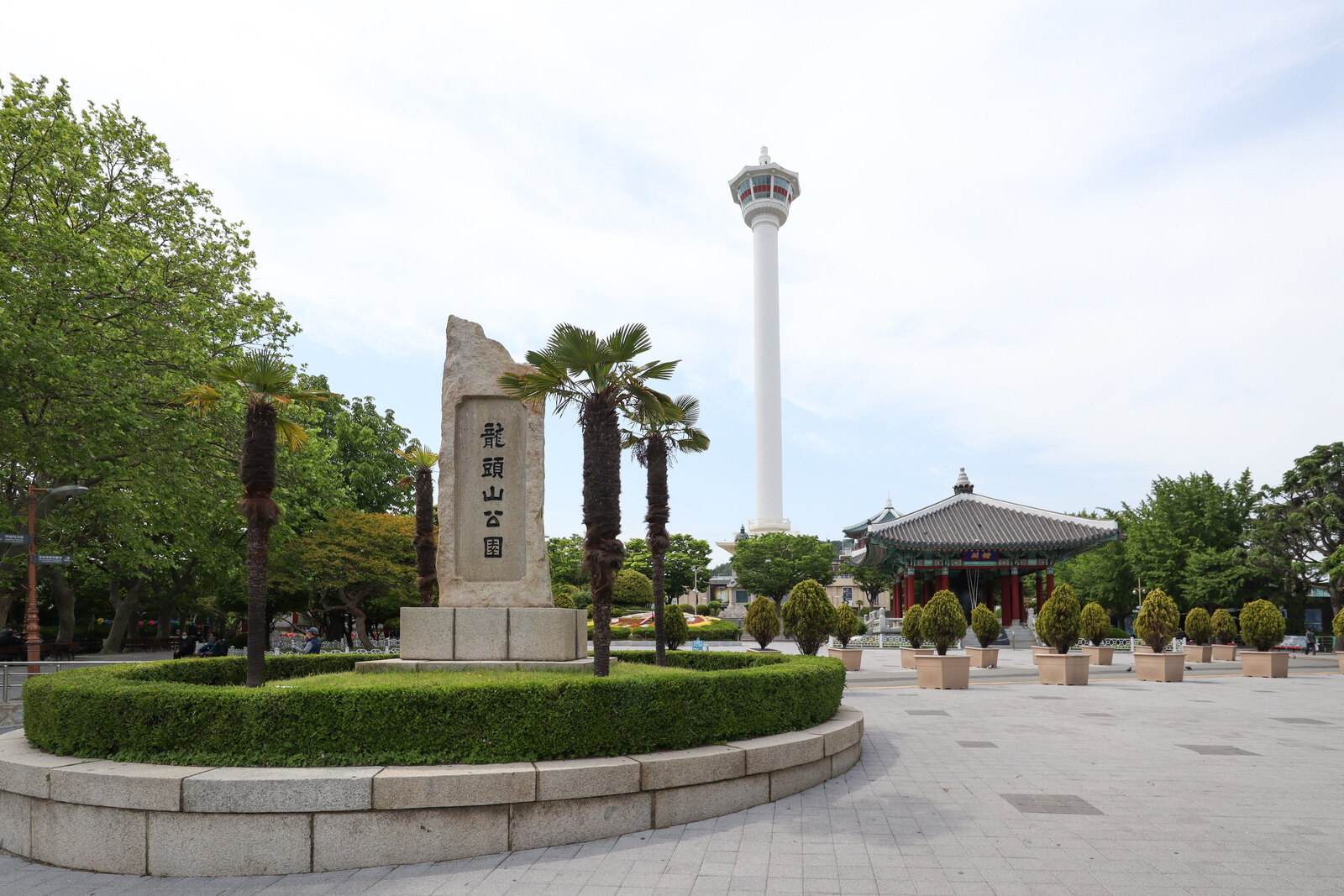
Look around first
What to notice
- The tower’s white shaft
- The viewing-platform level
- The central flower bed
- The viewing-platform windows
The story of the place
The white shaft of Busan Tower rises one hundred twenty meters above the park on the summit of Yongdusan; there have never been transmitters inside it. The structure was built as a viewing platform, and its upper level was given the shape of the stone canopy of Dabotap Pagoda at Bulguksa Temple. The central flower bed occupies the site where the shrine’s main hall once stood, and elevators now carry visitors to windows above the port.
On November seventeenth, nineteen forty-five, thirty-six-year-old Min Yeong-seok climbed this summit with a bottle of solvent and newspapers. He earned his living at a bag factory on Yeongdo Island and served as a deacon—a lay assistant in a Presbyterian congregation. Min wanted to burn down Yongdusan Shrine, which occupied the site of today’s tower and central flower bed.
Japanese settlers built the shrine. They chose the summit above the port and prayed here for the safety of sea crossings. In eighteen ninety-nine, the community raised money for a large new building. Later, the colonial administration paid for its upkeep and required Koreans to worship the deities venerated there.
Min was then employed by the Busan Railway Bureau. For refusing to take part in the worship, he was sent to prison twice and then dismissed. He was released without work or money. The Japanese name imposed on Min was Okada; along with it, he was required to recognize a foreign religious rite as his own.
After Korea’s liberation, the shrine stood for another three months. Japanese people gathered inside it while waiting to be sent home. Min decided to act alone so that no one would reveal the plan. At six o’clock in the evening, he spread out the newspapers, poured out the solvent, and set the building alight. Those inside managed to run out. The shrine burned down completely.
Newspapers reported the fire as having an unknown cause and only suggested arson. Min told several people close to him about what he had done, so his name was linked to the fire only decades later, based on his own testimony. He did not return to railway service: later, he graduated from a theological school and became a rural pastor.
When the summit was cleared again after the postwar fires, city leaders decided to place a new symbol of Busan here. The plan appeared in nineteen sixty-three, when Busan ceased to be part of the province and received special city status. The tower was completed for the National Sports Games of nineteen seventy-three.
The white shaft, one hundred twenty meters high, never carried transmitters: Busan Tower was built solely as a tourist viewing platform. Its upper section was modeled on the stone canopy of Dabotap Pagoda at Bulguksa Temple. Nothing remains of the former shrine—not its gate, nor its foundation. Its main hall stood in the area of today’s central flower bed, and beside it now rise the elevators to windows from which visitors look out over the port for which Japanese settlers once chose this summit.
Useful on site
Busan Tower: daily 10:00–22:00, last entry 21:30; operations may change because of weather.
Checked: June 27, 2026. Check the official source before visiting.The stop’s key details can be seen from outside. If you want to go up to the viewing platform, check visiting conditions separately.