 Guide On Map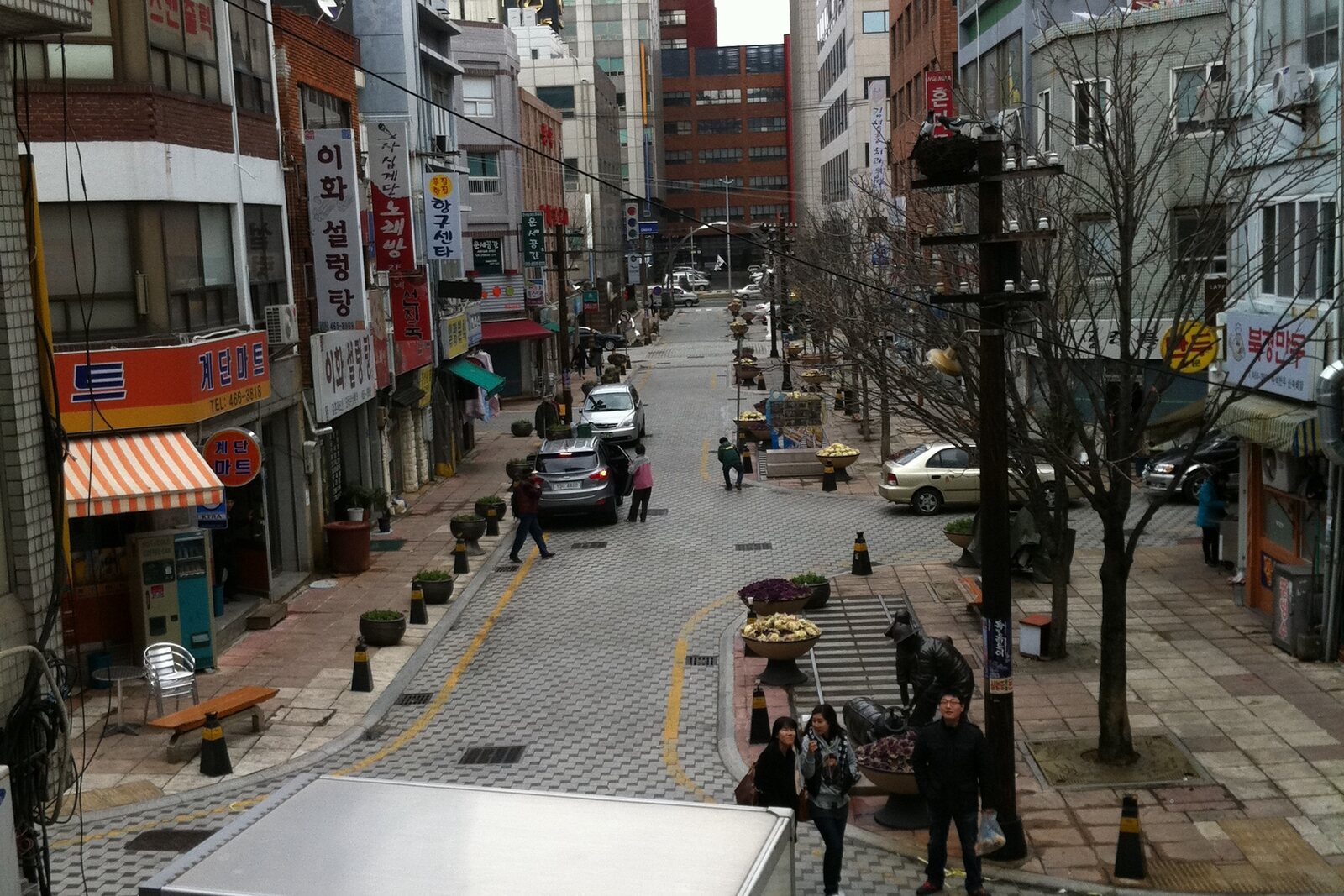
Look around first
What to notice
- 40 Steps
- Bronze figure of a porter
- Bronze mother with a child
- Bronze accordion player
The story of the place
The bronze porter, mother with a child, and accordion player stand by the ascent that was once the shortest route from the old station and international pier to Donggwang-dong on the slope. The staircase was laid out in the early twentieth century, and it really did have forty steps. After a fire in the station district, it was rebuilt about twenty-five meters farther south, so the true site of the old ascent remains nearby, but not beneath your feet. The figures were added much later, when this passage became a commemorative street.
People who had neither an address in Busan nor any certainty that their relatives had even reached the city arranged to meet on this staircase. During the Korean War, refugees from all over Korea converged here. Families lost one another on the road and agreed: if we make it to Busan, we will meet at the 40 Steps. Some stayed nearby for months, afraid of missing those they were waiting for.
The staircase was apparently laid out between nineteen oh nine and nineteen twelve. It had exactly forty steps. It linked the old Busan Station and the international pier with Donggwang-dong on the slope. In peacetime, it was a convenient shortcut. The war turned it into a bottleneck between two parts of the refugee city.
Above, in Donggwang-dong, Yeongju-dong, and Bosu-dong, more than one hundred thousand newcomers put up shacks made of boards and sheet metal. Below were the port, the station, and warehouses. In the mornings, people came down here to hire themselves out as porters or day laborers, to sell chewing gum, or to sell things received as humanitarian aid. A market sprang up at the foot of the staircase: the earnings made it possible to buy food and return to a shack uphill. On the steps, porters set down the heavy wooden frames that held cargo on their backs, rested, and then headed back to the piers.
This constant flow made the staircase a convenient place to search. Its name was known to dockworkers, traders, and residents of the nearby slopes; it could be passed along through a chance fellow traveler. Families separated during evacuation really did meet here. Many of those who could not return home after the armistice remained in Busan: two years after the war, the city's population reached one million.
The old steps did not remain in their place for long. After a major fire near Busan Station in nineteen fifty-three, the neighborhood was rebuilt, and the staircase was reconstructed about twenty-five meters farther south. The present bronze figures of a porter, a mother with a child, and an accordion player appeared later still, when a themed street was created here in two thousand four. The shacks, the market, and the old station are no longer in front of them; the original staircase stood about twenty-five meters from here.
Useful on site
The staircase itself and the themed street are accessible at all times; Forty Stairs Culture Hall is open Tue–Sun, weekdays 10:00–18:00, Sat–Sun 10:00–17:00, closed Mon and public holidays.
Checked: June 27, 2026. Check the official source before visiting.Stand to one side and keep the steps clear for passersby. All the main details can be seen from the street.