 Guide On Map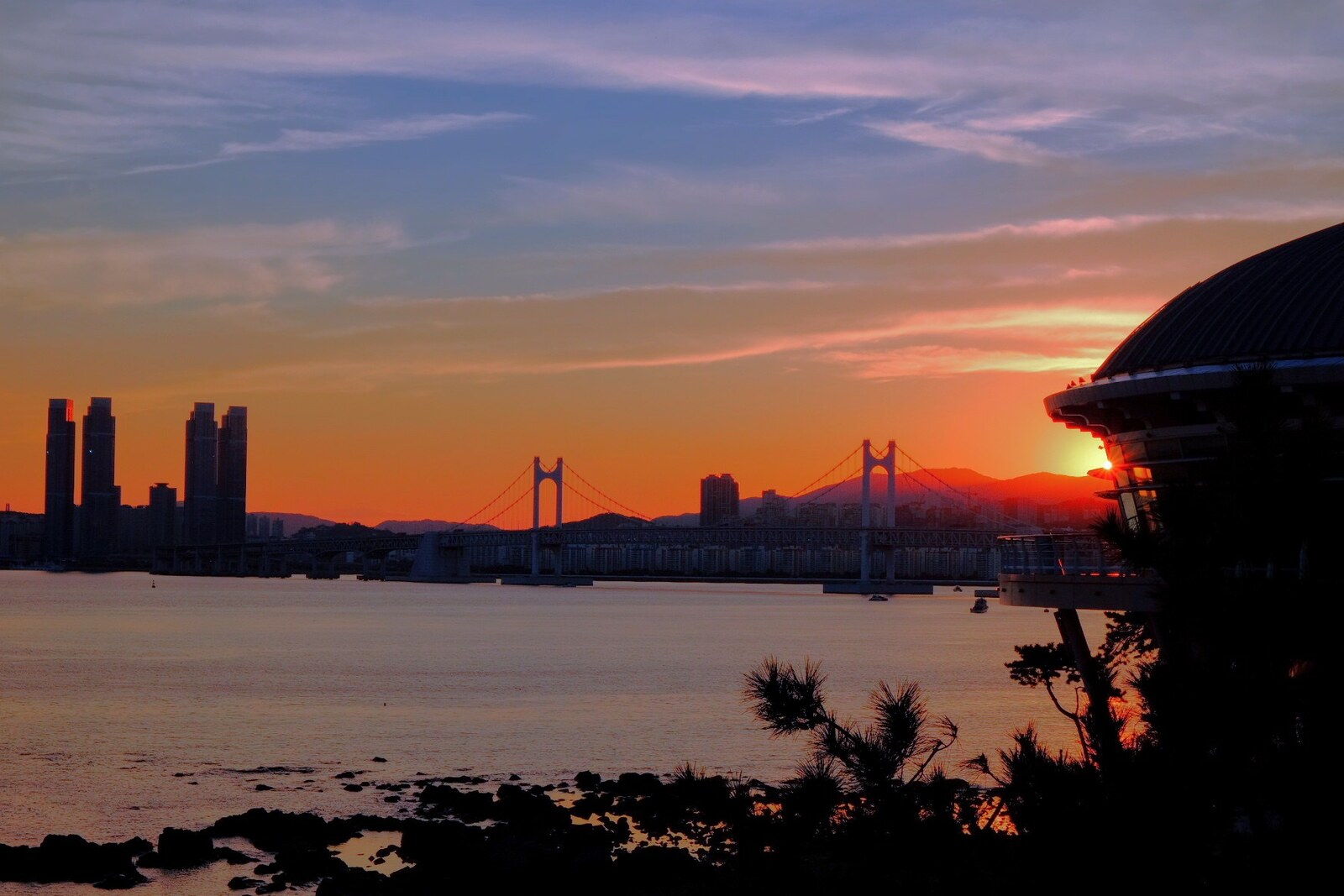
Look around first
What to notice
- Round roof
- Glass walls
- Round table
- Economy nameplates
The story of the place
Through Nurimaru's curved glass walls, the sea comes almost up to the hall itself, while the round roof recalls a Korean pavilion. On the third floor, a room has been preserved with a round table, a ring of armchairs, microphones, and labeled nameplates. Its name is formed from the Korean words nuri, meaning world, and maru, meaning a summit or a meeting of leaders.
The round building at the edge of Dongbaekseom Island was built primarily for one morning—November nineteenth, two thousand five. The summit's first session took place at a large exhibition center, while for the second, less formal conversation, the organizers set aside a separate pavilion by the sea. It was made to resemble a modern Korean pavilion: behind glass walls, beneath a round roof, the leaders sat facing one another.
The host of the meeting was Roh Moo-hyun, president of South Korea. He had to secure the agreement of the twenty-one economies of the Asia-Pacific region. Their forum is called APEC—Asia-Pacific Economic Cooperation. It does not impose binding decisions on its members: every joint pledge is adopted unanimously and then carried out voluntarily.
In those days, the leaders were discussing trade, but the morning session at Nurimaru was devoted to the safety of people. Two days before it, China confirmed the country's first cases of human infection with a dangerous strain of avian influenza. One patient, a young poultry worker, died. The virus was already affecting poultry in many countries; for rural families who lived by selling chickens and eggs, an outbreak meant the destruction of their flock and the loss of income, while for doctors it meant the risk that an infection capable of spreading from person to person might emerge.
Roh Moo-hyun put forward a joint plan for approval. The leaders pledged to report new cases quickly, share data and virus samples, draw up in advance a list of specialists for emergency assistance, and not close borders to people and goods without scientific justification. In a separate clause, they required this system to be tested in drills as early as the following year. The plan was approved unanimously.
Australian Prime Minister John Howard, who sat at the same table, instructed his country to pay for and organize the test. In June two thousand six, more than one hundred officials from all twenty-one economies received a fictional alert: a new strain of influenza had been detected among fishers in the Strait of Malacca, their boat had capsized, the people had been picked up by a cruise ship, and the infection had begun to spread through ports. For twenty-six hours, across eight time zones, the participants sent warnings, requested help, and made decisions. More than five hundred messages in several languages passed between them. For the first time, all APEC participants tested their communication channels simultaneously for such an emergency. After reviewing the drills, they created a shared list of coordinators to contact in the event of a real threat.
The hall on the third floor has been preserved as Roh Moo-hyun, John Howard, and the other participants left it on that November day: a round table, armchairs, microphones, and nameplates for the economies. The Korean word nuri means “world,” and maru means “summit” or “a meeting of leaders.” So the full name translates almost literally: the APEC house where the leaders of the world gathered.
Useful on site
Nurimaru: 09:00–17:00, closed on the first Monday of the month; free admission.
Checked: June 28, 2026. Check the official source before visiting.Check access inside separately, and do not assume that the exhibition is always open. Even without entering, the architectural concept is clearly visible from outside.